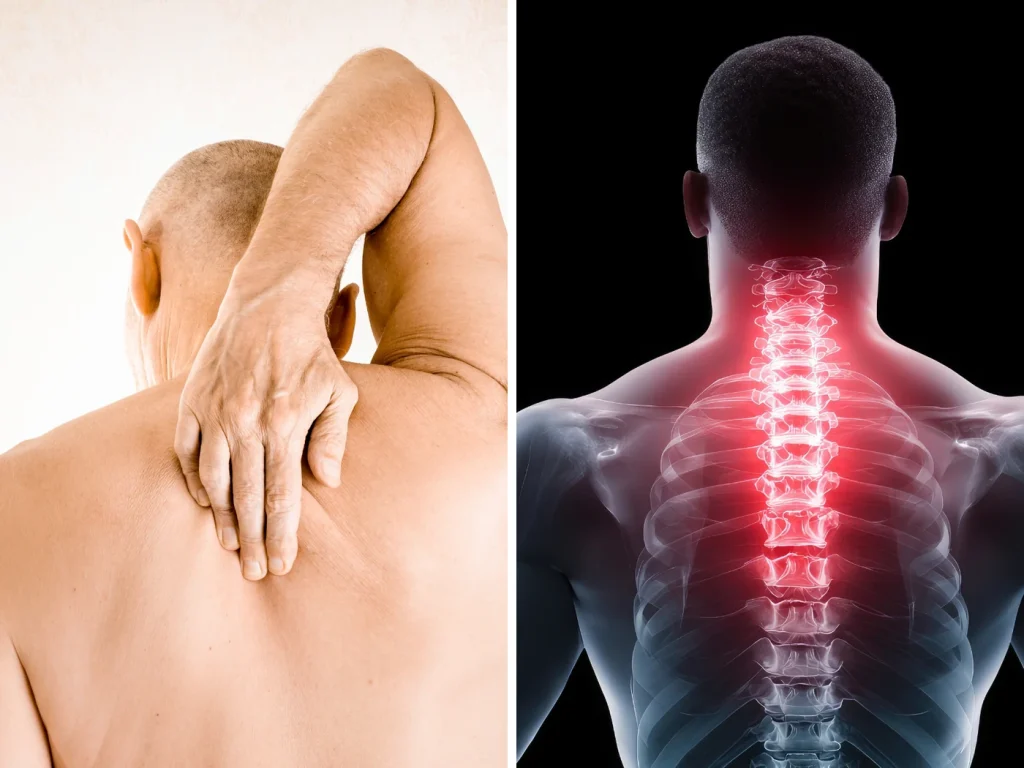
Pain between the shoulder blades gets less attention than low back or neck pain, and it is harder to pin down. The source of thoracic back pain is often challenging to diagnose and manage, because multiple potential causes and treatment strategies exist.1 One consequence is that mid-back pain is frequently treated as muscular by default, when a specific joint may be generating it.
A commonly overlooked generator
The costotransverse joints — small synovial joints where the ribs meet the transverse processes of the thoracic vertebrae — have been described as potentially prevalent but overlooked pain generators in the thoracic spine.1
They are worth knowing about because they sit exactly where people point when they describe pain between the shoulder blades, and because nothing about the symptom obviously announces a joint rather than a muscle.

What a worked-up case looks like
A published case report — and it is a single case, not a trial — describes a 35-year-old woman with thoracic hypomobility, a severe pressure sensation and dull pain in the T7 to T10 region bilaterally, between the medial borders of the scapulae.1
Physical therapy, pain medications and a thoracic epidural steroid injection were all ineffective. CT imaging of the thoracic spine then revealed isolated arthropathy of the costotransverse joints at T8 and T9 bilaterally.1
The sequence is the lesson
An intra-articular steroid injection gave significant short-term relief. That was followed by a diagnostic block, which produced over 80% pain relief — confirming the target before anything longer-lasting was attempted. Thermal radiofrequency ablation of the nerves to the costotransverse joints at T8 and T9 followed, and the patient had three months of relief with functional improvement and reduced pain medication requirements.1
Treat that as an illustration of method rather than as evidence of how well the procedure works generally. One patient cannot establish efficacy. What it does show is the logic: identify a candidate structure, confirm it with a block, then treat what was confirmed. The same sequence is described in facet joint pain and medial branch blocks.
The authors themselves note the need for further anatomic studies describing the complete innervation of the costotransverse joints.1 This is an area still being worked out.
Thoracic pain is not only an older person’s problem
In a cross-sectional study of 1,628 Brazilian high school students aged 14 to 18, the prevalence of thoracic spine pain was 51.5% (95% CI 49.1–53.9).2 That population is adolescents, not adults, and the figure should not be transferred to adults — but it does indicate the problem starts early.
In that cohort, thoracic pain was associated with female sex, using a computer more than three hours a day, using a cell phone in a semi-lying position, using a cell phone more than three hours a day, and the presence of mental health problems. Regular physical activity was a protective factor.2
Where evaluation goes
Because several structures can generate mid-back pain, the useful question is which one, established rather than assumed. Options relevant here include facet joint injection, facet joint radiofrequency ablation, trigger point injections where muscular referral contributes, and digital X-ray and image-guided procedures for the diagnostic steps.
Where a vertebral compression fracture is a possibility, kyphoplasty and vertebroplasty are the relevant pages. New thoracic pain with weight loss, fever, a history of cancer, or neurological change should be assessed promptly rather than managed as mechanical pain.
Frequently asked questions
Why is mid-back pain harder to diagnose than low back pain?
Because multiple potential causes and treatment strategies exist for thoracic back pain, and no single one dominates the picture. That is why identifying the specific generator matters — see the range of pain treatments.
What is a costotransverse joint?
A small synovial joint where a rib meets the transverse process of a thoracic vertebra. These have been described as potentially prevalent but overlooked pain generators in the thoracic spine. See facet joint injection for the related joint-directed approach.
Does radiofrequency ablation work for thoracic pain?
The published experience here is a single case report describing three months of relief after a diagnostic block confirmed the target. One case cannot establish general efficacy, and the authors call for further anatomic study. See facet joint radiofrequency ablation.
Is my posture or phone use to blame?
In adolescents, thoracic pain has been associated with prolonged computer and cell phone use, including using a phone in a semi-lying position, with physical activity protective. Those findings come from a study of 14 to 18 year olds and should not be assumed to apply unchanged to adults. See lifestyle medicine.
When should mid-back pain be seen urgently?
New thoracic pain accompanied by unexplained weight loss, fever, a history of cancer, or any neurological change warrants prompt assessment rather than watchful waiting — see same-day and emergency visits.
To have mid-back pain evaluated, request an appointment, call (314) 481-5000, or text (314) 886-5902.
Sources
- Patel J, Eaves AM, Deschler E, Bowlin C, Galang E. Radiofrequency Ablation of the Costotransverse Joint in a Case of Chronic Thoracic Back Pain. Cureus. 2024;16(7):e63958. doi:10.7759/cureus.63958. Retrieved via PubMed. DOI
- de Vitta A, Campos LD, Bento T, Felippe LA, Maciel NM, Perrucini P. Thoracic Spine Pain and Factors Associated in High School Students. Pain Management Nursing. 2021;23(4):517–523. doi:10.1016/j.pmn.2021.11.005. Retrieved via PubMed. DOI
Dr. Gurpreet Singh Padda, MD, MBA, MHP