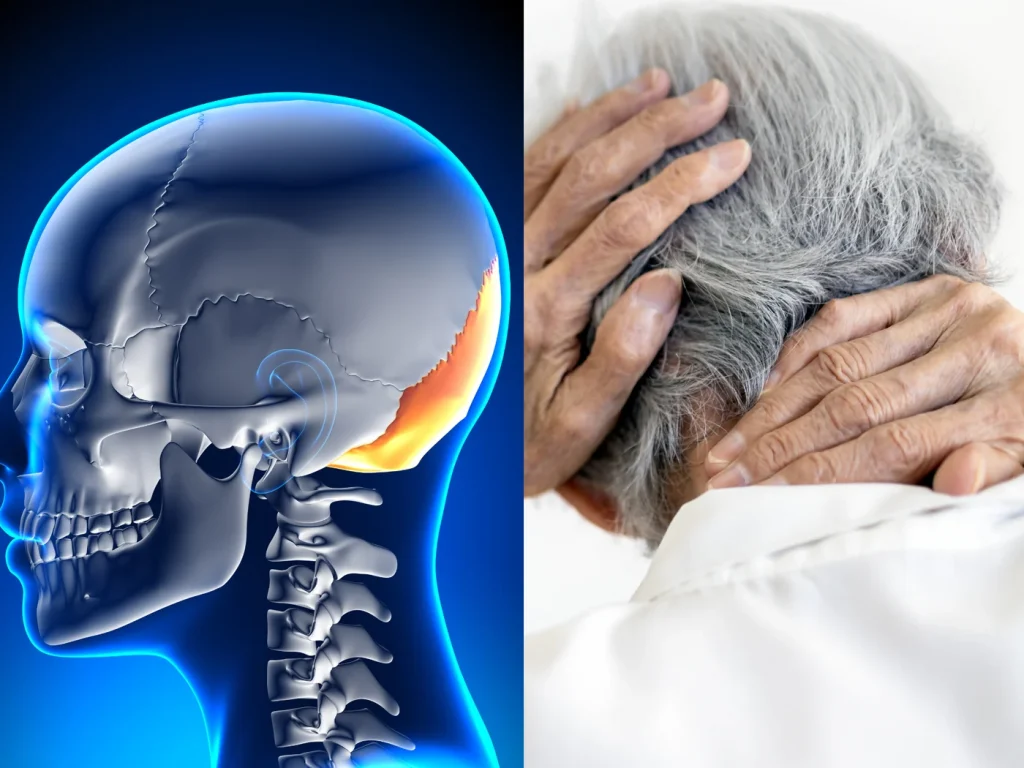
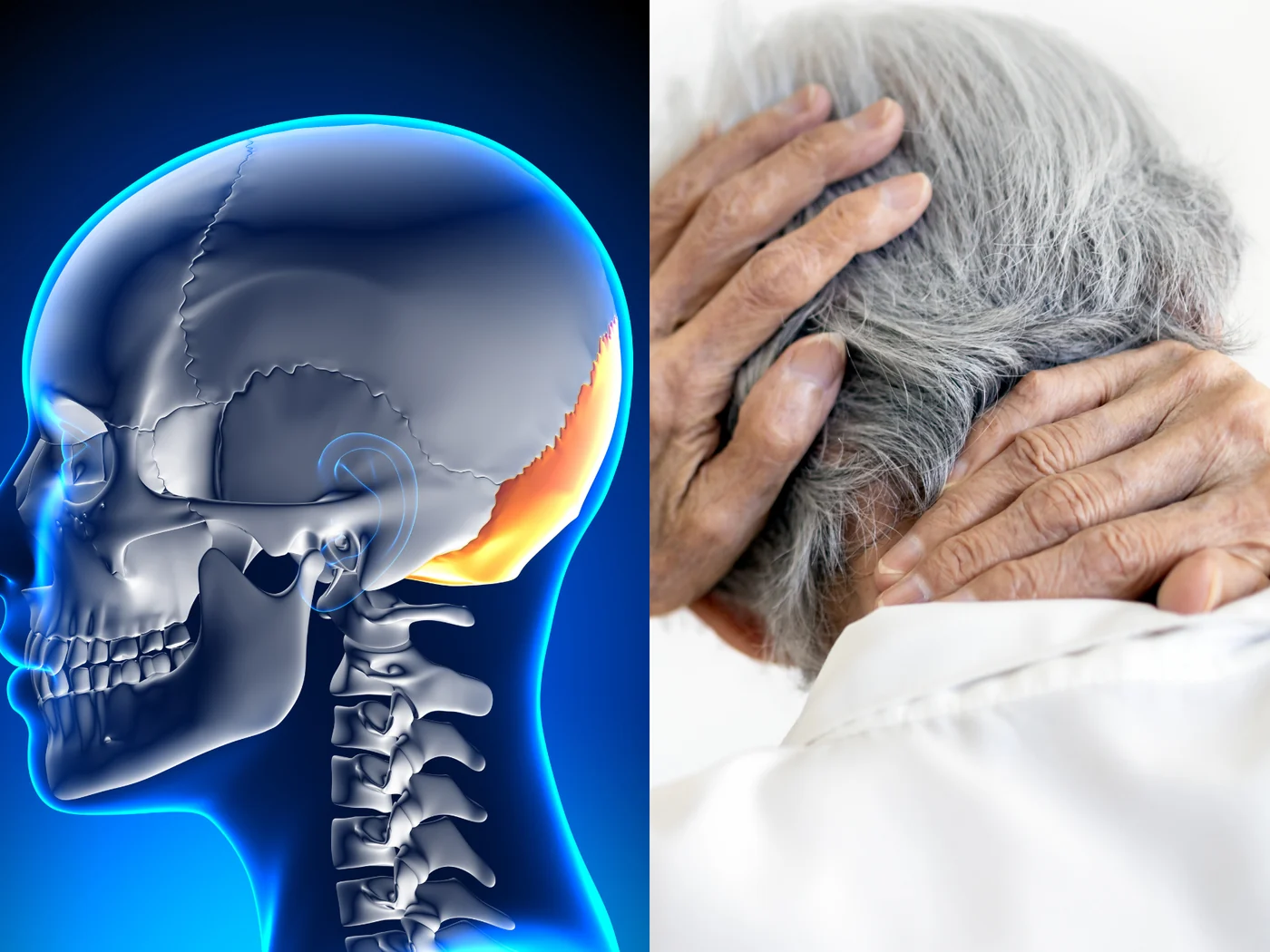
Occipital neuralgia and cervicogenic headache both start in the occiput — the base of the skull — and spread forward to the top of the head.1 That direction of travel is the most useful thing to notice. A headache that starts at the back of the head and moves forward does not act like a migraine. It points the workup at the neck, not the head.
Why these two get confused with each other
The base of the skull and the upper neck are tightly linked. So cervicogenic headache (headache from the neck) and occipital neuralgia (irritated nerves at the back of the head) look a lot alike.1 They are not the same thing. But they share ground, and telling them apart changes the treatment.
Diagnosis starts with your headache history, checked against the rules set by the International Headache Society. Then the exam tests how far your neck moves and looks for tender spots or pressure points.1
What conservative treatment covers
Conservative care means learning about pain, self-care, pain medicine, and physical therapy. Physical therapy works on tight muscles and posture. It also covers transcutaneous electrical nerve stimulation (TENS, a small device that sends mild current through the skin). Some patients get a mix of these.1
When tight muscles add to the pain, cervical traction and trigger point injections can help. How muscle pain spreads into the head is covered in what the evidence supports for trigger points.
What injections and procedures actually deliver
The evidence is clear about how long relief lasts. That helps set expectations.
Blocks
Injections of local anesthetic at several spots, with or without corticosteroids, can relieve pain for a short time. A deep cervical plexus block (numbing the nerve bundle deep in the neck) can ease pain for less than six months.1
In both conditions, an occipital nerve block can give key diagnostic information. It also eases pain in some patients. Pulsed radiofrequency gives better long-term pain control.1 The diagnostic value is the main point. The block tells you whether the occipital nerve is truly involved. You keep that answer no matter how long the relief lasts.
Radiofrequency
Radiofrequency ablation of the cervical facet joints (the small joints at the back of the neck) can bring relief that lasts over a year.1 The relevant page here is facet joint radiofrequency ablation. The test that comes before it is covered in facet joint pain and medial branch blocks.
The treatments diverge by diagnosis
This is where telling the two apart pays off. Cervicogenic headache is preferably treated with radiofrequency of the facet joints. Occipital neuralgia calls for pulsed radiofrequency of the occipital nerves.1 For occipital neuralgia that will not respond to treatment, occipital nerve stimulation should be considered.1
Other nerve treatments are covered under nerve blocks, peripheral nerve stimulation and severe head and neck pain.
Frequently asked questions
How do I tell this from a migraine?
Pain that starts at the base of the skull and spreads forward to the top of the head points to the back of the head or neck rather than a primary headache. Diagnosis uses International Headache Society rules plus a check of neck movement and tender points. See migraine headache for the alternative.
What does an occipital nerve block tell me?
Whether the occipital nerve is truly involved. It gives key diagnostic information and eases pain in some patients. Pulsed radiofrequency gives longer-lasting control. See nerve blocks.
How long does relief from an injection last?
Local anesthetic injections, with or without corticosteroid, usually give relief for a short time. A deep cervical plexus block lasts less than six months. Facet joint radiofrequency ablation can give relief lasting over a year — see facet joint radiofrequency ablation.
Is the treatment the same for cervicogenic headache and occipital neuralgia?
No, and that is why telling them apart matters. Cervicogenic headache is preferably treated with radiofrequency of the facet joints. Occipital neuralgia is treated with pulsed radiofrequency of the occipital nerves. Both are covered under severe head and neck pain.
What if nothing has worked?
For occipital neuralgia that will not respond to treatment, occipital nerve stimulation should be considered. See peripheral nerve stimulation, or ask for a visit through the appointment request form.
To have a headache from the base of the skull checked, request an appointment, call (314) 481-5000, or text (314) 886-5902.
Sources
- Lefel N, van Suijlekom H, Cohen SPC, Kallewaard JW, Van Zundert J. 11. Cervicogenic headache and occipital neuralgia. Pain Practice. 2024;25(1):e13405. doi:10.1111/papr.13405. Retrieved via PubMed. DOI
Dr. Gurpreet Singh Padda, MD, MBA, MHP