Postcholecystectomy syndrome often turns out to be bile acid diarrhea. Without a gallbladder, bile trickles into the gut around the clock. The colon answers it with water, urgency and cramping. The surgery data do not support bacterial overgrowth as the usual cause. So the bile gets tested before another course of antibiotics.
She is fifty-nine, more than a decade past gallbladder surgery. A fatty meal still costs her an afternoon of cramping and bloat. She has been through four separate courses of antibiotics for bacterial overgrowth. None of them changed that.
Postcholecystectomy syndrome is the catch-all label for symptoms that linger after the gallbladder comes out. Too often it ends the conversation instead of starting one. The question that should start it is plain. With the storage tank gone, where does the bile go now, and when does it arrive?
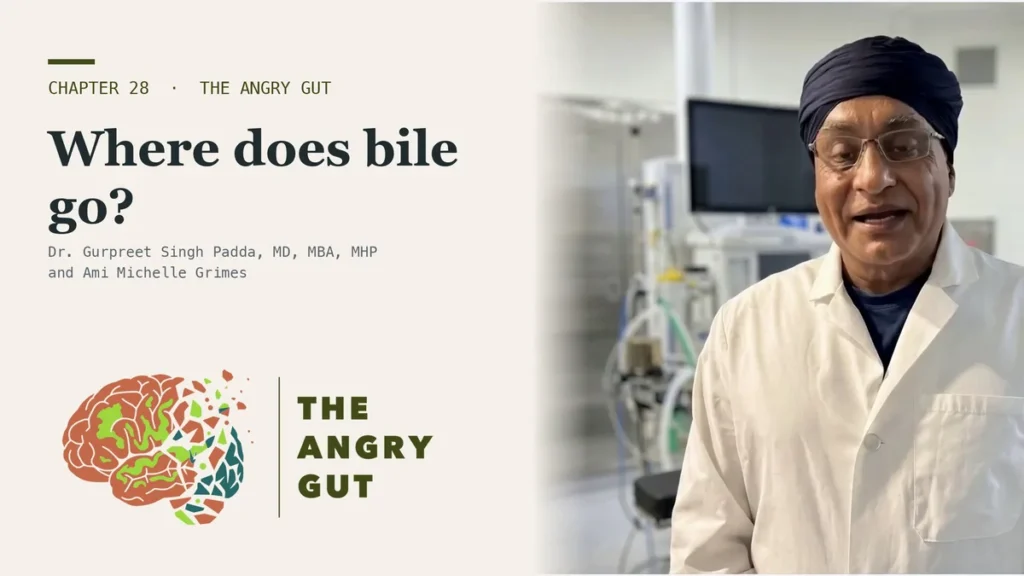
I’m Dr. Gurpreet Singh Padda, MD, MBA, MHP. In the Chapter 28 video of The Angry Gut, which I wrote with Ami Michelle Grimes, The Liver Flush Is Soap, I take the popular bile remedies apart one at a time. Here I stay with the pain patient. What does bile that arrives at the wrong time do to a bowel? Why did the antibiotics keep coming? And what changes once someone orders the right test?
What causes diarrhea after gallbladder removal?
One teaching hospital scanned 1,071 outpatients in a row with chronic diarrhea, looking for bile acid diarrhea. It was present in 42.7% of them. Past gallbladder removal (cholecystectomy) was one of three features that made an abnormal scan highly likely.
The figure that should shake every doctor comes next. 61.0% were sent in with no known risk factor at all. Of those, 35.7% had bile acid diarrhea anyway. Among those who tested positive, severity split close to thirds: 31.7% mild, 34.4% moderate and 33.9% severe.
The gallbladder held bile between meals and released it when fat arrived. Without it, bile trickles into the gut around the clock. Some runs on into the colon. The colon reads bile acid as an order to pour out water. The result is urgency, loose stools and cramping.
That scan is not available in the United States. So your doctor will choose another way to check.
The overgrowth story the surgery data do not support
I expected the missing gallbladder to be the reason bacteria climb upward. I would have told her so. The numbers corrected me.
One prospective study followed 146 patients after belly surgery and 30 healthy controls. Overgrowth ran 37.6% against 13.3%. Split by operation, gallbladder removal had the lowest rate of the three, at 17.1%. Hysterectomy came in at 36.0%. Stomach surgery reached 96.2%. The independent predictors of the hydrogen pattern were past stomach removal (gastrectomy) and a raised level of gastrin, a hormone that controls acid. That points at lost stomach acid, not lost bile, as the barrier that failed.
A second study looked at 265 patients with gallbladder disease and 39 healthy controls. The most positive breath tests, 40.5%, were in people who still had the organ and the stones. Controls and post-surgery patients together ran 24.6%. Gallstones were the only independent factor. And gallbladder disease traveled with fatty liver and metabolic syndrome.
So a gallbladder that will not empty is worse than none. Bile that is not moving is the real problem. Four rounds of antibiotics were aimed at a condition her own breath tests kept ruling out.
Why mistimed bile becomes a pain problem
Bile is not only a detergent for fat. It is part of the gut’s defense line. Take surgery for obstructive jaundice, where bile is fully blocked from the gut. Afterward, kidney failure runs at nearly ten percent. Researchers blamed endotoxin, the debris of bacterial walls. It crossed into the blood because there were no bile salts in the bowel to hold it back.
In one small surgical series, 12 patients took oral deoxycholate before the operation. None got endotoxin in the bloodstream or kidney impairment after surgery. A randomized trial of 40 patients used a different bile acid, ursodeoxycholic acid, for 48 hours. It lowered endotoxin in the portal vein (the vein from gut to liver) during surgery. It left endotoxin in the general circulation untouched. Kidney function, complications and deaths did not move either. Both are small studies of total obstruction.
Now carry that to a pain patient. I will label it for what it is: mechanism, not a trial. Bile that arrives out of step with food leaves fat poorly broken up and poorly absorbed. The fat-soluble vitamins leave with it. A bowel irritated all day keeps the first brain sending alarm to the second brain over the vagus nerve. Any bacterial products that slip past a weaker defense feed the low-grade metaflammation. That keeps a sensitized nervous system turned up. It is the same fire behind metabolic inflammation and chronic pain, and part of the route by which an inflamed bowel reaches the spine.
The third driver is money and time. A breath test takes planning and a return visit. A prescription takes a minute, and the reflex wins. Why bile acts as a signal the liver listens to is laid out in bile as a hormone rather than soap. What matters here is what to do when delivery fails.
Four courses of antibiotics and a negative breath test
What she finally got was short. First, a test of whether bile acids were reaching her colon, and they were. Then a bile acid sequestrant, a binder aimed at the condition she actually had. Then fat spread across the day instead of loaded into one meal. And the overgrowth treatment stopped, because her breath test had come back negative every single time.
The food change has a body-based reason. A steady trickle of bile can break up a modest amount of fat at a time. A large fatty dinner outruns it.
Antibiotics for overgrowth are a real tool. Their trigger is a positive test. The previous post, on why the weeds were never the problem, makes the broader case against killing first and measuring later. At four months she ate a restaurant meal for the first time since her surgery. If you take any medication for these symptoms, every change runs through your physician.
The liver flush, the bark and the laxative that did the work
The internet answer to bile trouble is the liver flush. You drink olive oil and citrus. Then soft green objects show up in the toilet that look like stones. When one patient’s objects were tested, they were mostly fatty acids. There was no cholesterol, no bilirubin and no calcium. They were soap, made in her own gut from what she drank.
Pain patients meet the next bottle for a different reason. Many take medications that slow the bowel, a problem covered in how some pain medications paralyze the gut. A cascara cleanse looks natural. Cascara lost its over-the-counter laxative status in 2002 because nobody sent in the requested data on genetic damage and cancer. That is missing evidence, not a finding of harm. A Chinese colonoscopy series found colon staining from this laxative family in 250 of 12,776 patients. The staining was associated with colorectal growths at an odds ratio of 1.701. The link to cancer did not reach significance.
The plain drugstore option has a real trial. It covered 368 people with chronic constipation. Bisacodyl at 10 mg daily raised complete, natural bowel movements from 1.1 to 5.2 a week, against 1.9 on placebo. Under the whole herbal category sits a claim nobody has tested. No agent has been shown to raise measured bile flow in a living person. Not disproven. Never measured.
What should I ask my doctor about symptoms after gallbladder surgery?
- Has anyone tested me for bile acid diarrhea, or only treated me for something else?
- Was overgrowth confirmed by a positive breath test before each antibiotic course?
- Were fatty liver or insulin problems checked? Gallbladder disease travels with both.
- Which bottles am I taking, and was any of them ever tested for what I take it for?
Doing nothing costs more years of fat intolerance and more antibiotics for a bug never confirmed. Once the drainage works, the gut wall still has to close. That is where rebuilding the gut wall with the right materials picks up. Every study named here is in the Chapter 28 Deep Dive, with its full numbers and what each one does and does not show.
Frequently asked questions
Can you get diarrhea years after gallbladder removal?
Yes. In a hospital series of patients sent in for chronic diarrhea, 42.7% had bile acid diarrhea. A prior gallbladder removal (cholecystectomy) made an abnormal scan highly likely. Without a storage tank, bile trickles into the gut all day. Some reaches the colon, which responds by pouring out water. It is a named condition with a test and a treatment. Why a bowel so often ends up with a label and no owner explains how it gets missed.
Does gallbladder removal cause SIBO?
Less often than people assume. After belly surgery, overgrowth was lowest after gallbladder removal, at 17.1%. It was highest after stomach surgery, at 96.2%. In gallbladder disease, people who still had stones ran higher than those who had surgery. Overgrowth should be confirmed with a positive breath test before antibiotics are repeated. What a breath test actually reads from your gut bacteria covers how that test works.
Do liver flushes remove gallstones?
No evidence says they do. The green objects from an olive oil and citrus flush were tested. They held fatty acids. They had none of the cholesterol, bilirubin or calcium that make up a gallstone. Researchers rebuilt them on a lab bench from oleic acid, lemon juice and potassium hydroxide. The patient still needed surgery for her real stones. Popular herbal supplements that have been tied to liver injury are worth knowing before the next cleanse.
Is cascara sagrada safe for constipation?
Its safety is unknown, not disproven. It lost over-the-counter laxative status in 2002 because the requested genetic and cancer safety data were never sent in. Long-term use of this laxative family causes colon staining. In a retrospective series, that staining was associated with colorectal growths. Bisacodyl, by contrast, has a randomized trial behind it. Talk through any laxative with your physician. What chronic constipation may signal about the brain shows why a stalled bowel deserves attention.
Can gallbladder problems make chronic pain worse?
They can feed the terrain that keeps pain loud. Gallbladder disease was independently associated with fatty liver and metabolic syndrome. And bile salts help keep bacterial endotoxin out of the bloodstream. Poorly timed bile, poor fat absorption and bacterial products crossing a weaker defense all push toward the low-grade inflammation that sensitizes nerves. That link is based on mechanism, not proven by a trial. How high insulin makes you hurt covers the metabolic side.
Symptoms after gallbladder surgery deserve a test
If cramping, bloating and loose stools followed your gallbladder surgery and the answer has been another antibiotic, we start by measuring what your bile and your bowel are actually doing.
Request an appointment, or call or text us.
Sources
- Kim, Y. J., Paik, C. N., Jo, I. H., Kim, D. B., & Lee, J. M. (2021). Serum gastrin predicts hydrogen-producing small intestinal bacterial overgrowth in patients with abdominal surgery: a prospective study. Clinical and Translational Gastroenterology, 12(1), e00291. https://doi.org/10.14309/ctg.0000000000000291
- Kim, D. B., Paik, C. N., Song, D. S., Kim, Y. J., & Lee, J. M. (2018). The characteristics of small intestinal bacterial overgrowth in patients with gallstone diseases. Journal of Gastroenterology and Hepatology, 33(8), 1477-1484. https://doi.org/10.1111/jgh.14113
- Lim, S. J., Gracie, D. J., Kane, J. S., Mumtaz, S., Scarsbrook, A. F., Chowdhury, F. U., Ford, A. C., & Black, C. J. (2019). Prevalence of, and predictors of, bile acid diarrhea in outpatients with chronic diarrhea: a follow-up study. Neurogastroenterology and Motility, 31(9), e13666. https://doi.org/10.1111/nmo.13666
- Cahill, C. J., Pain, J. A., & Bailey, M. E. (1987). Bile salts, endotoxin and renal function in obstructive jaundice. Surgery, Gynecology & Obstetrics, 165(6), 519-522. https://pubmed.ncbi.nlm.nih.gov/3120329/
- Thompson, J. N., Cohen, J., Blenkharn, J. I., McConnell, J. S., Barr, J., & Blumgart, L. H. (1986). A randomized clinical trial of oral ursodeoxycholic acid in obstructive jaundice. British Journal of Surgery, 73(8), 634-636. https://doi.org/10.1002/bjs.1800730819
- Sies, C. W., & Brooker, J. (2005). Could these be gallstones?. Lancet, 365(9468), 1388. https://doi.org/10.1016/S0140-6736(05)66373-8
- U.S. Food and Drug Administration, Department of Health and Human Services (2002). Status of certain additional over-the-counter drug category II and III active ingredients. Final rule. Federal Register, 67(90), 31125-31127 (FR Doc No: 02-11510). https://www.govinfo.gov/content/pkg/FR-2002-05-09/html/02-11510.htm
- Kassim, S. A., Abbas, M., Tang, W., Wu, S., Meng, Q., Zhang, C., Naeem, S., Li, X., & Chen, R. (2020). Retrospective study on melanosis coli as risk factor of colorectal neoplasm: a 3-year colonoscopic finding in Zhuhai Hospital, China. International Journal of Colorectal Disease, 35(2), 213-222. https://doi.org/10.1007/s00384-019-03435-7
- Kamm, M. A., Mueller-Lissner, S., Wald, A., Richter, E., Swallow, R., & Gessner, U. (2011). Oral bisacodyl is effective and well-tolerated in patients with chronic constipation. Clinical Gastroenterology and Hepatology, 9(7), 577-583. https://doi.org/10.1016/j.cgh.2011.03.026
Dr. Gurpreet Singh Padda, MD, MBA, MHP