Yes, in a specific sense: stress is a measurable change in how the bowel moves and how loudly it reports pain. It does not create a bowel disease out of nothing. It retunes how the gut moves and how it handles pain, in a gut that is already vulnerable.
He is forty-four. A biopsy confirmed his Crohn’s disease, and he has a narrowing near the end of his small intestine that no amount of therapy put there. Between flares he still hurts. His inflammation markers are normal and his last scope was clean. So his gut doctor (gastroenterologist) calls the pain stress. His psychiatrist, who knows what happened to him as a boy, insists the bowel problem is purely physical.
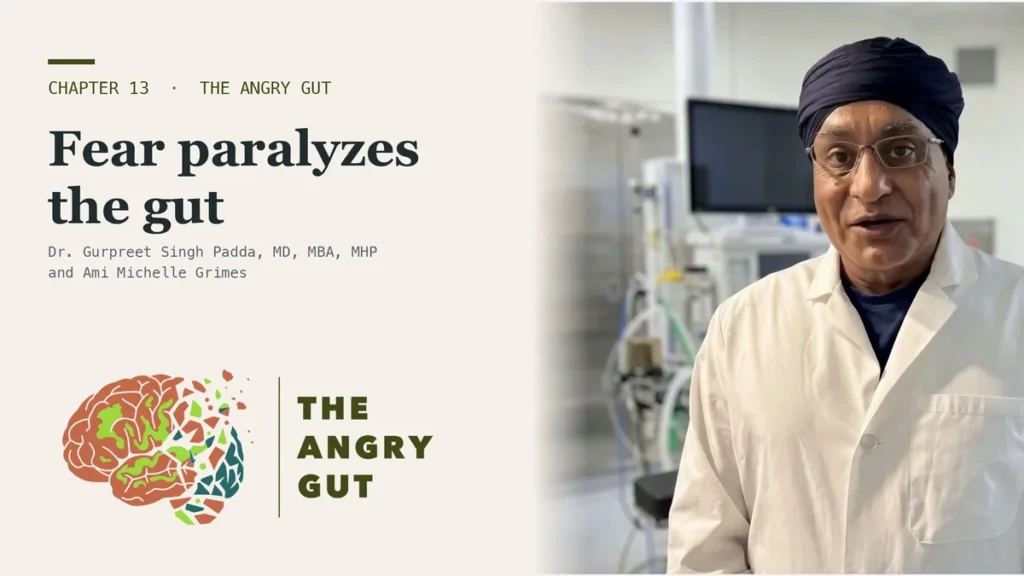
Each doctor has handed the whole man to the other. So when people ask “Can stress cause IBS?” or whether it makes Crohn’s disease pain worse, the honest answer begins with a correction: stress is not a shrug. It is a measurable change in how the bowel moves and how loudly it reports pain. The video above, drawn from Chapter 13 of The Angry Gut, the book Ami Michelle Grimes and I, Dr. Gurpreet Singh Padda, MD, MBA, MHP, wrote together, shows the instruments. This page follows the pain: the balloon test, the outbreaks and the trials that scored abdominal pain directly.
Two doctors, one bowel, no code for the space between
I used the word the same way for years. Stress is what gets written when the scope is clean and the next patient is waiting. I was wrong, and the physiology below is what changed my mind.
The silo is not a character flaw. It is an invoice. One specialist is paid for the procedure, the other for the session. Nobody is paid to look at what passes between a frightened nervous system and a bowel. A man with two specialists and nobody in charge is alone in a particular way. And social isolation is itself an inflammatory state that the first brain picks up.
Can stress cause IBS? What the pressure catheter recorded
Healthy volunteers had a thin tube (catheter) placed in the colon. A mental stressor caused more rolling squeezes, the kind that push contents along. A physical stressor caused more squeezes all at once. The whole colon responded, not just one part. The mental stressor did this without raising pulse or blood pressure. And when it ended, the colon stayed busy (Rao et al., 1998). The bowel kept reacting after the heart had settled.
The stomach tells the same story on a gamma camera. Under loud noise, the time to empty half a meal stretched from 105.0 minutes to 130.8 minutes, and after-meal discomfort and fullness climbed with it (Lee et al., 2013). The stomach still relaxed to receive food. What stress broke was the part that moves food onward. Eight subjects, seven of them men: that is mechanism, not epidemiology.
The dial turns the other way too. In 18 healthy people, raising vagal tone (the calming signal of the vagus nerve) boosted squeezes in the lower stomach. It also raised the gastroduodenal motility index, a measure of upper gut movement. And it raised pain thresholds to bone pressure while leaving muscle pain unchanged (Frøkjaer et al., 2016). That was one session in healthy volunteers. But the direction matters for anyone in pain. The nerve that fear turns down also shapes how much certain tissues hurt.
Put those findings together, and the answer is yes, in a specific sense. Stress does not create a bowel disease out of nothing. It retunes how the gut moves and handles pain, in a gut that is already vulnerable. In someone with Crohn’s disease, that retuning can keep pain going while the inflammation is quiet.
Why do some people keep IBS after a gut infection?
Twice, an outbreak handed researchers a study no ethics board could ever approve. After the Walkerton water contamination, IBS among exposed residents fell from 28.3% at two to three years to 15.4% at eight years. Yet their odds compared with unexposed neighbors were still 3.12 (Marshall et al., 2010). Who kept it? Anxiety or depression before the outbreak was one predictor. So were being a woman, being younger, and running a fever or losing weight while sick.
After the German outbreak, IBS rose from 9.8% before infection to 25.3% at 12 months. Truly new IBS showed up in 16.9%. Only somatization (feeling body sensations very strongly) and anxiety scores held up in the statistical model. How bad the infection had been predicted nothing (Andresen et al., 2016). One bacterium, one season, very different outcomes. The nervous system the infection landed in decided who stayed sick.
Where the pain signal lives: the balloon and somatization
Pain in IBS can be measured without a questionnaire. A device called a barostat inflates a balloon in the rectum. It records the pressure at which a person first reports pain. In two clinical groups of 231 and 141 people, somatization soaked up most of the gut sensitivity signal once it entered the model (Grinsvall et al., 2018). Somatization is the tendency to feel and report body sensations strongly.
That is the strongest challenge to a trauma explanation, and it deserves to be stated plainly. Yet abuse history still affected some sensitivity measures on its own in both groups. The abuse measured was sexual abuse in adulthood, not hard times in childhood. The patients came from top-level referral centers. And the paper reports directions, not exact sizes. The practical lesson survives those limits. Pain in a quiet bowel is a nervous system setting, and settings can be retrained. It is the same logic behind why a trauma memory is not a fixed recording.
Which therapies ease IBS abdominal pain?
Most IBS trials score an overall symptom index. One network analysis pooled belly pain alone. It covered forty-two randomized trials and 5,220 people, and counted dropouts as failures (Goodoory et al., 2024). Self-guided or low-contact CBT reached a relative risk of 0.71. In-person behavioral therapy with several parts reached 0.72. In-person gut-directed hypnotherapy reached 0.77. None beat the others. No trial was low risk of bias in every area, and the funnel plot suggests some overestimate. Discount the effect, and what remains is still worth offering.
Care by phone reached people at home. In 558 randomized patients, CBT by phone left symptom severity 61.6 points lower than usual care at 12 months. Work and social life improved by 3.5 points (Everitt et al., 2019). Head to head against the low FODMAP diet, gut-directed hypnotherapy gave the same symptom relief, -33 against -30. But only hypnotherapy lowered lasting anxiety and depression (Peters et al., 2016). The diet treated the gut. It did not treat the person living around it.
Then the guideline. The American College of Gastroenterology suggests gut-directed psychotherapies, with a combined number needed to treat of 4. Then it says they work less well in people who also have mental health conditions. Those people should be sent to mental health experts outside gastroenterology (Lacy et al., 2021). The patient who most needs nervous system care is the one the standard of care sends down the hall.
What we do with a bowel that learned to brace
Here is what changed for him. His gut doctor keeps managing the Crohn’s disease and the biologic drug, because a bowel in a flare can’t be retrained, and the biologic buys the quiet. Our job is the pain. We do an evaluation that weighs the gut, the stress load and the nervous system along with the pain source, in step with his gut doctor. Into that quiet go gut-directed hypnotherapy and body-based work. And Acceptance and Commitment Therapy is given in-house by our behavioral clinician.
Breath-based vagus nerve work and body-based calming have no trial that hit a main bowel goal. That is a gap in evidence, not a negative result. Nobody has tested them in the man with inflammatory bowel disease, a trauma history and chronic pain, because entry rules shut him out. The mechanism has been measured, so we use it. Keep every medication decision with your physician. And bring the question of how chronic stress sets your pain threshold to that visit.
The previous post traced how a slow bowel shows up years before memory loss. Next come the cells that starve when a frightened gut stops feeding its ecosystem. Every trial and cohort above, including what each one cannot show, is in the Deep Dive for Chapter 13. For a bowel that learned to brace, safety is not the aftercare. Safety is the treatment.
Frequently asked questions
Can stress cause IBS?
Stress alone does not create IBS from nothing, but it changes how the bowel moves and hurts. In healthy people, mental stress changed colon squeezes and kept them up after the stress ended. After two town-wide gut infections, anxiety and somatization, not how bad the infection was, predicted who got lasting IBS. Here is a behavioral definition of trauma you can actually measure.
Why does Crohn’s disease hurt when my markers are normal?
Pain between flares, with normal markers and a clean scope, is real. It often reflects a bowel whose movement and pain handling have been retuned by threat, not active inflammation. That state responds to nervous system treatments such as gut-directed hypnotherapy and CBT. These are used alongside the drug that controls flares. See why normal test results do not rule out real pain.
Does gut-directed hypnotherapy work for IBS pain?
Yes, in randomized trials. A pooled analysis looked at forty-two trials scored on belly pain. In-person gut-directed hypnotherapy did about as well as CBT and multi-part behavioral therapy. Against the low FODMAP diet, it matched symptom relief and also lowered anxiety and depression, which the diet did not. Learn how anxiety and PTSD are treated alongside chronic pain.
Can a stomach bug lead to long-term IBS?
It can. After a waterborne outbreak in Walkerton, exposed residents still had about three times the odds of IBS eight years later. After an outbreak in Germany, 16.9% got new IBS. Anxiety and somatization scores, not how sick people got, predicted who did. Read how the vagus nerve links the first brain and the second.
Why does my stomach stop working when I am anxious?
Under acute stress the stomach empties more slowly, even while it still relaxes to accept a meal, and discomfort and fullness rise with the slowing. Raising vagal tone in healthy volunteers did the reverse and increased stomach contractions. Digestion runs on a nervous system that feels safe. See how recovery after trauma is measured.
Does CBT help IBS pain?
Yes. A pooled analysis looked at forty-two trials that scored belly pain directly. Self-guided or low-contact CBT did as well as in-person behavioral therapy and gut-directed hypnotherapy. CBT by phone worked too. In 558 patients, phone CBT left symptom severity 61.6 points lower than usual care at 12 months, and work and social life improved.
Pain that outlasts the inflammation?
We evaluate your pain with the gut, the stress load and the nervous system in view, along with the pain source. We work with your own gut doctor, so nobody gets sent down the hall alone.
Request an appointment, or call or text us.
Sources
- Rao, S. S., Hatfield, R. A., Suls, J. M., & Chamberlain, M. J. (1998). Psychological and physical stress induce differential effects on human colonic motility. The American Journal of Gastroenterology, 93(6), 985-990. https://doi.org/10.1111/j.1572-0241.1998.00293.x
- Lee, H. S., An, Y.-S., Kang, J., Yoo, J. H., & Lee, K. J. (2013). Effect of acute auditory stress on gastric motor responses to a meal in healthy volunteers. Journal of Gastroenterology and Hepatology, 28(11), 1699-1704. https://doi.org/10.1111/jgh.12309
- Frøkjaer, J. B., Bergmann, S., Brock, C., Madzak, A., Farmer, A. D., Ellrich, J., & Drewes, A. M. (2016). Modulation of vagal tone enhances gastroduodenal motility and reduces somatic pain sensitivity. Neurogastroenterology and Motility, 28(4), 592-598. https://doi.org/10.1111/nmo.12760
- Marshall, J. K., Thabane, M., Garg, A. X., Clark, W. F., Moayyedi, P., & Collins, S. M. (2010). Eight year prognosis of postinfectious irritable bowel syndrome following waterborne bacterial dysentery. Gut, 59(5), 605-611. https://doi.org/10.1136/gut.2009.202234
- Andresen, V., Löwe, B., Broicher, W., Riegel, B., Fraedrich, K., von Wulffen, M., Gappmayer, K., Wegscheider, K., Treszl, A., Rose, M., Layer, P., & Lohse, A. W. (2016). Post-infectious irritable bowel syndrome (PI-IBS) after infection with Shiga-like toxin-producing Escherichia coli (STEC) O104:H4: A cohort study with prospective follow-up. United European Gastroenterology Journal, 4(1), 121-131. https://doi.org/10.1177/2050640615581113
- Grinsvall, C., Törnblom, H., Tack, J., Van Oudenhove, L., & Simrén, M. (2018). Relationships between psychological state, abuse, somatization and visceral pain sensitivity in irritable bowel syndrome. United European Gastroenterology Journal, 6(2), 300-309. https://doi.org/10.1177/2050640617715851
- Goodoory, V. C., Khasawneh, M., Thakur, E. R., Everitt, H. A., Gudleski, G. D., Lackner, J. M., Moss-Morris, R., Simren, M., Vasant, D. H., Moayyedi, P., Black, C. J., & Ford, A. C. (2024). Effect of brain-gut behavioral treatments on abdominal pain in irritable bowel syndrome: systematic review and network meta-analysis. Gastroenterology, 167(5), 934-943.e5. https://doi.org/10.1053/j.gastro.2024.05.010
- Everitt, H. A., Landau, S., O’Reilly, G., Sibelli, A., Hughes, S., Windgassen, S., Holland, R., Little, P., McCrone, P., Bishop, F., Goldsmith, K., Coleman, N., Logan, R., Chalder, T., & Moss-Morris, R. (2019). Assessing telephone-delivered cognitive-behavioural therapy (CBT) and web-delivered CBT versus treatment as usual in irritable bowel syndrome (ACTIB): a multicentre randomised trial. Gut, 68(9), 1613-1623. https://doi.org/10.1136/gutjnl-2018-317805
- Peters, S. L., Yao, C. K., Philpott, H., Yelland, G. W., Muir, J. G., & Gibson, P. R. (2016). Randomised clinical trial: the efficacy of gut-directed hypnotherapy is similar to that of the low FODMAP diet for the treatment of irritable bowel syndrome. Alimentary Pharmacology & Therapeutics, 44(5), 447-459. https://doi.org/10.1111/apt.13706
- Lacy, B. E., Pimentel, M., Brenner, D. M., Chey, W. D., Keefer, L. A., Long, M. D., & Moshiree, B. (2021). ACG clinical guideline: management of irritable bowel syndrome. The American Journal of Gastroenterology, 116(1), 17-44. https://doi.org/10.14309/ajg.0000000000001036
Dr. Gurpreet Singh Padda, MD, MBA, MHP