Opioid-induced constipation is a disease, not a side effect. That is because the body gets used to an opioid’s pain relief, but the bowel never gets used to the drug. Every dose increase lands on a gut that never adapts. The fix is a drug that blocks the opioid receptor in the bowel, not another stool softener.
He is fifty-six. He is nine years into an opioid prescription for a back that has had two surgeries. The dose has gone up four times, and the pain score has not moved. What changed is his bowel. He gets two hard-won stools a week. He eats nothing before leaving the house. A bottle of magnesium citrate rides in his car. His chart lists that under side effects. Opioid-induced constipation belongs on the problem list instead, and the evidence shows why.
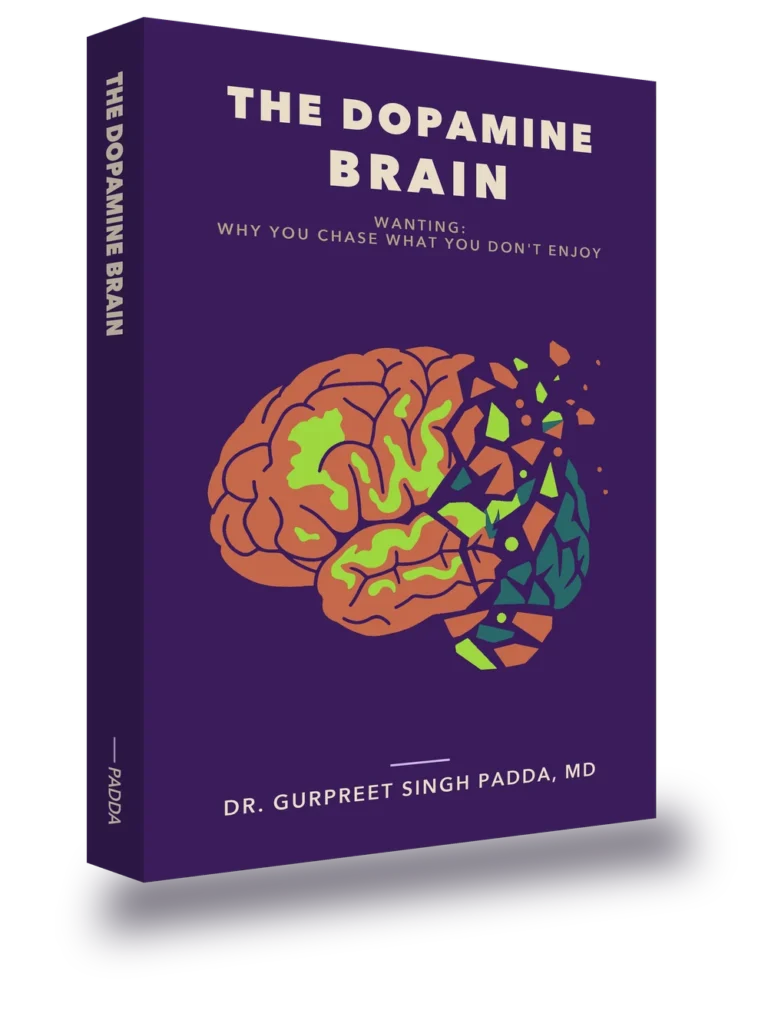
The video The Pain Pill That Paralyzes Your Gut tells his story. This page covers the evidence under it and what a pain practice does with it. The argument comes from The Angry Gut, by Dr. Gurpreet Singh Padda, MD, MBA, MHP, and Ami Michelle Grimes. In that book, the gut is the first brain and the skull holds the second. The vagus nerve ties them together.
A side effect is a price you accept for relief. A disease gets treated. Filed in the wrong column, his bowel has steered his care for nine years.
The bowel was built with the receptor already installed
An opioid pill is aimed at pain circuits in the second brain. But it binds wherever its receptor sits. In the human gut, the mu-opioid receptor sits on nerve cells in both nerve networks of the bowel wall. It sits on immune cells just under the lining. It sits on both halves of the peristaltic reflex, the squeeze that pushes food along. The gut already runs on a quiet opioid signal of its own, enkephalin. A prescription turns that volume all the way up.
The effect reaches the whole tube. Healthy volunteers took oral codeine for three days. The time for the stomach to half empty stretched to 144.0 minutes from 95.5. Colon filling at six hours fell to 11.0% from 51%. Higher up, 24% of 225 long-term users had a faulty esophagus (food pipe). The rate climbed with the strength of the drug: 12% on tramadol, 28% on hydrocodone and 31% on oxycodone.
Then comes the mismatch that makes it chronic. The body gets used to the pain relief, which is why doses creep up. It never gets used to the bowel effect. Every increase meant to chase the pain lands on a gut that never adapts.
Why so many patients never mention it
A European study looked at 1,200 people with cancer pain on opioids. Of them, 59.5% met the Rome IV criteria for opioid-induced constipation. Yet only 61.5% of those called themselves constipated. About four in ten with a measurably stalled bowel would not have brought it up. Of those given a prescription, only 66% took it every day.
A survey of 322 people already taking both an opioid and a laxative found 81% still constipated. And 45% passed fewer than three stools a week. A third had skipped, cut or stopped their opioid just to have a bowel movement. They are running their own taper, with no doctor watching and nothing in the chart.
Money explains the silence. A short visit rewards the fastest tool, and a stool softener takes seconds to add. The question that uncovers the problem takes minutes. The social cost piles on, and isolation is itself an inflammatory state that feeds pain.
Which drugs and doses weigh most on the bowel
A study followed 80,475 patients treated for non-cancer pain in Northwest England. The risk of severe constipation varied by drug. Measured against codeine, fentanyl had a hazard ratio of 1.37. Oxycodone came in at 1.46 and morphine at 1.59. Tramadol sat lower than codeine, at 0.80. Combination products sat highest of all, at 1.85.
The dose curve bent in an odd direction. Compare it with under 50 MME a day. The band from 50 to under 120 had a hazard ratio of 1.95. But 120 and above came in lower, at 1.45. The likely reason: the highest-dose patients get laxatives up front and closer watching. The study counted only enemas or suppositories given in the hospital. So the burden at home is larger.
Treating opioid-induced constipation at the receptor, not the stool
If constipation were just the price of pain relief, blocking the receptor would cost pain control. Peripherally acting mu-opioid receptor antagonists, called PAMORAs, block the receptor in the bowel without reaching the brain. Naldemedine was tested in two identical phase 3 trials. It helped 47.6% against 34.6% on placebo in one, and 52.5% against 33.6% in the other.
The bar to count as helped was high. It took at least three natural bowel movements a week, up by at least one from the start, for 9 of the 12 weeks. Overall side effects matched placebo. But gut side effects about doubled, 40 against 18 in one trial, as a bowel held down for months woke up. Across 27 trials and 9,149 patients, naloxone and naldemedine ranked most effective. They cut the risk of no response to 0.65 and 0.66.
Two cautions keep this honest. Those trials tracked bowel movements, not pain scores. So the claim that pain relief holds rests on how the drugs are built, not on a measured result. And the class is not a free pass. Alvimopan was limited to hospital use after an association with heart attacks. And in volunteers new to opioids, the approved 25 mg dose of naloxegol did not undo the slowdown from codeine.
Compare the usual reflex. Lubiprostone pulls water into the stool. It beat placebo on bowel movements, 27.1% against 18.9%. It moved no quality-of-life measure. It caused belly pain in 7.1% against 0%. The 2023 Japanese guidelines now name naldemedine a primary treatment option. That is because a laxative treats the stool, but the receptor is the problem. Whether a blocker fits your situation is a decision for the physician managing your pain.
When more medication means more pain
The deeper problem sits in the brain and spinal cord. Narcotic bowel syndrome is belly pain that gets worse even as the opioid dose for it holds steady or rises. It shows up in about 6% of people on long-term narcotics. It is thought to start in the central nervous system, apart from the constipation itself.
The broader pattern has been measured. Across 27 randomized trials and 1,630 surgical patients, higher opioid doses during surgery led to slightly worse pain afterward. Patients needed more rescue morphine, and their skin was more sensitive to pressure. The gap was small and the certainty low. The direction is what matters. Now run it the other way. A systematic review of 67 studies looked at dose reduction. Every fair-quality study that measured them found better pain (8 of 8), better function (5 of 5) and better quality of life (3 of 3). The certainty was graded very low. Medication-driven pain has a name and a workup.
Our position: the stalled bowel feeds metaflammation (inflammation driven by metabolism), and metaflammation turns up the central pain signal. That bridge rests on tissue and animal work. No human trial has tested it end to end, because trials shut out the patient with diabetes, depression and a nine-year prescription. Every step of the plan below stands without it.
Stewardship that spares the gut
The goal is not zero opioids. Untreated severe pain wrecks sleep, work and marriages. A taper forced onto pain that has never been treated is its own kind of harm. The goal is the lowest dose that keeps your function intact.
In our practice that follows an order. Interventional treatment goes after the structure causing the pain first. The dose comes down as a result, not as a target. New patients average more than 90 MME a day after more than two and a half years in pain. Under active interventional treatment, 21% are fully weaned within 90 days and 34% within one year. Across our established patients, fewer than 1% remain above 90 MME. The figures are practice-reported, drawn from our own patients rather than trial outcomes, and individual results vary.
For his bowel, that meant three moves. Constipation went on the problem list. The plan aimed at the receptor instead of a fourth laxative. And a taper measured in months began only once interventional work was underway. Behavioral care carries its share. Acceptance and Commitment Therapy, done in-house, helps a person get through the months of a taper. Rebuilding social contact removes an inflammatory load no pill touches. The arithmetic of a safe taper is its own subject.
The heartburn pill that rebounds when stopped set up this pattern of a drug that protects its own prescription. And the next post turns to a chemical nobody prescribed. For every study and number behind these claims, and what each one cannot show, read the companion Deep Dive on the narcotic bowel.
Frequently asked questions
Does opioid-induced constipation go away over time?
Usually not. The body gets used to the pain relief from opioids. But guideline reviews note that it never gets used to the bowel effect. That effect lasts and needs long-term care. That is why constipation often worsens as doses rise to chase pain. Treating it as a passing nuisance leaves it untreated for years. The gut’s cleaning wave between meals is part of what stalls.
Why don’t stool softeners fix constipation from opioids?
A softener changes the stool. But the cause is the opioid receptor in the bowel wall. It keeps signaling as long as the drug is present. A secretagogue, a drug that pulls water into the stool, beat placebo by a little without improving quality of life. Drugs that block the gut receptor act on the cause. That is why newer guidance moves them earlier. Morphine also tightens the door that bile passes through.
What is narcotic bowel syndrome?
It is belly pain that gets worse even as the opioid dose for it holds steady or climbs. It shows up in about 6% of long-term users. It is thought to be driven by the central nervous system, not the bowel, though it often comes with constipation. The treatment is a supervised dose cut, not a higher dose. How to tell whether a medication is feeding your pain.
Will my pain get worse if my opioid dose is lowered?
Not necessarily, and often the opposite. In the dose-reduction research, the better-designed studies all found pain easing as doses fell. Overall certainty is very low. What makes it work is order. The source of the pain gets treated first. Then the dose comes down slowly with your prescriber, never suddenly and never alone. Why medication is a bridge, not a destination.
Can opioids change the gut microbiome?
Early data suggest they can. One study looked at five opioid-agonist users in addiction treatment. Their gut bugs were less varied, and two genera were depleted. Roseburia makes butyrate. Bilophila handles bile acids. It is a very small sample. People using a receptor blocker showed no such difference. A stool species list is not the same as what the microbiome is doing.
Move the bowel onto the problem list
If your pain treatment has quietly reshaped your digestion, bring both problems to the same visit. We treat the source of the pain first, so the medication burden on your gut can come down with it.
Request an appointment, or call or text us.
Sources
- Sternini, C., Patierno, S., Selmer, I.-S., & Kirchgessner, A. (2004). The opioid system in the gastrointestinal tract. Neurogastroenterology and Motility, 16(Suppl 2), 3-16. https://doi.org/10.1111/j.1743-3150.2004.00553.x
- Manabe, N., Ihara, E., Yomiya, K., Iseki, M., Torii, A., Miwa, H., & Camilleri, M. (2026). Current strategies and future perspectives in the management of opioid-induced constipation: A review of international and Japanese guidelines. Neurogastroenterology and Motility, 38(5), e70343. https://doi.org/10.1111/nmo.70343
- Davies, A., Fagan, N., Gonzalez-Barboteo, J., Chelazzi, C., Economos, G., Elsner, F., Leach, C., Monsen, R. E., Oldenmenger, W. H., Remi, C., van den Beuken-van Everdingen, M., & Wüstefeld, M. (2024). Inadequate management of opioid-induced constipation in European cancer pain patients: Results of a real-world, multicentre, observational study (“E-StOIC”). Supportive Care in Cancer, 32(10), 701. https://doi.org/10.1007/s00520-024-08898-1
- Bell, T. J., Panchal, S. J., Miaskowski, C., Bolge, S. C., Milanova, T., & Williamson, R. (2009). The prevalence, severity, and impact of opioid-induced bowel dysfunction: Results of a US and European patient survey (PROBE 1). Pain Medicine, 10(1), 35-42. https://doi.org/10.1111/j.1526-4637.2008.00495.x
- Yimer, B. B., Soomro, M., McBeth, J., Medina, C. R. R., Lunt, M., Dixon, W. G., & Jani, M. (2025). Comparative risk of severe constipation in patients treated with opioids for non-cancer pain: A retrospective cohort study in Northwest England. BMC Medicine, 23(1), 288. https://doi.org/10.1186/s12916-025-04118-7
- Hale, M., Wild, J., Reddy, J., Yamada, T., & Arjona Ferreira, J. C. (2017). Naldemedine versus placebo for opioid-induced constipation (COMPOSE-1 and COMPOSE-2): Two multicentre, phase 3, double-blind, randomised, parallel-group trials. The Lancet Gastroenterology & Hepatology, 2(8), 555-564. https://doi.org/10.1016/S2468-1253(17)30105-X
- Luthra, P., Burr, N. E., Brenner, D. M., & Ford, A. C. (2019). Efficacy of pharmacological therapies for the treatment of opioid-induced constipation: Systematic review and network meta-analysis. Gut, 68(3), 434-444. https://doi.org/10.1136/gutjnl-2018-316001
- Jamal, M. M., Adams, A. B., Jansen, J.-P., & Webster, L. R. (2015). A randomized, placebo-controlled trial of lubiprostone for opioid-induced constipation in chronic noncancer pain. The American Journal of Gastroenterology, 110(5), 725-732. https://doi.org/10.1038/ajg.2015.106
- Drossman, D., & Szigethy, E. (2014). The narcotic bowel syndrome: A recent update. American Journal of Gastroenterology Supplements, 2(1), 22-30. https://doi.org/10.1038/ajgsup.2014.6
- Frank, J. W., Lovejoy, T. I., Becker, W. C., Morasco, B. J., Koenig, C. J., Hoffecker, L., Dischinger, H. R., Dobscha, S. K., & Krebs, E. E. (2017). Patient outcomes in dose reduction or discontinuation of long-term opioid therapy: A systematic review. Annals of Internal Medicine, 167(3), 181-191. https://doi.org/10.7326/M17-0598
Dr. Gurpreet Singh Padda, MD, MBA, MHP