Calorie restriction fails because obesity is a problem of energy partitioning driven by insulin, not simple arithmetic. Energy partitioning means where your body sends the fuel. While insulin is high, fat moves into storage and does not easily come out. So a real calorie deficit leaves you hungry and worn out while the scale refuses to move.
If you have failed at dieting over and over, let’s fix how you see that right now, not at the end.
You did not fail. The instruction failed — and we can measure how badly with some precision.
Is a calorie just a calorie?
A calorie measures the energy given off when food is burned in a lab device called a bomb calorimeter. It is a fine measure of that.
You are not a bomb calorimeter.
Equal-calorie portions of sugar, alcohol, steak and olive oil do very different things inside a human body. They cause different insulin responses. They trigger different fullness hormones. They get sent to different places. Some go to fuel right away. Some go to storage.
What matters is not the number printed on the label. It is what your body does with it. What gets burned? What gets stored? How long until you are hungry again?
How often does calorie restriction actually work?
Researchers tracked the electronic health records of 76,704 men and 99,791 women with obesity in the United Kingdom. They followed up to nine years of routine primary care.1
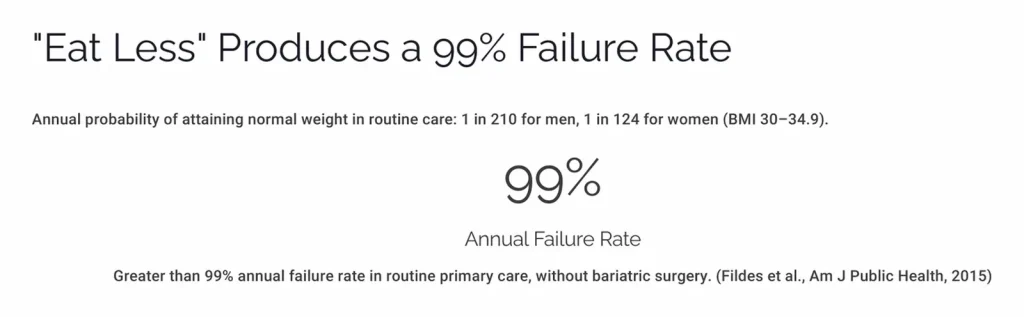
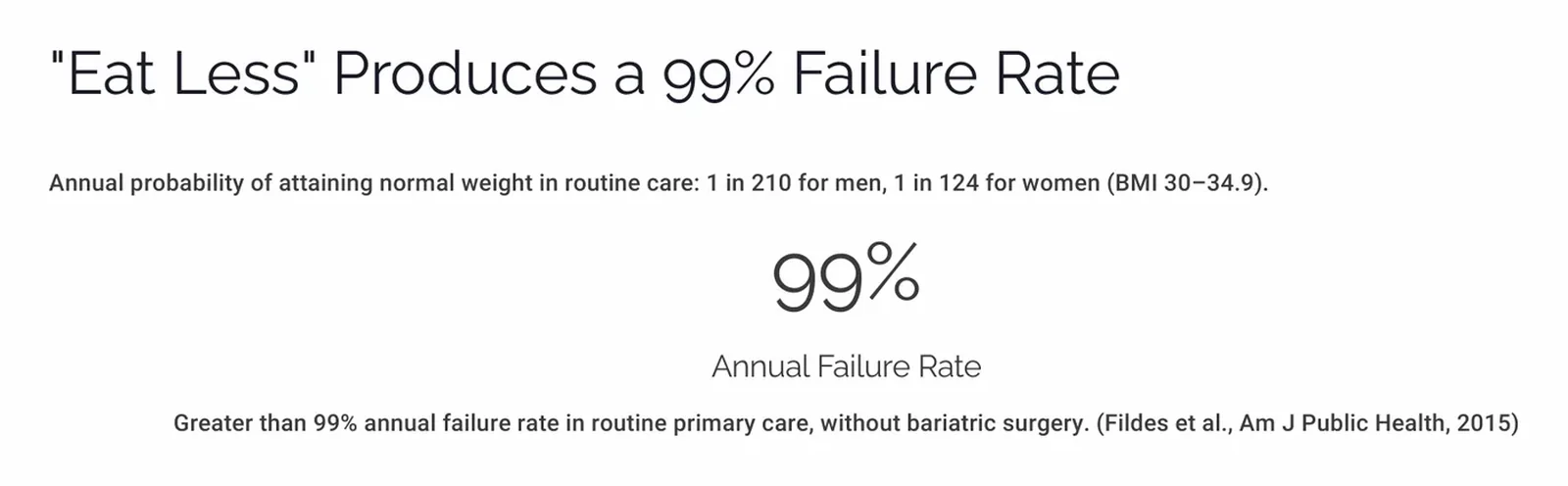
Take someone with simple obesity, a body mass index between 30 and 34.9. Their yearly chance of reaching a normal body weight was 1 in 210 for men and 1 in 124 for women.
At a BMI between 40 and 44.9, it was 1 in 1,290 for men and 1 in 677 for women.
It is worth stating exactly what that number measures, because people often misquote it. That is the annual probability of returning to normal weight in routine primary care, without bariatric surgery. It is not a controlled test of any one diet. It is not a claim that no one ever succeeds.
But it is the real-world result of the standard advice, as real patients actually get it. In any other part of medicine, a treatment this weak would trigger a hard look at the treatment, not at the patients.
Is obesity a hormone problem or a calorie problem?
Here is the alternative model.
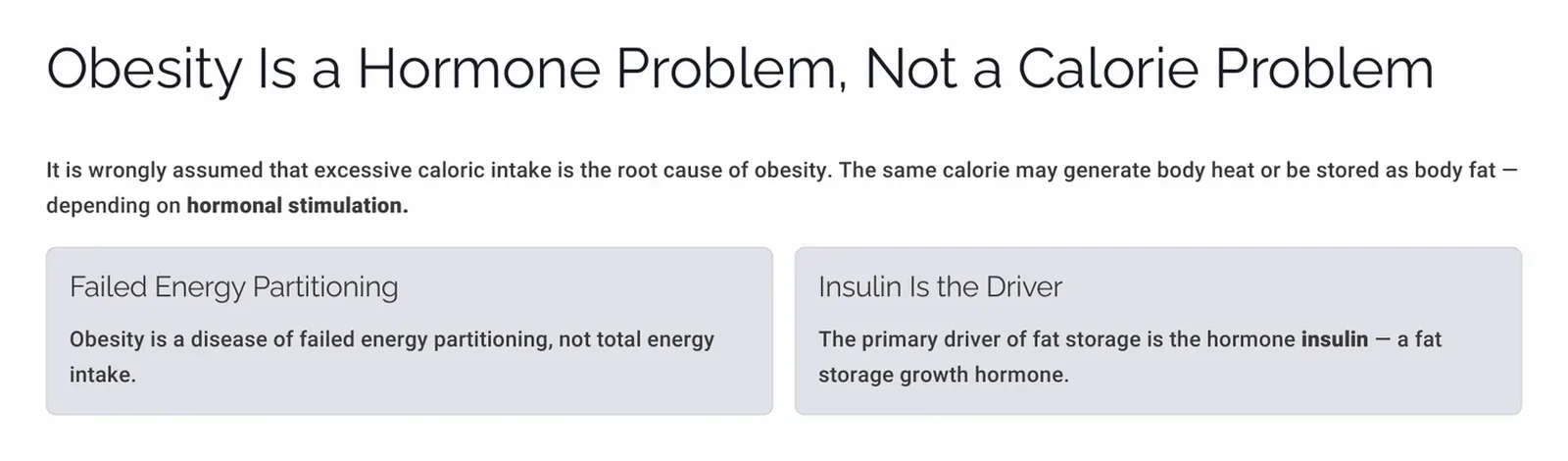
Obesity is not simply a disease of eating too much energy. It is better understood as a disease of failed energy partitioning. The same calorie may be burned as body heat or locked away as body fat. Which one happens depends on hormone signals.
The main driver of fat storage is insulin. It works as a storage hormone. While insulin is high, fat moves into the fat cell (adipocyte) and does not easily come out. This is why people can create a real calorie deficit, feel worn out and hungry, and still watch the scale refuse to move. The stored energy is locked away.
There is a second problem with counting calories. It builds in a bias against high-fat foods. Those foods pack a lot of calories, but they curb appetite and barely move insulin. So the calorie mindset nudges people toward starch and sugar. Those promote the very insulin resistance that created the problem.
As Malhotra and colleagues put it in Open Heart, moving the focus away from calories and onto food quality, not quantity, is what will reduce obesity and cardiovascular (heart and blood vessel) risk.2
Weight cycling, and the trial that tested this properly
Losing and regaining over and over does its own harm. Weight cycling is associated with high blood pressure, insulin resistance and unhealthy blood fats (dyslipidemia). It is also associated with worse cardiovascular (heart and blood vessel) outcomes.3 Losing thirty pounds five times is not the same as losing thirty pounds once.
Then there is Look AHEAD — Action for Health in Diabetes. Adults with type 2 diabetes got an intensive lifestyle program. It was a low-calorie diet plus more physical activity. They were followed for a median of 9.6 years.4
People in the program lost weight and kept off more than the control group. The trial found no cardiovascular benefit and was stopped early for futility (it was not going to work).
That is the calorie-restriction theory, tested at scale, in exactly the group it should have helped most.
Can you lose weight with exercise alone?
People often mishear this point, so here it is with care.
Physical activity is truly and strongly good for you. It improves insulin sensitivity, mood, sleep, bone density, heart fitness and pain. In a pain practice, movement is not optional. It is central.
It is simply not a good weight-loss tool. Measured activity levels changed very little over three decades while obesity rose sharply. The curves do not match, because activity was not what drove the change.5
There is a reason the opposite belief is so common. Food and drink companies have pushed the exercise message hard, because it moves the blame from the product to the buyer. The same companies selling processed food have sponsored the sporting events and paid the athletes.
You cannot outrun a bad diet.6 Move because it makes you healthier. Change what you eat to change your weight.

Does eating less often help you lose weight?
This may be the most useful step here, and it costs nothing.
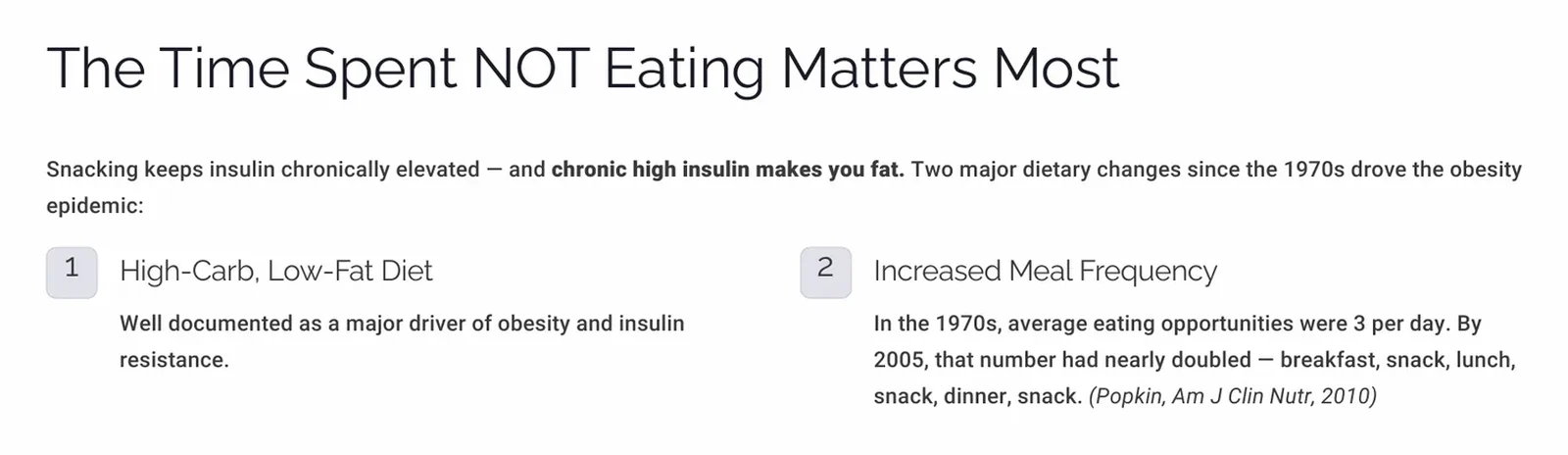
In the 1970s the average American ate about three times per day. By the mid-2000s that had nearly doubled: breakfast, snack, lunch, snack, dinner, snack.7 People were told to do this. The theory was that eating often speeds up metabolism.
Every time you eat, insulin rises. Eat six times a day and insulin never drops back to baseline. Insulin that stays high means storage mode from waking to sleeping. There is no long window when the body burns its own fat.
And eating more often does not cause weight loss. When tested directly, it simply makes people eat more in total.8
So eat fewer times a day. This is not a new idea. It is what nearly everyone did before the obesity epidemic.
Frequently asked questions
Does the 99% failure figure mean weight loss is impossible?
No. It describes the yearly chance of reaching a normal BMI in routine primary care without bariatric surgery: 1 in 210 for men and 1 in 124 for women at BMI 30 to 34.9. It measures how the standard advice works as given. It is not the limit of what a different approach can achieve. Individual results vary.
If calories do not matter, why do people lose weight when they eat less?
Calories are not meaningless. The point is that they are not what is in control. Different foods cause different insulin and fullness responses. So the same calorie count leads to different hunger, different storage and different staying power on a plan. Food quality changes how much you eat without counting.
Should I stop exercising if it does not cause weight loss?
Definitely not. Exercise improves insulin sensitivity, sleep, mood, bone density, heart fitness and pain. It is one of the best things you can do. It is simply the wrong tool for weight loss. Keep it, and change the diet to change the weight.
Is intermittent fasting safe for everyone?
No. Long fasts are not right for you if you are pregnant or breastfeeding or have had an eating disorder. They are also not right if you take insulin or a sulfonylurea, where fasting risks hypoglycemia (low blood sugar). Cutting back on snacks is a gentler place to start than a formal fasting plan. Do not start, stop, or change any medication without consulting your physician.
Why am I not losing weight even though I am exercising and eating right?
Because exercise is not a good weight-loss tool, and “eating right” often still means eating five or six times a day. Every time you eat, insulin rises. While insulin is high, fat moves into storage and does not easily come out. Keep exercising for your insulin sensitivity, sleep, mood and pain. Change what you eat, and how often you eat, to change your weight.
Why does my body not let me lose weight?
Because insulin, not arithmetic, decides where energy goes. Insulin is a storage hormone. While it is high, fat moves into fat cells and stays there. So a real calorie deficit leaves you worn out and hungry while the scale refuses to move. Counting calories nudges you toward starch and sugar. Those drive the insulin resistance that created the problem.
How can I trigger my body to burn fat?
Give insulin time to fall. Every time you eat, insulin rises. Eat six times a day and it never drops back to baseline. Then there is no long window when your body burns its own fat. Eating fewer times a day opens that window. It costs nothing, and it is how nearly everyone ate before the obesity epidemic.
Where can I be assessed for the metabolic side of this?
Padda Institute Center for Interventional Pain Management, 4477 Woodson Rd, Suite 100, St. Louis, MO 63134, next to St. Louis Lambert International Airport, with a second location at 12174 Natural Bridge Rd, St. Louis, MO 63044, serving the St. Louis region across Missouri and Illinois. Call (314) 481-5000 or text (314) 886-5902, Monday to Friday, 8:00 AM to 5:00 PM.
Key takeaways
- Annual probability of reaching normal weight in routine care: 1 in 210 for men, 1 in 124 for women.
- Obesity acts as a disorder of energy partitioning driven by insulin, not simple arithmetic.
- Look AHEAD tested intensive calorie restriction in type 2 diabetes and was stopped early for futility.
- Exercise is essential for health but does not work for weight loss. Industry pushed the opposite belief.
- Eating occasions nearly doubled since the 1970s. Eating less often is the cheapest change you can make.
This article is educational and is not a substitute for evaluation, diagnosis, or treatment by a physician. Individual results vary. Do not start, stop, or change any medication without consulting your physician. To be evaluated, request an appointment or call (314) 481-5000.
References
- Fildes A, Charlton J, Rudisill C, Littlejohns P, Prevost AT, Gulliford MC. Probability of an obese person attaining normal body weight: cohort study using electronic health records. American Journal of Public Health. 2015;105(9):e54–e59.
- Malhotra A, DiNicolantonio JJ, Capewell S. It is time to stop counting calories, and time instead to promote dietary changes that substantially and rapidly reduce cardiovascular morbidity and mortality. Open Heart. 2015;2(1):e000273.
- Mann T, Tomiyama AJ, Westling E, Lew AM, Samuels B, Chatman J. Medicare’s search for effective obesity treatments: diets are not the answer. American Psychologist. 2007;62(3):220–233.
- Wing RR, Bolin P, Brancati FL, et al. (Look AHEAD Research Group). Cardiovascular effects of intensive lifestyle intervention in type 2 diabetes. New England Journal of Medicine. 2013;369(2):145–154.
- Luke A, Cooper RS. Physical activity does not influence obesity risk: time to clarify the public health message. International Journal of Epidemiology. 2013;42(6):1831–1836.
- Malhotra A, Noakes T, Phinney S. It is time to bust the myth of physical inactivity and obesity: you cannot outrun a bad diet. British Journal of Sports Medicine. 2015;49(15):967–968.
- Popkin BM, Duffey KJ. Does hunger and satiety drive eating anymore? Increasing eating occasions and decreasing time between eating occasions in the United States. American Journal of Clinical Nutrition. 2010;91(5):1342–1347.
- Cameron JD, Cyr MJ, Doucet É. Increased meal frequency does not promote greater weight loss in subjects who were prescribed an 8-week equi-energetic energy-restricted diet. British Journal of Nutrition. 2010;103(8):1098–1101.
Get evaluated by a physician who treats the terrain, not just the signal
Chronic pain, metabolic disease and trauma physiology reinforce each other. At the Padda Institute they are assessed together, because treating one alone underperforms.
Or call or text us.
Medically reviewed by Dr. Gurpreet Singh Padda, MD, MBA, MHP — Board Certified in Anesthesiology, Pain Medicine, Interventional Pain Management, Addiction Medicine, and Obesity Medicine. Last reviewed July 2026.
Dr. Gurpreet Singh Padda, MD, MBA, MHP