Doctor reviews measure courtesy, wait times and whether requests were granted. Star ratings show little or no link to how well doctors actually treat. A forty-four-year-old man chose his pain clinic for its 4.9 stars. Across eleven visits and three epidurals, nobody examined his hip, checked his fasting insulin or asked how he slept.
A forty-four-year-old man picked his pain clinic because it had a 4.9-star rating. Over fourteen months he had eleven visits, three epidurals, a monthly prescription and a satisfaction survey at every visit. He even left one of the glowing reviews himself. Nobody examined his hip, checked his fasting insulin or asked how he slept. The doctor reviews had correctly measured the part of his care that was going well, and nothing else.
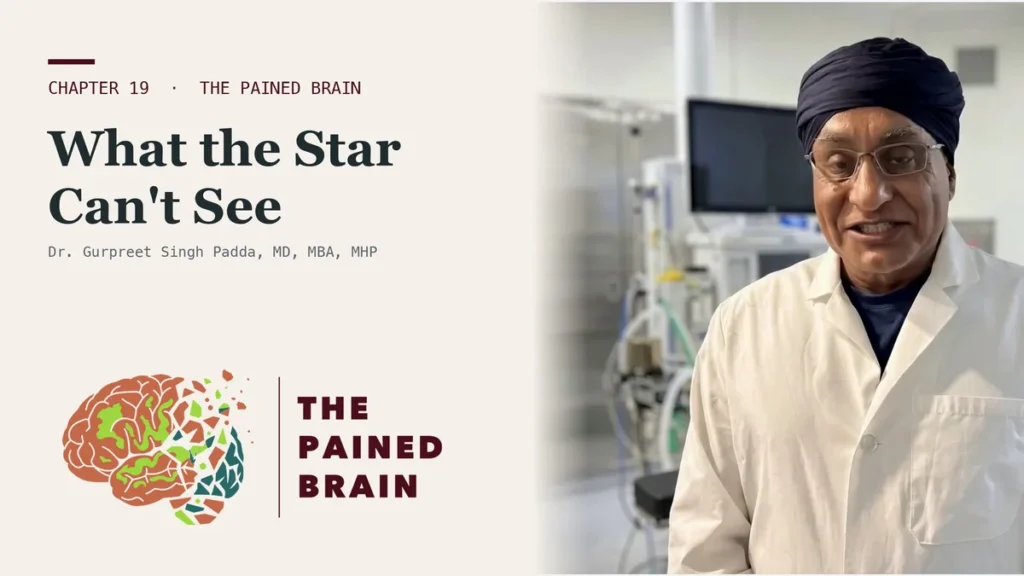
The video above, Kindness Is the Baseline, Not the Achievement, is Chapter 19 of The Pained Brain by Dr. Gurpreet Singh Padda, MD, MBA, MHP, and Dr. KrisJay Fucanan, MD. Below is the research on what star ratings track and why pain medicine is especially exposed to them. It also covers the signs that truly predict whether a clinic will find what is wrong.
Do doctor reviews track clinical quality?
In every study that has looked, no. Take 614 heart surgeons. Their average online rating was 4.4 out of 5 no matter how many of their bypass patients died, after adjusting for risk. And the middle rating rested on just 4 reviews. In another study, 78 specialists’ consumer ratings on five sites were compared with their hospital’s performance scores. The link ran from −0.04 to 0.04. Across 4,437 hospitals, Google stars tracked quality scores at −0.065 to −0.13. The researchers told consumers not to treat the stars as a stand-in for quality.
Ratings agree across sites, so they measure something real — just not medicine. At the Mayo Clinic, doctors who got negative online reviews matched their peers on the formal survey, 4.05 against 4.04. The gap was limited to the office, staff and access.
What do doctor star ratings actually measure?
One study looked at 15,101 Healthgrades reviews of pain doctors. Words such as care, professional and kind predicted a high rating. Words like pain, back, office, time and years predicted a low one. Of 16,695 online reviews of spine surgeons, 10.1 percent were one star. And 64.7 percent of those came from people who never had surgery. Reviewers report how they were treated. They cannot rate a diagnosis nobody gave them.
At the hospital level, the most satisfied quarter of surgery patients did have slightly lower death rates, 3.1 against 3.6 percent. Strong hospitals tend to be pleasant. Pleasant clinics are not automatically strong.
Why are patient satisfaction scores risky in pain care?
The score rewards the request that gets granted. In 1,319 primary-care visits, 85.2 percent of patient requests were granted. When a request for pain medicine was denied, satisfaction fell 10.72 percentile points. Among 19,566 Americans with bone and muscle conditions, those taking an opioid were 1.32 times as likely to report high satisfaction with their care. Among veterans with colds, getting a drug barely moved satisfaction. But expecting one and not getting it moved satisfaction 16.6 points.
Here is the finding that surprises people. One health system cut opioid doses in chronic pain. After that, 86.4 percent of those visits were still rated well. The score dropped in a real way only when a doctor the patient did not know made the cut. In the primary-care group, when a patient’s usual doctor said no, satisfaction held up 12.4 points better than when a stranger said it. But the incentive runs the wrong way. A clinic paid on the score learns that yes without a diagnosis costs nothing. And no without an explanation costs a star.
Kindness, measured honestly
Kindness is not decoration. Pooled across thirteen trials, the bond between patient and doctor had an effect the authors compared, fairly, to aspirin after a heart attack. Among Scottish family doctors, strong empathy was linked to odds of 5.7 that symptoms improved. Yet it was linked to odds of 20.1 that the patient was satisfied. Put those side by side and the problem is plain. Warmth moves satisfaction several times further than it moves the symptom. A satisfaction score is a sharp tool for spotting kindness and a blunt one for spotting results. Kindness is what I owe every patient first. It is the floor, not the finish line.
What does a thorough pain evaluation find that a short visit misses?
About 5.08 percent of American adults get a wrong or missed diagnosis in outpatient care each year. At one specialist (tertiary) referral center, the diagnosis patients arrived with matched the final one exactly in 12 percent. It was refined in 66 percent and clearly different in 21 percent. In a spine surgeon’s own clinic, 8 percent of back pain patients had hip or sacroiliac disease instead of spine disease. That is where this man’s pain belonged. When a hand clinic tested everyone with a tendon problem, 58.3 percent had an A1c in the prediabetes range. Of chronic pain patients on opioids who were tested, 58.8 percent had sleep apnea.
Little of that fits into an average primary-care visit of 18.0 minutes. The middle visit covers six topics and gives about a minute to each one after the first. A thorough evaluation is not every test. It is the exam plus the tests the pain points toward. And some searches come back empty. Screening fibromyalgia patients for celiac disease found no cases. How a joint is proven to be the source with a numbing injection is explained in when low back pain is actually the sacroiliac joint.
How do I choose a pain management doctor beyond the star ratings?
- Board certification, kept current. Among internists treating heart attacks and heart failure, certification went with lower odds of death in the hospital (an odds ratio of 0.835). Keeping it current went with 0.804.
- Volume. Spine surgeons who do few cases had 1.56 times the odds of a repeat surgery at five years. And about 1 percent of doctors account for 32 percent of paid malpractice claims, which are public records.
- The specialty’s own warnings. The anesthesiologists’ pain medicine list advises against three things. Opioids as the first choice for chronic pain not caused by cancer. Imaging sudden back pain without a specific reason. And sedation for nerve blocks by default.
- Measurement. A clinic that tracks your pain and function in numbers can tell whether a treatment worked. A clinic that never asks cannot.
- Explanation. People told they had a bout of back pain rated their need for imaging at 4.2 out of 10. People told they had arthritis, wear and tear, or a disc bulge rated it 5.7 to 6.0.
What a scan report does and does not mean is covered in why abnormal MRI findings are so common in people without pain. More practical tips are in tips on finding the best pain management doctors.
The review worth writing
In one pain program, patients rated their care higher than their improvement. A better review would hold three sentences. First, I understood what was wrong. That matters, because back pain patients unsure of their diagnosis had more depression and disability at the same pain level. Second, it was explained in words I could use. Added to exercise, about 200 minutes of pain education mattered for pain and 150 for disability. Third, it stayed better, and that one needs a number. Researchers call a 30 percent drop in pain meaningful. Patients asked to define success named 56 percent. About a year after a low back medial branch ablation, 43.7 percent of patients kept half their relief. A procedure described with its expected span is an honest bridge. A procedure sold as a cure is the five-star clinic.
For this man, a diagnostic injection (a test injection) showed that his hip caused most of what had been called back pain. His A1c came back at 6.2, and a sleep study found apnea. He heard all three in plain words, along with how long the epidurals were likely to help. Walking, better food and treated apnea were part of the treatment, not extras. They address the insulin and the broken sleep that keep a nervous system sensitized. The cost of skipping that work is the subject of what a fusion adds and what it costs. The next step, telling a nerve from a joint, is in nociceptive versus neuropathic pain. The studies behind every number, with their limits and questions for your doctor, are in the Chapter 19 Deep Dive.
Frequently asked questions
Are online doctor reviews reliable?
They are reliable about the visit and unreliable about the medicine. Ratings agree across sites, so they capture something consistent — mostly courtesy, wait times and staff. Studies of surgeons, specialists and hospitals found little or no link between stars and measured results. Use reviews to learn how an office treats people. Then judge the care by the diagnosis and the results. How payment models shape what clinics do is covered in fee-for-service healthcare and the ninth epidural.
What should I look for in a pain management doctor?
Look for current board certification and regular experience with the procedures offered. Look for a clinic that explains your diagnosis in a sentence you can repeat. Good signs include tracking pain and function over time, examining the body and not just the scan, and asking about sleep, mood and blood sugar. Warning signs include sedating every block and opening with a prescription. If you are unsure how to start, read whether you need a referral for pain management.
How common is a wrong or incomplete diagnosis?
More common than most people expect. About 5.08 percent of American adults get a wrong or missed outpatient diagnosis each year. At one specialist (tertiary) referral center, only 12 percent of referral diagnoses matched the final diagnosis exactly. In a spine clinic, 8 percent of back pain came from the hip or sacroiliac joint instead. A vague label can also stand in for a missing answer. That is why nonspecific is not a diagnosis.
Why would a pain doctor check blood sugar and sleep?
Because they change the pain and are often missed. In a hand clinic, 58.3 percent of patients with tendon problems had an A1c in the prediabetes range. Among chronic pain patients on opioids who were tested, 58.8 percent had sleep apnea. Both feed the inflammation and poor recovery that keep pain signals loud. The insulin side of that link is explained in how high insulin makes you hurt.
How long should relief from a pain procedure last?
It depends on the procedure and the pain source. A good clinic will tell you the expected span up front. About a year after low back medial branch radiofrequency ablation, 43.7 percent of patients still had at least half their relief. Relief is the window for rehab and terrain repair, not a cure by itself. What that ablation does to the nerves is explained in facet joint pain and the medial branch nerves.
Judge Us by the Diagnosis
Come in with your history and your questions. You should leave knowing what is causing the pain, in words you can repeat. And you should know how we will measure whether the plan is working.
Request an appointment, or call or text us.
Sources
- Okike, K., Peter-Bibb, T. K., Xie, K. C., & Okike, O. N. (2016). Association Between Physician Online Rating and Quality of Care. Journal of Medical Internet Research, 18(12), e324. https://doi.org/10.2196/jmir.6612
- Daskivich, T. J., Houman, J., Fuller, G., Black, J. T., Kim, H. L., & Spiegel, B. (2018). Online physician ratings fail to predict actual performance on measures of quality, value, and peer review. Journal of the American Medical Informatics Association, 25(4), 401–407. https://doi.org/10.1093/jamia/ocx083
- Cheng, C. P., Owusu, T., Shekane, P., & Patel, A. M. (2024). Sentiment analysis of pain physician reviews on Healthgrades: a physician review website. Regional Anesthesia and Pain Medicine, 49(9), 656–660. https://doi.org/10.1136/rapm-2023-104650
- Jerant, A., Fenton, J. J., Kravitz, R. L., Tancredi, D. J., Magnan, E., Bertakis, K. D., & Franks, P. (2018). Association of Clinician Denial of Patient Requests With Patient Satisfaction. JAMA Internal Medicine, 178(1), 85–91. https://doi.org/10.1001/jamainternmed.2017.6611
- Sharp, A. L., Shen, E., Wu, Y. L., Wong, A., Menchine, M., Kanter, M. H., & Gould, M. K. (2018). Satisfaction with care after reducing opioids for chronic pain. The American Journal of Managed Care, 24(6), e196–e199. https://pubmed.ncbi.nlm.nih.gov/29939510/
- Kelley, J. M., Kraft-Todd, G., Schapira, L., Kossowsky, J., & Riess, H. (2014). The influence of the patient-clinician relationship on healthcare outcomes: a systematic review and meta-analysis of randomized controlled trials. PLoS One, 9(4), e94207. https://doi.org/10.1371/journal.pone.0094207
- Sembrano, J. N., & Polly, D. W. (2009). How often is low back pain not coming from the back? Spine (Phila Pa 1976), 34(1), E27-E32. https://doi.org/10.1097/BRS.0b013e31818b8882
- Heiting, C., Wickes, C. B., Katakam, S., Herrera, C., Li, B., Intravia, J., Nolan, J. E., & Nellans, K. W. (2026). Occurrence of Undiagnosed Diabetes Mellitus With Musculoskeletal Disorders of the Upper Extremity: Prospective Screening With Point-of-Care Haemoglobin A1c Fingerstick Testing. Musculoskeletal Care, 24(3), e70256. https://doi.org/10.1002/msc.70256
- Serbic, D., & Pincus, T. (2014). Diagnostic uncertainty and recall bias in chronic low back pain. Pain, 155(8), 1540–1546. https://doi.org/10.1016/j.pain.2014.04.030
- Kanjanapanang, N., Sen, H., Cooper, A. N., Adler, A., Nabi, A., Dickenson, B., Tang, W., Young, C., Burnham, T., Fogarty, A. E., Przybysz, A. G., Conger, A. M., & McCormick, Z. L. (2025). The effectiveness of lumbar medial branch radiofrequency ablation using a three-tined electrode: A real-world cross-sectional cohort study. Interventional Pain Medicine, 4(4), 100711. https://doi.org/10.1016/j.inpm.2025.100711
Dr. Gurpreet Singh Padda, MD, MBA, MHP