Yes. In large studies, chronic pain that limits daily life, or that hurts in several places at once, raises the risk of early death. Much of that runs through heart disease, insulin resistance and visceral fat (deep belly fat around the organs). Chronic pain is almost always treated as a quality-of-life problem. It is also a survival problem, and the people carrying it are rarely told so.
Does chronic pain shorten your life? The latest federal estimate puts the cost of chronic pain in the United States at 722.8 billion dollars a year, counting medical care and lost work. Its authors list what the figure leaves out, including the hidden cost of suffering. No line in that ledger counts a death.
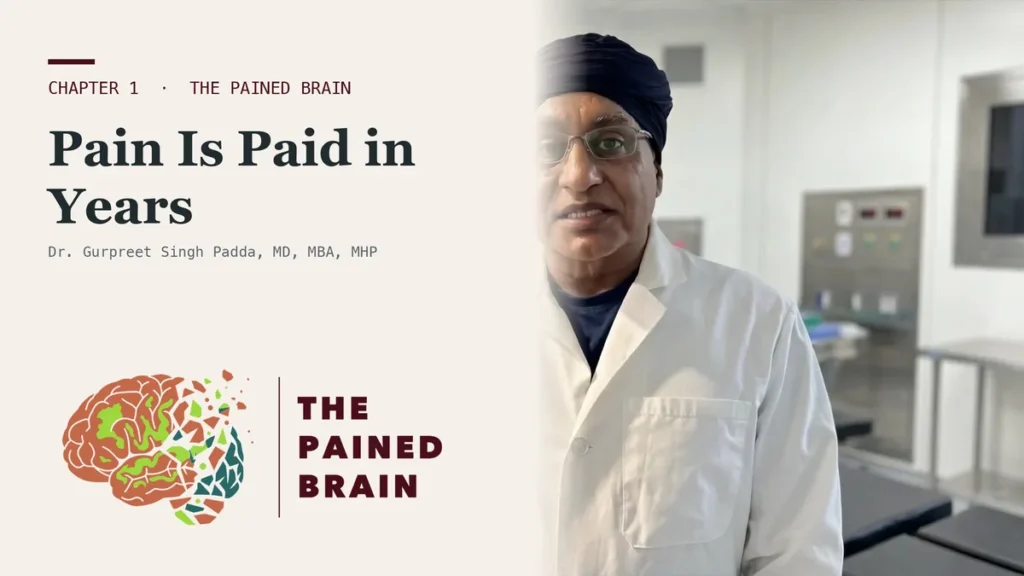
The video for Chapter 1 of The Pained Brain, The Cost of Pain Is Paid in Years, introduces the patient behind that number. The book is by Dr. Gurpreet Singh Padda, MD, MBA, MHP, and Dr. KrisJay Fucanan, MD. This page goes into what the video had no room for. What predicts an early death in a person who hurts? And what should be measured because of it?
Does chronic pain shorten your life? What the large cohorts found
For a long time the published answer was no. Seven community studies pooled before the big registries gave a death rate ratio of 1.14, which was not statistically significant. For most of my career, my own specialty treated pain as a local structural failure. Those numbers never pushed back.
Then the half-million-person studies arrived. Among British research volunteers, pain all over the body carried 2.43 times the rate of death from any cause. It carried 3.24 times the rate of death from heart disease, compared with people who had no chronic pain.
Heart disease is where much of that extra risk lands. One study followed 475,171 adults for a middle time of 7.0 years. Widespread chronic pain carried 1.48 times the risk of a major heart or blood vessel event. That was after body mass index, C-reactive protein and type 2 diabetes were already in the model. The share of that risk due to chronic pain was 8.6 percent, against 7.3 percent for diabetes.
Pain keeps adding even inside diabetes. One study followed 19,899 people with type 2 diabetes for a middle time of 13.9 years. Each extra painful site raised the hazard of death 1.04-fold and the hazard of heart disease 1.10-fold.
Interference, not intensity, predicts who dies
This is the finding I would put on every intake form. One study followed 19,487 American adults over 50 for twenty years. Pain that limited daily activity carried 1.33 times the hazard of death. That was after heart disease, cancer, lung disease, diabetes and body mass were taken into account. Moderate or severe pain that did not limit activity carried 1.05, which was not significant. For a 67-year-old woman, that model put ten-year death risk at 13.0 percent without limiting pain and 20.3 percent with it.
The number of painful places matters too. Among 384,367 British adults, the hazard of death climbed with each extra site of muscle and joint pain. It went from 1.09 at one site to 1.46 at four. A pain score tells me how loud the alarm is. Whether the pain stops you from living, and in how many places it rings, tells me far more about your years.
Fibromyalgia marks the edge of this pattern. Pooled across seven studies and 152,933 people, it showed no clear extra death from all causes, at 1.11. Yet the odds of suicide were 5.39. It shortens life another way. That is why mood screening belongs inside a pain evaluation.
Where the risk lives: insulin, visceral fat and an unfinished fire
When statisticians adjust the link between pain and death for weight, diabetes and heart disease, the link shrinks. In the American study, the hazard fell from 1.52 to 1.33. Most readers take that as pain being explained away. I read it as an address. The risk shrank because part of it was already sitting inside the metabolic disease.
The first driver is insulin. Among American adults without diabetes, the share with insulin resistance rose from 24.8 percent to 38.4 percent between 1999 and 2018. Blood sugar stays normal while insulin climbs, so the chart reads healthy. We have covered how high insulin makes you hurt. The nerve-level detail is in the post on the hormone that starves your nerves.
The second driver is visceral fat, the fat packed around the organs. It acts like a gland that releases inflammation signals all day. In 5,905 American adults, a visceral-fat score predicted chronic pain better than body mass index or waist size past age 65. That is why belly fat is not passive storage.
The third piece flips what most of us were taught. One study looked at 98 people with new low back pain. Those who recovered had more than 5,500 immune genes change their activity and then settle back down. Those whose pain became chronic showed none. The recovery response was about 75 percent larger. The problem was never inflammation itself. It is inflammation that never finishes, the state we call metaflammation. The human side of that work is observational. Still, the direction is hard to ignore.
It also explains why a normal C-reactive protein settles nothing. Higher CRP that comes from your genes does not cause spinal pain. What raised CRP seems to do is amplify. In one group followed forward, hs-CRP at or above 3 mg/L did not predict new chronic pain on its own. Paired with poor sleep, it carried 2.47 times the odds of chronic muscle and joint pain. Sleep is not a comfort measure. It is part of the inflammation equation, and the sleep and pain loop runs both ways.
The social driver: schooling, work and the year you were born
Two body drivers are not the whole story. At age 52, 40 percent of Americans born in 1965 without a college degree reported pain. That compares with 32 percent of those born in 1955. Pain rose 0.6 percentage points per birth year for people without a degree, and 0.2 for those with one. Body mass explained only about a quarter of that rise. Pain is being handed out by schooling and money, not only by joints.
That pattern feeds the biology. Losing work means losing income, movement and company, and each pushes insulin the wrong way. In British adults over 60 who started without diabetes, pain at four to seven sites raised the hazard of new type 2 diabetes to 1.198. Body weight carried nearly half of that effect.
What to measure, and what to do with the answer
Limiting pain, the number of painful sites, insulin and visceral fat (deep belly fat) carry the risk. So a pain evaluation that images only the joint is incomplete. In our practice, the first workup includes a fasting insulin, markers of inflammation, vitamin D and the blood fat pattern, along with the exam. Fewer than 1 percent of the chronic pain patients who come to us are metabolically healthy. That is a figure from our own patients, not a trial outcome, and individual results vary.
Opioids sit inside this same picture. Dose carries risk. Among 9,940 patients on long-term opioids for chronic pain not caused by cancer, 100 or more milligrams a day carried 8.87 times the overdose hazard of the lowest doses. A forced taper carries risk too, as covered in the questions below. The way through is to shrink what the dose is covering for. Under that plan, within ninety days 21 percent of our patients no longer take opioid pain medicine. By one year it is 34 percent. And in our established patients, under 1 percent stay above 90 morphine milligram equivalents. Those are figures from our own patients, not trial outcomes, and individual results vary. Any dose change belongs with your doctor. That is why we call medication a bridge, not a destination.
Here is what comes back to you. Ask for your fasting insulin, not only your glucose. Ask that the number of places you hurt, and whether pain stops you from doing things, be written in your chart. Guard your sleep as seriously as a prescription. Every study behind these figures, what each one shows and what it cannot show, is in the Deep Dive to Chapter 1, written to hand to your doctor. The next step is learning what pain actually is: a signal with a source, not a diagnosis.
Frequently asked questions
Can chronic pain shorten your life expectancy?
In large studies, yes. British volunteers with widespread pain died at more than twice the rate of people without chronic pain. The extra risk held at 1.47 times after weight, activity, smoking, alcohol and diet were adjusted. The risk centers on pain that limits daily life and pain at several sites. It is not a verdict on any one person. And much of it runs through metabolic disease that can be measured. Untreated pain is not a neutral holding position.
Why does chronic pain raise the risk of heart disease?
Pain and heart disease share a terrain: insulin resistance, visceral fat (deep belly fat) and inflammation that never clears. Among 475,171 adults, widespread chronic pain carried 1.48 times the risk of major heart and blood vessel events. That held even with diabetes and C-reactive protein in the model. Pain also drives sitting still and broken sleep, which push the same terrain further the wrong way. Here is why we treat insulin before we treat the joint.
Can my blood sugar be normal if I have insulin resistance?
Yes. When cells stop responding to insulin, the pancreas makes more, and glucose can stay normal for years. Among American adults without diabetes, high fasting insulin rose from 28.2 percent to 41.4 percent between 1999 and 2018. A normal A1c does not rule it out. So ask your doctor for the fasting insulin number itself. Insulin resistance arrives years before diabetes, and a glucose test misses it.
Is it risky to taper pain medication quickly?
A fast or forced taper carries its own risk. Even 12 to 24 months after a taper began, overdose or withdrawal events and mental health crises were still higher. They ran at 1.57 and 1.52 times the rate seen on a stable dose. The safer route first lowers what the dose is covering for. Any change is worked through with your doctor. Why an abrupt taper is also harm.
Does a normal CRP mean I have no inflammation?
No. Higher C-reactive protein that comes from your genes does not cause spinal pain. In 5,905 American adults, CRP explained only 7.4 percent of the link between visceral fat (deep belly fat) and chronic pain. The trouble in chronic pain is inflammation that never finishes, and one marker cannot show that. CRP means more when read beside your sleep than when read alone. How a sensitized nervous system lowers its own pain threshold.
Measure the body your pain lives in
Has your pain been treated one joint at a time, with nobody checking your fasting insulin? Start there. We check the terrain before we reach for the needle.
Request an appointment, or call or text us.
Sources
- Macfarlane, G. J., Beasley, M., & Jones, G. T. (2023). Chronic pain and premature mortality in men and women, using data from UK Biobank. The Journal of Clinical Investigation, 133(5), e166949. https://doi.org/10.1172/JCI166949
- Ruan, H., Yang, Y., & Grol-Prokopczyk, H. (2026). Which is More Predictive of Mortality-Pain Severity or Pain Interference? Evidence from 20-Year Longitudinal Data. The Journal of Pain, 40, 106192. https://doi.org/10.1016/j.jpain.2026.106192
- Chen, L., Ferreira, M. L., Nassar, N., Preen, D. B., Hopper, J. L., Li, S., Bui, M., Beckenkamp, P. R., Shi, B., Arden, N. K., & Ferreira, P. H. (2021). Association of chronic musculoskeletal pain with mortality among UK adults: A population-based cohort study with mediation analysis. EClinicalMedicine, 42, 101202. https://doi.org/10.1016/j.eclinm.2021.101202
- Vaegter, H. B., Støten, M., Silseth, S. L., Erlangsen, A., Handberg, G., Sondergaard, S., & Stenager, E. (2019). Cause-specific mortality of patients with severe chronic pain referred to a multidisciplinary pain clinic: a cohort register-linkage study. Scandinavian Journal of Pain, 19(1), 93–99. https://doi.org/10.1515/sjpain-2018-0094
- Wu, C., Ke, Y., & Nianogo, R. A. (2025). Trends in Hyperinsulinemia and Insulin Resistance Among Nondiabetic US Adults, NHANES, 1999-2018. Journal of Clinical Medicine, 14(9), Article 3215. https://doi.org/10.3390/jcm14093215
- Zhu, J., Wang, Y., Yu, G., Li, L., He, J., Liao, H., & Wu, X. (2025). Association between metabolic score for visceral fat and chronic pain: a cross-sectional analysis of NHANES 1999-2004. Frontiers in Nutrition, 12, Article 1545774. https://doi.org/10.3389/fnut.2025.1545774
- Parisien, M., Lima, L. V., Dagostino, C., El-Hachem, N., Drury, G. L., Grant, A. V., Huising, J., Verma, V., Meloto, C. B., Silva, J. R., Dutra, G. G. S., Markova, T., Dang, H., Tessier, P. A., Slade, G. D., Nackley, A. G., Ghasemlou, N., Mogil, J. S., Allegri, M., & Diatchenko, L. (2022). Acute inflammatory response via neutrophil activation protects against the development of chronic pain. Science translational medicine, 14(644), eabj9954. https://doi.org/10.1126/scitranslmed.abj9954
- Liang, J., He, X., Ouyang, Y., Song, X., Li, M., Qi, T., Chen, J., Zhang, X., Guo, X., Jia, T., Wu, S., Kou, C., & Bai, W. (2026). Association between chronic pain and type 2 diabetes in older adults: A prospective study in the UK Biobank. The Journal of Pain, 43, 106272. https://doi.org/10.1016/j.jpain.2026.106272
- Dunn, K. M., Saunders, K. W., Rutter, C. M., Banta-Green, C. J., Merrill, J. O., Sullivan, M. D., Weisner, C. M., Silverberg, M. J., Campbell, C. I., Psaty, B. M., & Von Korff, M. (2010). Opioid prescriptions for chronic pain and overdose: a cohort study. Annals of Internal Medicine, 152(2), 85–92. https://doi.org/10.7326/0003-4819-152-2-201001190-00006
- Agnoli, A., Xing, G., Tancredi, D. J., Magnan, E., Jerant, A., & Fenton, J. J. (2021). Association of Dose Tapering With Overdose or Mental Health Crisis Among Patients Prescribed Long-term Opioids. JAMA, 326(5), 411–419. https://doi.org/10.1001/jama.2021.11013
Dr. Gurpreet Singh Padda, MD, MBA, MHP