Nociplastic pain is pain produced by a nervous system that has changed, not by damaged tissue or an injured nerve. It is also the kind most likely to be missed. Once a chart says chronic low back pain, people stop looking.
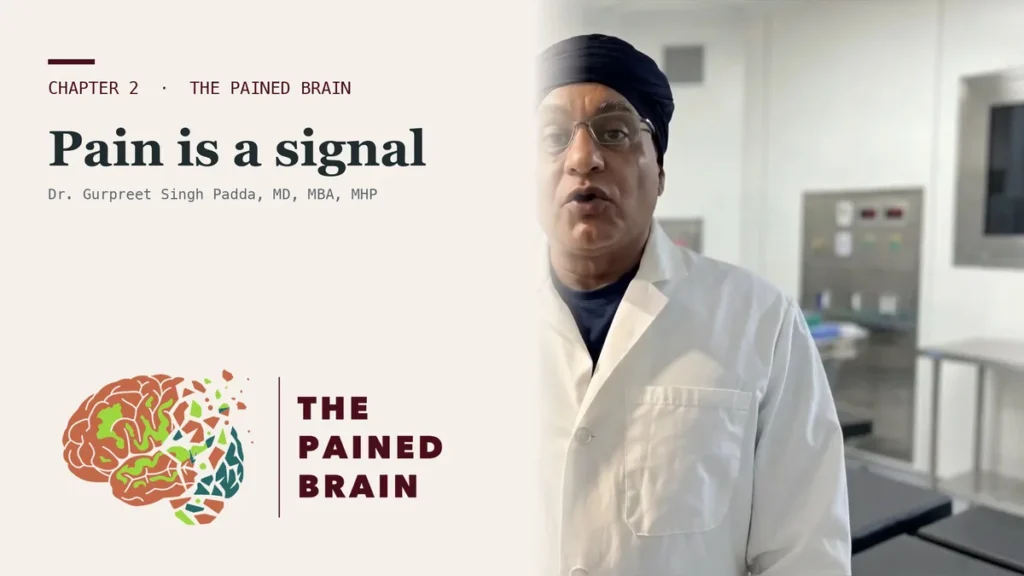
The video for Chapter 2 of The Pained Brain, Pain Is Not a Diagnosis, makes the case that pain is a signal. The book is by Dr. Gurpreet Singh Padda, MD, MBA, MHP, and Dr. KrisJay Fucanan, MD. This page goes further. Every signal demands three questions before anyone treats it: which structure, which mechanism, which terrain. The broader argument is in why pain is the signal and not the disease.
When the label becomes the disease
ICD-11 is the World Health Organization’s list of diseases. In it, chronic primary pain means pain lasting more than 3 months, with significant distress or disability, that no other condition explains better. As a coding tool it works. In field tests fewer than 3% of cases fell into the leftover groups. The World Health Assembly endorsed the list in 2022. But no paper gives a biological test that splits primary from secondary pain. The line is drawn by ruling things out.
The system pushed the same way. Take 1,294,247 adults who had never used opioids. A year after a first prescription, 6.0 percent were still taking them. If that first supply ran 31 days or more, 29.9 percent were. And 83 percent of leaders at academic pain centers felt pressure from managers over satisfaction scores. The reward went to quieting the alarm, not finding its cause.
Question one: which structure is hurting?
The major reviews say that for nearly all people with low back pain, no specific tissue cause can be found. Look at what specific means in those papers: fracture, cancer, infection. That sorting is built to catch the rare and dangerous, and it does. It was never built to find a facet joint.
Finding one takes a controlled block. The small nerves to a joint are numbed with a short-acting anesthetic. On another day they are numbed with a long-acting one. The question is whether the pain follows the drug. The case for doing it twice does not rest on one research group. Take 176 patients in a row with no past low back surgery. Of them, 47 percent responded to a single screening block. Only 15 percent were confirmed on the second drug. That is a false-positive rate of 38 percent. One referral practice worked 170 cases to an answer. The disc was the source in 42 percent, the facet joint in 31 percent and the sacroiliac joint in 18 percent. There is more on how a medial branch block confirms facet joint pain.
The technique has limits. No test without a needle exists to check a block against. False positives with paired blocks still run 17 to 41 percent. A positive double block names a structure with more confidence than anything else we have. Yet it has not been shown to predict a long-term treatment result. That is the reason I block before I ablate, never after.
Question two: nociplastic pain, nerve pain or tissue pain?
Nociceptive pain comes from damaged or inflamed tissue. Neuropathic pain comes from damage to the nerve itself. The nociplastic kind comes from changed pain signaling with no tissue damage. It responds poorly to treatments aimed at the body’s edges: anti-inflammatory drugs, opioids, surgery and injections. The three often show up together in one person. That is part of why chronic pain is so stubborn. We have written about how pain is classified and why the category changes the treatment.
There are bedside criteria for it. Possible nociplastic pain in muscles and joints needs four things. The pain has lasted more than 3 months. It covers a region, several spots or the whole body, not one small spot. Tissue or nerve damage does not fully explain it. And the painful area shows signs of being oversensitive. Those criteria are expert agreement, not proven tests. Fibromyalgia is the clearest example. Chronic low back pain can carry a nociplastic component mixed with a structural one.
Skipping this question has a cost you can measure. Look at 27 trials of nerve-pain drugs for back pain and spine-related leg pain. Of them, 59 percent either shut out people with neuropathic (nerve) pain or never checked for it. Only 22 percent enrolled patients at the level where those drugs are advised. Where neuropathic pain was probable, short-term pain fell 10.45 points on a 100-point scale. Where it was only possible, it fell 5.50. The subgroup differences were not statistically significant. So this does not prove that sorting patients by mechanism improves results. It shows that most of the field never sorted them.
The calendar will not sort them either. In one clinic, a nerve-pain part had almost no link to how long the pain had lasted. How an oversensitive system makes pain a scan cannot explain is covered in why your scan does not match your pain.
Question three: what state is the body in?
The third question is the one pain care rarely asks. One joint replacement program screened all 1,461 incoming patients. Of them, 58.9 percent had diabetes or prediabetes. And 40.9 percent of those with diabetes had never been told. Screening everyone before knee replacement in Hong Kong found hidden prediabetes in 36.4 percent.
That number predicts the result. Look at 4,778 planned low back operations. An HbA1c above 8 percent before surgery carried 0.64 times the odds of a meaningful gain in function. Across 17,472 knee replacements, diabetes dulled early pain relief. The other side deserves its place. In 587 hip and knee replacements, the 12-month pain and function scores were similar once body mass index and other illnesses were adjusted. Obesity with several illnesses is still terrain. But that study does not back the narrower claim that HbA1c alone predicts the pain result.
The guidelines leave this gap open. The 2022 federal opioid guideline runs 95 pages. It names HbA1c, insulin, vitamin D or an inflammation marker 0 times. The word laboratory shows up 4 times, each about urine drug tests. The British guidance on assessing chronic pain sets out 23 recommendations and names no blood test. It does tell doctors to ask about sleep, work, housing and income. Those belong in the history, because pain travels with them. When no guideline asks for a number, no payer builds around it, and it goes undone. The case for the one number almost nobody draws is in the post on fasting insulin and your nerves.
What changes when the terrain changes
Treat the imbalance and pain moves, even in trials that never touched the joint. In 407 adults with obesity and knee osteoarthritis, weekly semaglutide cut knee pain by 41.7 points against 27.5 on placebo over 68 weeks. The placebo arm improved on counseling alone. So about a third of the total was the drug’s added share.
What is eaten matters, not only how much. In 129 patients on two diets with set calories, weight loss was the same. Yet pain was lower on the Mediterranean diet than on low-fat. A 24-person pilot first took ultra-processed food out of everyone’s diet. Then adding carbohydrate restriction lowered pain 17.9 millimeters against 11.0. And hsCRP fell only in the restricted arm. That points to the route: the pain change traveled with a fall in inflammation. Where the terrain did not change, neither did pain. A phone referral that moved weight by 0.4 kilograms produced no pain change.
The needle has a place in that plan. In one neck epidural cohort, arm pain fell from 8.7 to 3.5 at 3 months. That was measured within the group, not against placebo. And 92 percent of the diabetic patients had brief high blood sugar afterward. As the whole plan, repeated forever, an epidural buys under five points against placebo. Bone density drops show up past a total of 200 mg of methylprednisolone in a year. As a bridge that makes sleep, movement and diet change possible, the relief earns its cost. Here is what an epidural steroid injection actually does.
Before any procedure, ask three things. Which structure, and will it be confirmed with two blocks? Which mechanism, and has anyone screened for a nerve or nociplastic mechanism? Which terrain, and what are my HbA1c and fasting insulin? The studies, and what each can and cannot show, are in the Deep Dive to Chapter 2, written to hand to your physician. Why an untreated terrain costs years is in the post on how chronic pain shortens life, and why the picture of your spine so often misleads is in the post on what an abnormal MRI really means.
Frequently asked questions
What is nociplastic pain?
Nociplastic pain comes from changed processing in the nervous system. No tissue damage or nerve injury explains it. It tends to be widespread or in many spots. It often travels with fatigue, poor sleep and fog. It responds poorly to injections, surgery, anti-inflammatory drugs and opioids. It can exist alone or next to tissue pain in the same person. So naming it early changes the plan. Why normal test results are expected in fibromyalgia.
What are examples of nociplastic pain?
Fibromyalgia is the clearest example. Chronic low back pain can carry a nociplastic part mixed with a structural one. That is one reason treatment aimed only at the spine can fall short. Doctors look for pain that has lasted more than 3 months and spreads past one small area. Tissue or nerve injury does not fully explain it. And it shows signs of oversensitivity. Why chronic back pain keeps coming back.
Why was pain called the fifth vital sign?
In 1999 the Veterans Health Administration asked for a 0-to-10 pain rating at every visit. Hospital standards followed in 2001. The number did not improve care. Across 600 visits no quality measure changed. And 52 percent of patients reporting real pain got no new treatment at that visit. A rating proves someone asked. It does not prove anyone looked for the cause. Why pain scores alone can mislead care.
Is one diagnostic block enough to find the source of back pain?
Usually not. In one low back series, a single uncontrolled block would have labeled 67.9 percent of patients positive. That is a false-positive rate of 49.8 percent. A separate group found 38 percent. The evidence supports repeating the block on another day with a different anesthetic, under imaging. Trust the result only when both answers agree. When low back pain is actually the sacroiliac joint.
Can losing weight reduce joint pain?
In trials, pain fell about as much as the metabolic terrain changed. Semaglutide in adults with obesity and knee osteoarthritis cut pain 41.7 points against 27.5 on placebo. After bariatric (weight-loss) surgery, 77.1 percent of patients with severe knee pain improved meaningfully at one year. Programs too light to move weight did not move pain. Any drug decision belongs with your physician. What Wegovy and Ozempic do to knee pain.
Name the structure, the mechanism and the terrain
A diagnosis should say what is hurting, what kind of pain it is and what state your body is in. We confirm the source, screen the mechanism and measure the terrain before we treat.
Request an appointment, or call or text us.
Sources
- Nicholas, M., Vlaeyen, J. W. S., Rief, W., Barke, A., Aziz, Q., Benoliel, R., Cohen, M., Evers, S., Giamberardino, M. A., Goebel, A., Korwisi, B., Perrot, S., Svensson, P., Wang, S.-J., & Treede, R.-D. (2019). The IASP classification of chronic pain for ICD-11: chronic primary pain. Pain, 160(1), 28–37. https://doi.org/10.1097/j.pain.0000000000001390
- Fitzcharles, M.-A., Cohen, S. P., Clauw, D. J., Littlejohn, G., Usui, C., & Häuser, W. (2021). Nociplastic pain: towards an understanding of prevalent pain conditions. Lancet (London, England), 397(10289), 2098–2110. https://doi.org/10.1016/S0140-6736(21)00392-5
- Kosek, E., Clauw, D., Nijs, J., Baron, R., Gilron, I., Harris, R. E., Mico, J.-A., Rice, A. S. C., & Sterling, M. (2021). Chronic nociplastic pain affecting the musculoskeletal system: clinical criteria and grading system. Pain, 162(11), 2629–2634. https://doi.org/10.1097/j.pain.0000000000002324
- Ward, J., Grinstead, A., Kemp, A., Kersten, P., Schmid, A. B., & Ridehalgh, C. (2024). A Meta-analysis Exploring the Efficacy of Neuropathic Pain Medication for Low Back Pain or Spine-Related Leg Pain: Is Efficacy Dependent on the Presence of Neuropathic Pain? Drugs, 84(12), 1603–1636. https://doi.org/10.1007/s40265-024-02085-6
- DePalma, M. J., Ketchum, J. M., & Saullo, T. (2011). What is the source of chronic low back pain and does age play a role? Pain Medicine, 12(2), 224–33. https://doi.org/10.1111/j.1526-4637.2010.01045.x
- Cohen, S. P., Bhaskar, A., Bhatia, A., Buvanendran, A., Deer, T., Garg, S., Hooten, W. M., Hurley, R. W., Kennedy, D. J., McLean, B. C., Moon, J. Y., Narouze, S., Pangarkar, S., Provenzano, D. A., Rauck, R., Sitzman, B. T., Smuck, M., van Zundert, J., Vorenkamp, K., … Zhao, Z. (2020). Consensus practice guidelines on interventions for lumbar facet joint pain from a multispecialty, international working group. Regional Anesthesia and Pain Medicine, 45(6), 424–467. https://doi.org/10.1136/rapm-2019-101243
- Shohat, N., Goswami, K., Tarabichi, M., Sterbis, E., Tan, T. L., & Parvizi, J. (2018). All Patients Should Be Screened for Diabetes Before Total Joint Arthroplasty. The Journal of Arthroplasty, 33(7), 2057–2061. https://doi.org/10.1016/j.arth.2018.02.047
- Lim, S., Yeh, H. H., Macki, M., Mansour, T., Schultz, L., Telemi, E., Haider, S., Nerenz, D. R., Schwalb, J. M., Abdulhak, M., Park, P., Aleem, I., Easton, R., Khalil, J., Perez-Cruet, M., & Chang, V. (2021). Preoperative HbA1c > 8% Is Associated With Poor Outcomes in Lumbar Spine Surgery: A Michigan Spine Surgery Improvement Collaborative Study. Neurosurgery, 89(5), 819–826. https://doi.org/10.1093/neuros/nyab294
- Bliddal, H., Bays, H., Czernichow, S., Uddén Hemmingsson, J., Hjelmesæth, J., Hoffmann Morville, T., Koroleva, A., Skov Neergaard, J., Vélez Sánchez, P., Wharton, S., Wizert, A., & Kristensen, L. E. (2024). Once-Weekly Semaglutide in Persons with Obesity and Knee Osteoarthritis. The New England Journal of Medicine, 391(17), 1573–1583. https://doi.org/10.1056/NEJMoa2403664
- Field, R., Pourkazemi, F., & Rooney, K. (2022). Effects of a Low-Carbohydrate Ketogenic Diet on Reported Pain, Blood Biomarkers and Quality of Life in Patients with Chronic Pain: A Pilot Randomized Clinical Trial. Pain Medicine, 23(2), 326–338. https://doi.org/10.1093/pm/pnab278
Dr. Gurpreet Singh Padda, MD, MBA, MHP