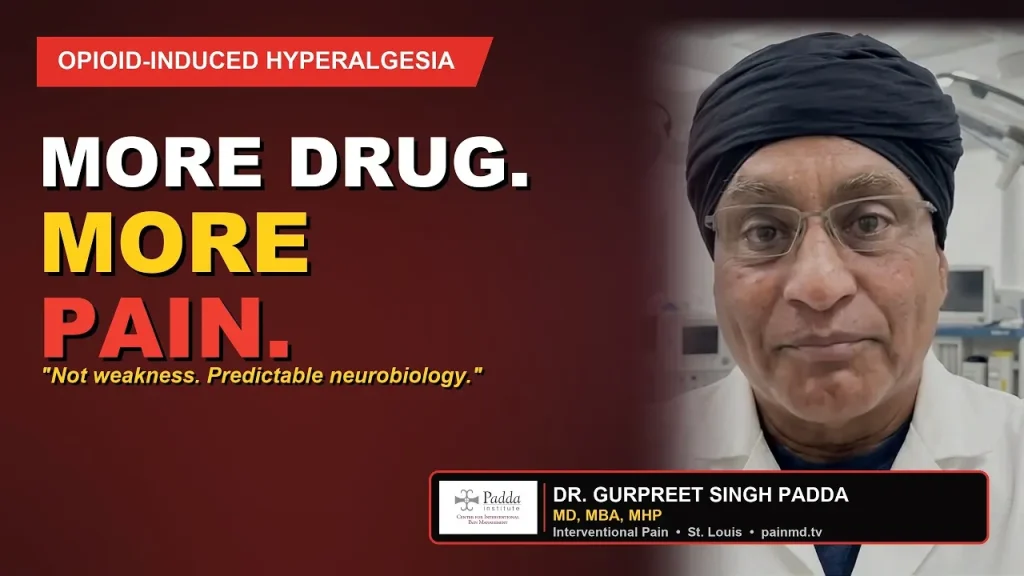
Sometimes, yes. When the opioid dose goes up and the pain gets worse, one reason is opioid-induced hyperalgesia. The drug itself has turned up the gain on your pain system. Tolerance, a worsening disease and withdrawal between doses all look the same from the outside. A doctor must rule them out first.
If you have been taking opioid pain medication for a long time, you may have lived through something that makes no sense on paper. The dose went up, and the pain got worse. Not the same — worse.
Most people assume one of two things when that happens. Either the disease is getting worse, or they are turning into a complainer. There is a third reason, and it has a name in the medical research: opioid-induced hyperalgesia. This article is about how to spot it. It also covers the three other problems that look exactly like it and must be ruled out first.
Is it hyperalgesia or tolerance?
Hyperalgesia means being more sensitive to pain. Opioid-induced hyperalgesia means the drug taken to reduce pain has started to amplify it. The nervous system has become a louder amplifier, and the drug is what turned up the gain.
That is a different problem from tolerance, and the difference decides what happens next. With tolerance, the drug still works. You just need more of it for the same relief. With hyperalgesia, the pain system has been reset. More drug does not fix it. More drug feeds it.
The practical way to tell them apart is what a dose increase really buys. With tolerance, it helps, at least for a while. With hyperalgesia, it buys a short lift and then a worse baseline. The pain often spreads past the first injury. It becomes more spread out and burning. And normal feelings that should not hurt start to hurt — bedsheets, a light touch, a shower.
If that describes you, you are not imagining it and you are not failing at being a patient.
Why does my pain get worse when I take more opioids?
The mu-opioid receptor is not a simple on-off switch. It is a regulated protein built to be stimulated on and off. When an opioid binds, the receptor’s tail gets tagged with phosphate. That draws in beta-arrestin proteins, which pull the receptor into the cell and cut it off from its signaling partner. That is desensitization. It is a thermostat, not a malfunction. The receptor is meant to recover between doses.
Take away the recovery window by keeping a drug on the receptor around the clock, and the thermostat gets stuck turned down. Birdsong and colleagues described this control system at the receptor in Molecular Pharmacology in 2015. That is cell-level work. It explains a mechanism, not a clinical result. The fuller account is in our companion article on why long-acting opioids can make pain worse.
Why are my opioids not working for pain anymore?
This is why hyperalgesia gets missed. There are at least four reasons a long-term opioid patient reports worse pain. They all produce the same sentence: it is not working anymore, and I need more.
- Tolerance. The drug still works, the receptor system has adapted, and a higher dose truly helps.
- Disease progression. Something structural really got worse — a disc ruptured, a joint collapsed, a nerve got trapped. The pain report is accurate, and the medicine was never the issue.
- Between-dose withdrawal. With short-acting drugs, each dose wearing off brings a mild withdrawal. Withdrawal itself hurts and raises pain sensitivity. It looks a lot like hyperalgesia but is treated differently — usually by changing the timing of doses, not the total dose.
- Opioid-induced hyperalgesia.
Four different problems, one complaint. Treat all four by raising the dose and you are wrong three times out of four.
How do doctors tell hyperalgesia from a worsening condition?
Partly by pattern. Hyperalgesia tends to spread past the nerve zone or joint that was hurt. It tends to bring allodynia (pain from light touch). And it tends not to respond for long to dose increases.
Partly by ruling things out. We repeat scans when needed and use nerve testing — EMG and nerve conduction studies — to see if a structural or nerve problem was missed. Hyperalgesia is not a convenient label.
And partly by a careful, monitored trial of lowering the dose. If a slow, supported dose cut is followed by pain that gets better, not worse, that tells us a lot. In many cases it is the only way to know. That takes trust. It asks a frightened patient to go down before going up. That is why it is done slowly and never as an ultimatum.
What is the treatment for opioid-induced hyperalgesia?
If hyperalgesia is suspected, the move that seems backward is the right one: lower the dose carefully instead of raising it. Tapering here is not taking away support. It is measuring how well the body regulates itself as the drug noise is removed. The pace is set by clinical stability, progress in movement and metabolic markers, not a random schedule.
That difference matters because the opposite failure is also real. Research has tied dose tapering to a higher long-term risk of overdose and mental health crisis. That is exactly why it must be slow, monitored, and paired with something that replaces the drug. In our practice that means procedures aimed at the real pain source. It means a minimum of twelve physical therapy sessions a year. It means psychological support, sleep and body-clock repair, and metabolic work. Chronic pain is often an extension of body-wide metabolic inflammation, not just a nerve event.
Related reading: Opioid bankruptcy: why opioids stop working explains why your own endorphin system is the other half of this picture. Pill counts vs. pharmacology covers what we tell pharmacists and referring doctors. For the full picture of our approach, see interventional pain management in St. Louis and our pain treatment FAQs.
Frequently asked questions
What is opioid-induced hyperalgesia?
It is a state where pain sensitivity rises because of the opioid, not in spite of it. Nonstop stimulation of the mu-opioid receptor wears it down (desensitization). The nervous system makes up for it by turning pain signals up. The telltale sign is a dose increase that buys a short lift and then a worse baseline. Individual results vary.
For how continuous receptor occupancy produces it, read Why Long-Acting Opioids Can Make Pain Worse.
How is it different from tolerance?
With tolerance, the drug still works and a higher dose truly helps. With hyperalgesia, the pain system itself has been reset, so a higher dose feeds the problem. Pain also tends to spread past the first injury and turn more spread out and burning. It brings allodynia — where a light touch or a bedsheet hurts.
Does this mean opioids are always harmful?
No. Opioids have a real role in sudden pain, pain after surgery and cancer pain. Some patients with severe, complex pain need them long term. The concern is nonstop, rising doses with no plan to lower them. Do not start, stop, or change any prescribed medication on your own — that decision belongs with your physician, and abrupt discontinuation carries real risk.
How do you tell hyperalgesia apart from the disease simply getting worse?
By pattern, by ruling things out and by a monitored trial. Hyperalgesia tends to spread past the first injured area and not respond for long to dose increases. We repeat scans when needed and use nerve testing to look for a missed structural or nerve problem. If it is still unclear, a slow, supported dose cut is often the only way to know.
For why that dose reduction has to be slow rather than abrupt, read Why Abrupt Opioid Tapering Is Also Harm.
Is the evidence for hyperalgesia settled?
Not fully, and we say so. Systematic reviews support that opioids can raise pain sensitivity in people. But a randomized placebo-controlled trial of sustained-release morphine in chronic low-back pain found clear tolerance to pain relief without proof of hyperalgesia. The honest position: it happens in some patients on long-term therapy. It is under-recognized. It should be actively looked for, not assumed either way.
For how that evidence shapes our position on long-acting opioids, read Pill Counts vs. Pharmacology: What Pharmacists and Referring Physicians Should Know.
What are the signs that my pain medication is making my pain worse?
The clearest sign is what a dose increase buys you: a short lift, then a worse baseline than before. The pain often spreads past the first injury and becomes more spread out and burning. Normal feelings start to hurt, like bedsheets, a light touch or a shower. If that describes you, you are not imagining it.
Why does my pain get worse when my medication wears off?
With short-acting opioids, each dose wearing off can bring a mild withdrawal. That withdrawal itself hurts and makes you more sensitive to pain. So it looks a lot like hyperalgesia. It is a different problem and is treated differently, usually by changing the timing of doses, not raising the total dose.
Should I stop my opioid if I think it is making my pain worse?
No, not on your own. Do not start, stop or change any prescribed medication without your physician, because abrupt discontinuation carries real risk. If hyperalgesia is suspected, the right move is a slow, supported and monitored dose cut. When pain gets better, not worse, as the dose comes down, that answer is often the only way to know.
What replaces the opioid during a taper?
A taper here never takes away support without replacing it. In our practice that means procedures aimed at the real pain source and at least twelve physical therapy sessions a year. It means psychological support, sleep and body-clock repair, and metabolic work. The pace is set by your clinical stability and progress in movement and metabolic markers, not a random schedule.
Where are you located and how do I make an appointment?
Padda Institute Center for Interventional Pain Management, 4477 Woodson Rd, Suite 100, St. Louis, MO 63134. Book at painmd.tv/appointment/, call (314) 481-5000 or text (314) 886-5902.
The office, hours and directions are on our Locations page.
Key takeaways
- Opioid-induced hyperalgesia is higher pain sensitivity caused by the opioid, not just in spite of it.
- It is not the same as tolerance. With tolerance a higher dose helps. With hyperalgesia it feeds the problem.
- Three other problems look the same — tolerance, a worsening disease, and withdrawal between doses. Raising the dose treats all four the same wrong way.
- The evidence supports it but does not all agree. One randomized trial found tolerance without proof of hyperalgesia.
- If your dose has been climbing along with your pain, that pattern is worth raising with your physician — never change medication on your own.
Services referenced in this article
- Counseling for chronic pain — in-house psychological support.
- Lifestyle medicine — sleep, nutrition, movement and metabolic markers.
- Medical weight loss — physician-led, coaching through medication.
Find what is driving the pain — not just the signal
The Padda Institute builds a doctor-led plan that treats the pain source and the metabolic terrain around it, so medicine has less work to do.
Or call or text us — 4477 Woodson Rd, Suite 100, St. Louis, MO 63134.
Msg & data rates may apply. Reply STOP to opt out, HELP for help. Text is not a secure channel — please don’t send medical or personal health information by text, and don’t use text for emergencies.
This article is educational and is not a substitute for evaluation, diagnosis, or treatment by a physician. Individual results vary. Do not start, stop, or change any medication without consulting your physician. Opioid withdrawal can be medically hazardous and abrupt discontinuation carries real risk.
References
- Birdsong WT, Arttamangkul S, Bunzow JR, Williams JT. Agonist binding and desensitization of the μ-opioid receptor is modulated by phosphorylation of the C-terminal tail domain. Mol Pharmacol. 2015;88(4):816–24. PMID 25934731. Cellular work describing a receptor mechanism, not a clinical outcome.
- Angst MS, Clark JD. Opioid-induced hyperalgesia: a qualitative systematic review. Anesthesiology. 2006;104(3):570–87. PMID 16508405.
- Higgins C, Smith BH, Matthews K. Evidence of opioid-induced hyperalgesia in clinical populations after chronic opioid exposure: a systematic review and meta-analysis. Br J Anaesth. 2019;122(6):e114–e126. PMID 30915985.
- Mercadante S, Arcuri E, Santoni A. Opioid-induced tolerance and hyperalgesia. CNS Drugs. 2019;33(10):943–55. PMID 31578704.
- Chu LF, D’Arcy N, Brady C, et al. Analgesic tolerance without demonstrable opioid-induced hyperalgesia: a double-blinded, randomized, placebo-controlled trial of sustained-release morphine for chronic nonradicular low-back pain. Pain. 2012;153(8):1583–92. PMID 22704854. Counter-evidence.
- Fenton JJ, Magnan E, Tseregounis IE, Xing G, Agnoli AL, Tancredi DJ. Long-term risk of overdose or mental health crisis after opioid dose tapering. JAMA Netw Open. 2022;5(6):e2216726. PMID 35696163.
- Dowell D, Ragan KR, Jones CM, Baldwin GT, Chou R. CDC clinical practice guideline for prescribing opioids for pain — United States, 2022. MMWR Recomm Rep. 2022;71(3):1–95. PMID 36327391.
Medically reviewed by Dr. Gurpreet Singh Padda, MD, MBA, MHP — Board Certified in Anesthesiology, Pain Medicine, Interventional Pain Management, Addiction Medicine, and Obesity Medicine. Last reviewed July 2026.
Dr. Gurpreet Singh Padda, MD, MBA, MHP