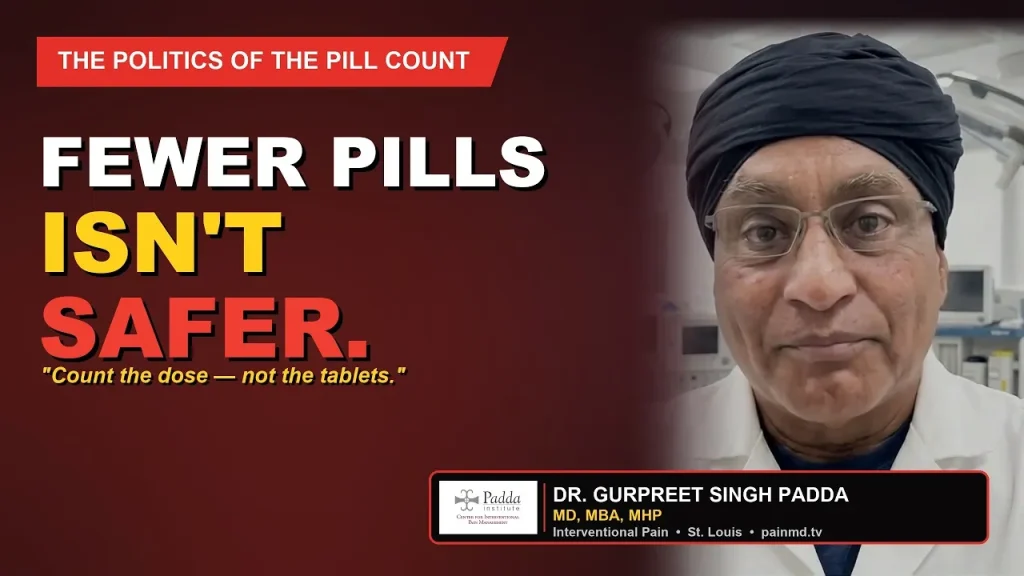
Pharmacists, insurers and regulators regularly ask why we do not consolidate short-acting opioid tablets into one long-acting tablet twice a day. Fewer tablets improve the prescribing numbers and worsen the pharmacology: continuous receptor occupancy removes the recovery window, and observational data associate long-acting agents with higher overdose risk and total mortality.
This is an argument that comes up several times a month, usually with a pharmacist, occasionally with an insurer, sometimes with a regulator. They look at a patient on thirty-day quantities of a short-acting opioid, see a large number of individual tablets, and ask a reasonable-sounding question: why not consolidate? One long-acting tablet, twice a day. Fewer units, less to divert, better-looking numbers.
Our answer is no — deliberately, in writing, and with reasons. This page is written for pharmacists, referring physicians and dispensing partners, and it is deliberately public. We do not describe this practice one way to clinicians and another way to the people we treat.
Why do pharmacists ask to switch to long-acting opioids?
It is worth being honest that this pressure is not primarily clinical. It is metric pressure. Enforcement actions and news coverage quote raw tablet numbers because raw tablet numbers are vivid; nobody writes a headline about morphine milligram equivalents. A practice with high unit counts therefore looks dangerous even when total exposure is low, and a practice that consolidates onto fewer, stronger, longer-acting units looks responsible even when total exposure is higher. That is an optics problem being solved with pharmacology.
The pressure on pharmacies is real and we do not dismiss it. Major chains have faced substantial liability over opioid dispensing, and pharmacists carry genuine corresponding-responsibility exposure — sometimes while being squeezed by their own employers. When a pharmacist pushes back on one of our prescriptions we do not assume bad faith. We assume they are carrying risk they did not create. But we still have to answer for the pharmacology.
Why do long-acting opioids work against the receptor?
The mu-opioid receptor is built to be stimulated intermittently — bind, signal, desensitize, recover, resensitize. A long-acting formulation is specifically engineered to eliminate the trough. That is its selling point: smooth, continuous plasma levels with no peaks or valleys. But the valley is not a defect; the valley is when the receptor recovers. Continuous occupancy means continuous desensitization pressure and no resensitization window. The receptor-level detail is set out in why long-acting opioids can make pain worse.
We label this honestly as mechanistic rationale. Birdsong and colleagues described the phosphorylation and beta-arrestin machinery in cellular work, not in patients, and a randomized trial of sustained-release morphine found tolerance without demonstrable hyperalgesia. If mechanism were all we had, a skeptical pharmacist would be right to be unimpressed.
Are long-acting opioids more dangerous than short-acting ones?
So here is the outcome data, which is the stronger part of the case. Ray and colleagues published in JAMA in 2016: long-acting opioid prescriptions were associated with significantly increased total mortality compared with short-acting agents, and critically the excess was not confined to overdose — there was excess cardiovascular and other non-overdose mortality, consistent with sustained systemic exposure rather than a single acute event. Miller and colleagues published in JAMA Internal Medicine in 2015: long-acting agents were associated with higher unintentional overdose risk, with risk especially elevated early in treatment.
The caveat belongs in the same breath. Both are observational. Patients placed on long-acting opioids may be more severe to begin with, so confounding by indication cannot be excluded and neither study establishes causation. What we do claim is narrower: when the mechanistic reasoning and the large-scale outcome data point the same way, and the argument for the alternative is that the unit count looks tidier, the burden of proof does not sit with us.
What happened in Missouri when prescribing was cut
The pill-count argument assumes a tight coupling between how much opioid is dispensed in a population and how many people die. Missouri is a useful test of that assumption, because the state started the period among the heaviest prescribers in the country and cut hard.
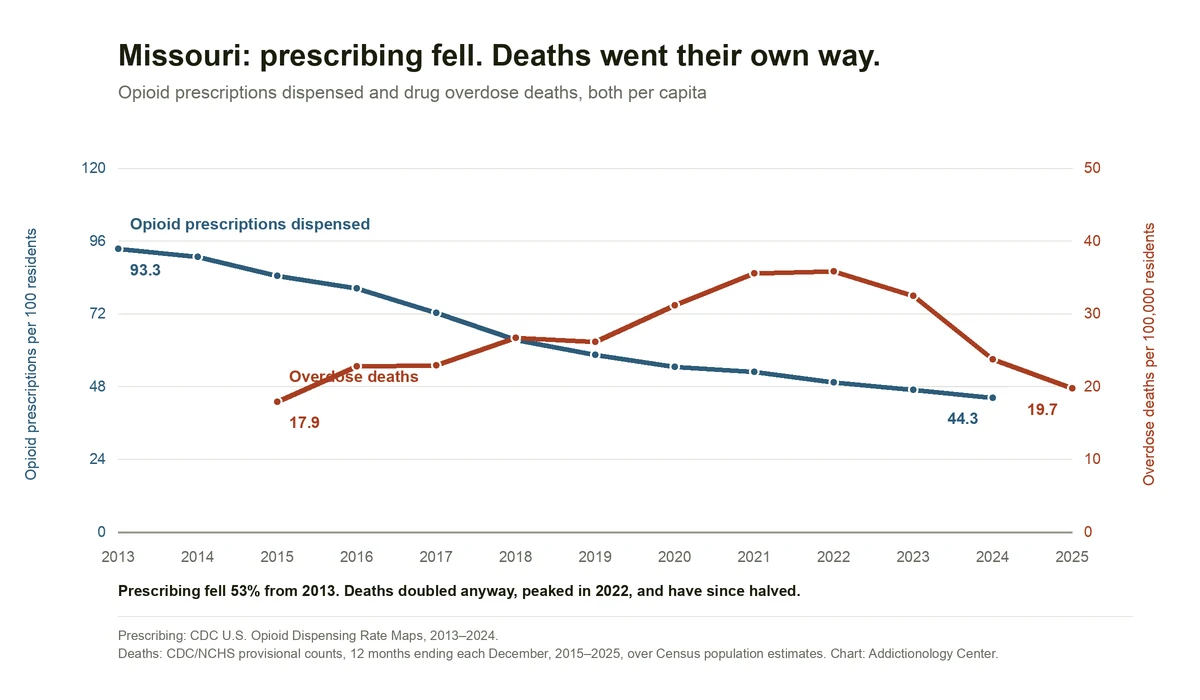
Missouri went from 93.3 opioid prescriptions per 100 residents in 2013 to 44.3 in 2024, a cut of 53 percent. The overdose death rate moved the other way over the same years, from 17.9 per 100,000 in 2015 to 35.8 in 2022 — the two lines cross in 2018 — and then fell to a provisional 19.7 by the end of 2025 while prescribing continued to decline. Locally the prescribing figures are higher still: St. Louis County dispensed 53.6 per 100 residents in 2024 and the city of St. Louis 69.3.
What that does and does not establish is worth stating precisely. It is population-level co-movement, not causation, and it cannot tell you whether any individual prescription was appropriate. What it does rule out is the simple version of the pill-count thesis: dispensing volume fell continuously for a decade while mortality rose, peaked, and then fell on its own timetable. A policy lever that moves one series without moving the other is not the lever anyone thought it was — which is the argument for judging a regimen by the patient in front of you rather than by the quantity on the label.
What opioid doses do our patients actually take?
“Low total dose” is meaningless without figures, and figures mean little unless you know where in the course of treatment they were taken. Here they are at both ends.
On arrival. The average new patient reaching this practice has been in pain for more than two and a half years and is taking more than 90 MME per day. Some arrive far higher — we frequently inherit patients from primary care at 400 to 500 MME. That is the starting line we are handed, not a description of how we prescribe.
Under active interventional treatment. Within 90 days, 21% of patients are completely weaned off opioid pain medication. Within one year, 34% are completely weaned off all opioid pain medication. Of those who cannot be fully weaned, the large majority are brought below 30 MME per day — well beneath the thresholds at which federal prescribing guidance places its sharpest cautions.
Across the established population. Roughly 60 to 65% receive any opioid analgesic at all. The average maintained patient sits at approximately 27 to 32.5 MME, with typical dosing under 30 to 40 MME, and fewer than 1% of established patients remain above 90 MME. Those few are specific situations — active cancer pain under co-management, or postoperative failed back surgery syndrome and arachnoiditis — where the elevated dose is a temporizing measure during reduction rather than a maintenance strategy.
These figures were published publicly on International Overdose Awareness Day, August 31, 2026 — see the announcement and the original release. They are practice-reported figures from our own population, not trial outcomes, and individual results vary.
What makes the numbers worth reporting is the mechanism rather than the arithmetic. This practice is interventional first and does not offer medication-only pain management. When the pain generator is identified and treated directly — an inflamed facet joint, a compressed nerve root, an irritated sacroiliac joint — the clinical need for systemic opioids frequently falls on its own, without a taper imposed as an end in itself.
There is also a deliberate safety design in the dispensing pattern itself: we do not dispense more medication than a patient could foreseeably overdose on at one time. That produces more tablets on paper and less risk in practice.
Does lower dosing produce better outcomes?
This is the right question. The SPACE randomized trial, published by Krebs and colleagues in JAMA in 2018, compared opioids with non-opioid medication for chronic back pain and hip or knee osteoarthritis pain: opioids were not superior for pain-related function over twelve months, and the opioid group had more adverse events. High-dose therapy is not buying the functional benefit that escalation implies.
The regulatory position has moved the same way. The CDC’s 2022 clinical practice guideline deliberately removed the rigid dose thresholds that the 2016 version had been misapplied as hard caps, replacing them with individualized decision-making, and it explicitly warns against abrupt or rapid reduction in patients on long-term therapy. That matters because the opposite failure is also lethal: Fenton and colleagues found tapering associated with increased long-term risk of overdose and mental health crisis. This is not an argument for aggressive cuts. It is an argument for a low, stable, intermittent dose reached gradually, with real treatment underneath it.
What actually makes opioid prescribing safe?
“Fewer pills is safer” only sounds true if everything else in the system is ignored. A tablet count is a static number on a page; safety is a process. Ours is built from frequency and verification rather than unit reduction:
- Patients on long-term controlled substances are seen in person every two weeks. We do not provide telehealth for this population.
- Every patient brings every bottle to every visit for a physical count.
- Urine drug testing runs every six to twelve weeks, sent to an independent high-complexity laboratory using gas chromatography rather than a moderate-complexity immunoassay. Absence of the prescribed drug is treated as seriously as the presence of an illicit one.
- Every prescription is electronic. We issue no verbal orders and no telephoned prescriptions.
- Every patient signs a medication agreement with a single designated pharmacy, no early fills, and no controlled substances from other prescribers without telling us. Violations end the treatment relationship.
Compare the two models honestly. One patient collects sixty tablets a month and is seen twice, counted twice and screened regularly. Another collects fourteen long-acting tablets and is seen once a quarter. The unit count is the least informative number in that comparison.
What we ask of dispensing partners
Call us — and tell us what you see at the counter. Patients often present appropriately in clinic and behave differently at a pharmacy, where their guard is down. That information is not otherwise available to us and we act on it; credible reports of aberrant behavior end the treatment relationship. Your corresponding responsibility and ours point in the same direction.
The full protocol — monitoring, urine drug testing, PDMP use, agreement terms and discharge criteria — is published as our opioid stewardship protocol. Related reading for patients: Is your pain medication making your pain worse? and Opioid bankruptcy: why opioids stop working. See also interventional pain management in St. Louis.
Frequently asked questions
If the pill count went down, isn’t that safer?
Not necessarily. Unit count and pharmacological risk are different measures. Consolidating a patient onto fewer, longer-acting units lowers the tablet number while increasing continuous receptor occupancy. Total morphine milligram equivalent (MME) dose and the pattern of exposure matter more than how many tablets appear on the prescription.
What does the outcome data actually show about long-acting opioids?
Two large studies point the same way. Ray and colleagues reported in JAMA in 2016 that long-acting opioid prescriptions were associated with increased total mortality compared with short-acting agents, including excess non-overdose deaths. Miller and colleagues reported in JAMA Internal Medicine in 2015 that long-acting agents were associated with higher unintentional overdose risk, especially early in treatment. Both are observational, so confounding by indication cannot be excluded and neither establishes causation.
For how continuous exposure to long-acting opioids can also raise pain sensitivity, read Why Long-Acting Opioids Can Make Pain Worse.
What MME do your patients typically receive?
Patients arrive on more than 90 MME per day on average, after more than two and a half years in pain, and some are inherited from primary care at 400 to 500 MME. Under active interventional treatment, 21% are completely weaned off opioid pain medication within 90 days and 34% are completely weaned off all opioid pain medication within one year; of those who cannot be fully weaned, the large majority are brought below 30 MME per day. Across the established population the average maintained patient sits at approximately 27 to 32.5 MME, with typical dosing under 30 to 40 MME, and fewer than 1% of established patients remain above 90 MME. These are practice-reported figures from our own population rather than trial results, and individual results vary.
Is there evidence against your position?
Yes, and we cite it. A randomized, placebo-controlled trial of sustained-release morphine in chronic low-back pain found analgesic tolerance but no demonstrable hyperalgesia. That means the hyperalgesia argument for avoiding long-acting formulations is a clinical judgment rather than a settled fact, which is why we rest the case on the mortality and overdose data instead.
For how hyperalgesia is told apart from tolerance and a worsening condition, read Is Your Pain Medication Making Your Pain Worse?
How should a pharmacist reach the prescriber?
Directly. The clinic is (314) 481-5000, and for urgent pharmacist queries you can text (314) 886-5902 or email info@painmd.tv. If a prescription from us looks wrong to you, please call before refusing the fill. We also operate a strict electronic-prescribing-only policy: if you receive a verbal or telephoned prescription purporting to come from this clinic, it did not come from us.
What is the difference between long-acting and short-acting opioids?
A long-acting opioid is engineered to remove the trough: smooth, continuous blood levels with no peaks or valleys. A short-acting opioid rises and falls. That valley is not a defect. It is when the mu-opioid receptor recovers and resensitizes. Continuous occupancy means constant pressure on the receptor and no recovery window.
How often are patients on long-term opioids seen at your practice?
In person every two weeks, with no telehealth for this group. Every patient brings every bottle to every visit for a physical count. Urine drug testing runs every six to twelve weeks at an independent high-complexity laboratory using gas chromatography. Every prescription is electronic, and each patient uses a single designated pharmacy with no early fills.
Why do your prescriptions show more tablets than a long-acting regimen would?
Because the dispensing pattern is a safety design. We do not dispense more medication than a patient could foreseeably overdose on at one time. That produces more tablets on paper and less risk in practice. A tablet count is a static number, while safety comes from visit frequency, bottle counts, lab testing and electronic prescribing.
Did cutting opioid prescriptions lower overdose deaths in Missouri?
Not on the timeline the pill-count argument predicts. Missouri cut prescribing from 93.3 per 100 residents in 2013 to 44.3 in 2024. Overdose deaths rose from 17.9 per 100,000 in 2015 to 35.8 in 2022, then fell to a provisional 19.7 by 2025. That is population-level movement, not causation, but it rules out a simple link.
Where are you located and how do I make an appointment?
Padda Institute Center for Interventional Pain Management, 4477 Woodson Rd, Suite 100, St. Louis, MO 63134. Book at painmd.tv/appointment/, call (314) 481-5000 or text (314) 886-5902.
Addresses, hours and directions are listed on our Locations page.
Key takeaways
- Unit count and pharmacological risk are different measures; total MME and the pattern of exposure matter more.
- Long-acting formulations eliminate the trough that lets the mu-opioid receptor resensitize.
- Ray 2016 and Miller 2015 associate long-acting agents with higher mortality and overdose risk — both observational, neither causal.
- A randomized trial found tolerance without demonstrable hyperalgesia, so the mechanistic case is a clinical judgment, not settled fact.
- The SPACE trial found opioids were not superior for function at twelve months, and the CDC’s 2022 guideline removed rigid dose caps.
- Aggressive tapering is the opposite failure and carries its own overdose and mental-health risk.
- Real safety comes from visit frequency, bottle checks, gas chromatography testing and electronic prescribing — not from a lower tablet number.
Services referenced in this article
- Counseling for chronic pain — in-house psychological support
- Lifestyle medicine — sleep, nutrition, movement and metabolic markers
- Medical weight loss — physician-led, coaching through medication
Find what is driving the pain — not just the signal
The Padda Institute builds a physician-led plan that treats the pain generator and the metabolic terrain around it, so medication has less work to do.
Or call or text us — 4477 Woodson Rd, Suite 100, St. Louis, MO 63134.
Msg & data rates may apply. Reply STOP to opt out, HELP for help. Text is not a secure channel — please don’t send medical or personal health information by text, and don’t use text for emergencies.
This article is educational and is not a substitute for evaluation, diagnosis, or treatment by a physician. Individual results vary. Do not start, stop, or change any medication without consulting your physician. Opioid withdrawal can be medically hazardous and abrupt discontinuation carries real risk.
References
- Ray WA, Chung CP, Murray KT, Hall K, Stein CM. Prescription of long-acting opioids and mortality in patients with chronic noncancer pain. JAMA. 2016;315(22):2415–23. PMID 27299617. Observational.
- Miller M, Barber CW, Leatherman S, Fonda J, Hermos JA, Cho K. Prescription opioid duration of action and the risk of unintentional overdose among patients receiving opioid therapy. JAMA Intern Med. 2015;175(4):608–15. PMID 25686208. Observational.
- Birdsong WT, Arttamangkul S, Bunzow JR, Williams JT. Agonist binding and desensitization of the μ-opioid receptor is modulated by phosphorylation of the C-terminal tail domain. Mol Pharmacol. 2015;88(4):816–24. PMID 25934731. Cellular.
- Krebs EE, Gravely A, Nugent S, et al. Effect of opioid vs nonopioid medications on pain-related function in patients with chronic back pain or hip or knee osteoarthritis pain: the SPACE randomized clinical trial. JAMA. 2018;319(9):872–82. PMID 29509867.
- Dowell D, Ragan KR, Jones CM, Baldwin GT, Chou R. CDC clinical practice guideline for prescribing opioids for pain — United States, 2022. MMWR Recomm Rep. 2022;71(3):1–95. PMID 36327391.
- Fenton JJ, Magnan E, Tseregounis IE, Xing G, Agnoli AL, Tancredi DJ. Long-term risk of overdose or mental health crisis after opioid dose tapering. JAMA Netw Open. 2022;5(6):e2216726. PMID 35696163.
- Fishbain DA, Pulikal A. Does opioid tapering in chronic pain patients result in improved pain or same pain vs increased pain at taper completion? A structured evidence-based systematic review. Pain Med. 2019;20(11):2179–97. PMID 30597076.
- Chu LF, D’Arcy N, Brady C, et al. Analgesic tolerance without demonstrable opioid-induced hyperalgesia: a double-blinded, randomized, placebo-controlled trial of sustained-release morphine for chronic nonradicular low-back pain. Pain. 2012;153(8):1583–92. PMID 22704854. Counter-evidence.
Medically reviewed by Dr. Gurpreet Singh Padda, MD, MBA, MHP — Board Certified in Anesthesiology, Pain Medicine, Interventional Pain Management, Addiction Medicine, and Obesity Medicine. Last reviewed July 2026.
Dr. Gurpreet Singh Padda, MD, MBA, MHP