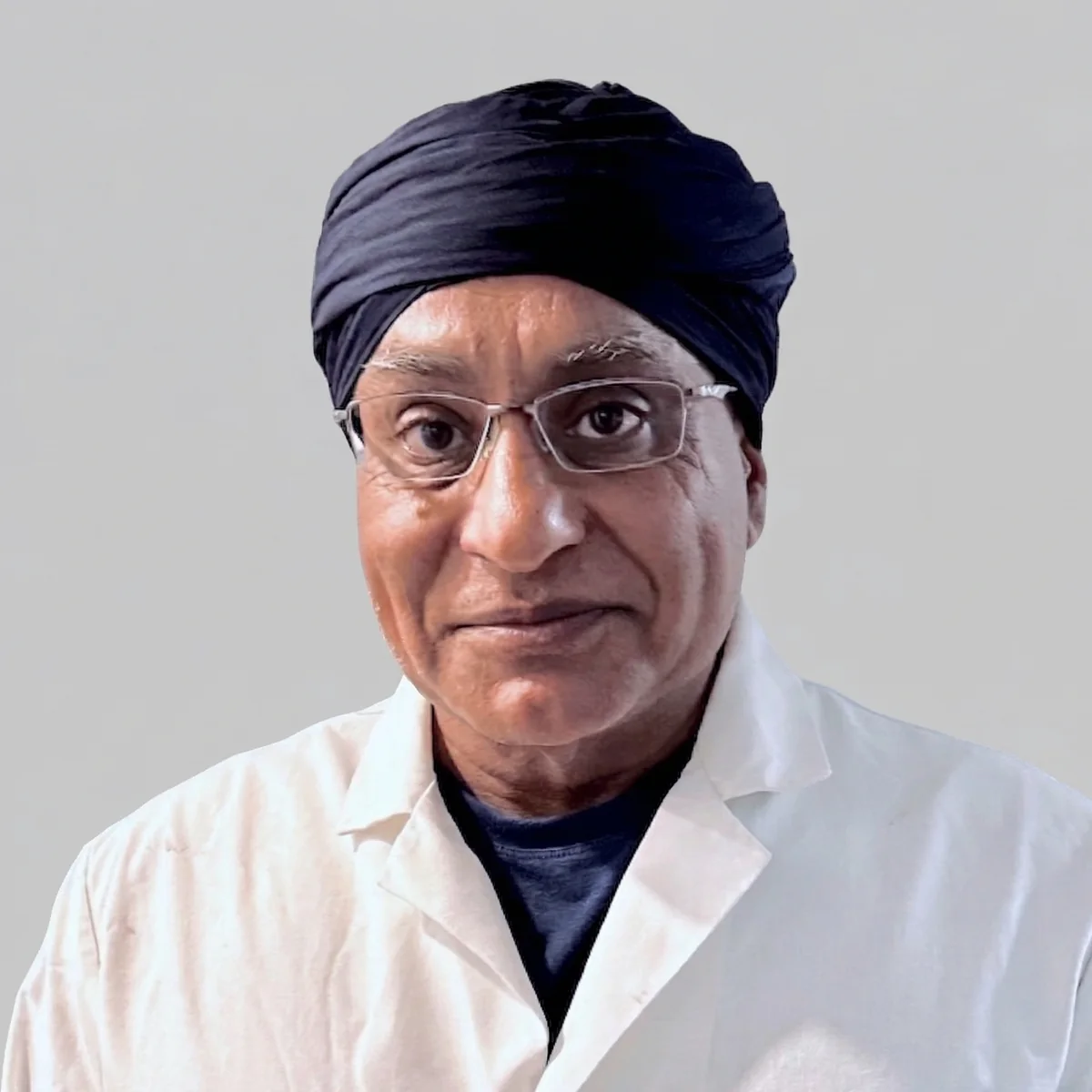
Dr. Gurpreet Singh Padda, MD, MBA, MHP is the founder and Chief Medical Officer of the Padda Institute Center for Interventional Pain Management in St. Louis, Missouri. He has practiced interventional pain medicine in the St. Louis region for more than three decades, and holds diplomate status with five American specialty boards.
Five board certifications, and why the combination matters
Board certification in pain medicine is common among physicians who advertise pain management. This particular combination is not, and it is deliberate rather than decorative.
- American Board of Anesthesiology — Diplomate
- American Board of Interventional Pain Physicians (ABIPP) — Diplomate
- American Board of Pain Medicine — Diplomate
- American Board of Addiction Medicine — Diplomate
- American Board of Obesity Medicine — Diplomate
The anesthesiology and interventional pain certifications cover the procedural work: placing a needle precisely against a named anatomical target, under imaging, safely. The addiction medicine certification covers what actually arrives at a pain clinic, since a meaningful share of chronic pain patients present already on long-term opioids that are no longer helping and cannot be stopped abruptly. The obesity medicine certification covers the metabolic environment the painful structure sits in, because insulin resistance, visceral adiposity and chronic inflammation change how the nervous system processes pain signals.
Most interventional practices refer the second and third of those out. Holding all three means a single physician can manage the whole picture rather than the part that fits the specialty.
Additional certifications
- Competency Certification in Regenerative Medicine in Interventional Pain Management, ABIPP (2024)
- Fellow of Interventional Pain Physicians (FIPP)
- Diplomate, Metabolic Health Practitioner
- Certified Physician Executive (CPE)
- MoCA Certified Rater (Montreal Cognitive Assessment)
Training
- Doctor of Medicine — University of Missouri–Kansas City School of Medicine
- Anesthesiology residency — Washington University / Barnes Hospital, St. Louis
- Master of Business Administration — Saint Louis University
Verify these credentials independently
Credentials are only worth as much as your ability to check them. These are the primary sources, not testimonials:
- Individual NPI 1427035955 — verify in the CMS national provider registry
- Missouri medical license MD 100572 — issued by the Missouri Board of Registration for the Healing Arts
- American Board of Anesthesiology — theaba.org
- American Board of Interventional Pain Physicians — abipp.org
Hospital affiliation: Anderson Hospital, listed under Pain Management.
Independent physician directories carrying his profile include U.S. News, Healthgrades and Doximity.
Published research. His peer-reviewed record is registered under ORCID 0009-0001-0166-3186 and indexed at PubMed, OpenAlex and Semantic Scholar. His biographical record is Wikidata Q141049117.
Professional affiliations
- American Society of Interventional Pain Physicians (ASIPP)
- Society of Metabolic Health Practitioners (SMHP)
- Nutrition Network — advisor
- Low Carb USA — certified
Clinical focus
Dr. Padda’s clinical work centers on treating chronic pain as a problem with structural, neurological and metabolic drivers rather than a symptom to be medicated. In practice that means the diagnostic question comes first: identifying which specific structure is generating the pain, using image-guided injections that double as diagnostic tests, before any treatment is aimed at it.
His areas of concentration include interventional pain management, pain medicine, metabolic health, regenerative medicine, addiction medicine, obesity medicine and anesthesiology. A full account of how that approach is applied at the practice is on the pain management doctors page, and the procedures themselves are indexed in the interventional pain management guide.
Academic and professional leadership
Dr. Padda spent seven years on the faculty of Saint Louis University School of Medicine before moving into full-time interventional pain practice.
- Assistant Professor, Anesthesiology (1992–1999) — Cardinal Glennon Children’s Hospital, Saint Louis University Health Sciences Center
- Assistant Professor, Pediatrics (1993–1999) — Cardinal Glennon Children’s Hospital
- Associate Director, Pediatric Anesthesiology (1995–1999) — Cardinal Glennon Children’s Hospital
- Director, Pediatric Acute Pain Management Service (1995–1999) — Cardinal Glennon Children’s Hospital
- Deputy Director, Institutional Review Board (1998–1999) — Saint Louis University School of Medicine
- Chairman, Department of Anesthesia, Perioperative Medicine and Pain Management — St. Joseph’s Hospital, Kirkwood (1999–2001) and St. Alexius Hospital, St. Louis (2000–2002)
- Faculty, Psychiatry Residency Program (2024–present) — KCU Freeman Health System, pain and addiction
Specialty society leadership:
- President, Missouri Society of Interventional Pain Physicians (2002–2010, and 2023–present)
- Board Member and Examiner, American Board of Interventional Pain Physicians (2007–2009)
- Board of Directors, American Society of Interventional Pain Physicians (2008–2010)
- Director at Large, Missouri Society of Interventional Pain Management (2010–2023)
- Chief Medical Officer, Center for Interventional Pain Management (2001–present)
- Medical Director, Center for Regenerative Medicine (2004–present)
He is licensed to practice medicine in Missouri and Illinois, and has held licensure in Arizona, New Mexico, Georgia and Florida. He is also a Department of Homeland Security–designated Civil Surgeon.
Selected peer-reviewed publications
Dr. Padda has published in anesthesiology, pain medicine, critical care and ophthalmology journals, and has served as a review editor for PharmacoEconomics. Every entry links to the paper itself.
- Padda G. The Future of the Independent Practice after COVID. Pain Physician. 2020;23(4S):S473–S474. PMID 32942810
- Rosen SM, Bromberg TA, Padda G, Barsa J, Dunbar E, Dwarakanath G, Navalgund Y, Jaffe T, Yearwood TL, Creamer M, Deer T. Intrathecal administration of Infumorph® vs compounded morphine for treatment of intractable pain using the Prometra® programmable pump. Pain Medicine. 2013;14(6):865–73. doi:10.1111/pme.12077
- Rauck R, Deer T, Rosen S, Padda G, Barsa J, Dunbar E, Dwarakanath G. Long-term follow-up of a novel implantable programmable infusion pump. Neuromodulation: Technology at the Neural Interface. 2013;16(2):163–7. doi:10.1111/j.1525-1403.2012.00515.x
- Rauck R, Deer T, Rosen S, Padda G, Barsa J, Dunbar E, Dwarakanath G. Accuracy and efficacy of intrathecal administration of morphine sulfate for treatment of intractable pain using the Prometra® Programmable Pump. Neuromodulation: Technology at the Neural Interface. 2010;13(2):102–8. doi:10.1111/j.1525-1403.2009.00257.x
- Rosen S, Deer T, Rauck R, Barsa J, Dwarakanath G, Dunbar E, Padda G. Multi-center evaluation of drug delivery accuracy with the Prometra intrathecal infusion pump. Pain Medicine. 2009;10:124.
- Padda GS, Kishioka C, Rubin BK. Propofol and methohexital have no significant effect on mucus secretion or clearance in the anesthetized dog. Critical Care Medicine. 2001;29(5):1045–8. doi:10.1097/00003246-200105000-00035
- Padda GS, Cruz OA, Silen ML, Krock JL. Skin conductance responses in paediatric Harlequin syndrome. Paediatric Anaesthesia. 1999;9(2):159–62. doi:10.1046/j.1460-9592.1999.9220266.x
- White JM, Siegfried E, Boulden M, Padda G. Possible hazards of cryogen use with pulsed dye laser. A case report and summary. Dermatologic Surgery. 1999;25(3):250–2; discussion 252–3. doi:10.1046/j.1524-4725.1999.08198.x
- Krock JL, Padda GS, Gabriel HF. Defeating proprietary technology. Anesthesiology. 1998;89(5):1292. doi:10.1097/00000542-199811000-00055
- Krock JL, Padda GS, Moore JD. Ohmeda 7900 Ventilator Flow Sensor failure. Anesthesia & Analgesia. 1998;87(1):231–2. doi:10.1097/00000539-199807000-00052
- Padda GS, Cruz OA, Krock JL. Comparison of postoperative emesis, recovery profile, and analgesia in pediatric strabismus repair. Rectal acetaminophen versus intravenous fentanyl-droperidol. Ophthalmology. 1997;104(3):419–24. doi:10.1016/s0161-6420(97)30298-x
- Azzam FJ, Padda GS, DeBoard JW, Krock JL, Kolterman SM. Preoperative pregnancy testing in adolescents. Anesthesia & Analgesia. 1996;82(1):4–7. doi:10.1097/00000539-199601000-00002
- Padda GS, Bowen CH. Anesthetic implication of snake-bite envenomation. Anesthesia & Analgesia. 1995;81(3):649–51. doi:10.1097/00000539-199509000-00043
- Bamshad M, Rosa U, Padda G, Luce M. Acute upper airway obstruction in rheumatoid arthritis of the cricoarytenoid joints. Southern Medical Journal. 1989;82(4):507–11. doi:10.1097/00007611-198904000-00023
He was also a contributor to the Pain Medicine & Interventional Pain Management Board Review Self-Assessment (2011).
National presentations
Dr. Padda has twice delivered the keynote address at the American Society of Interventional Pain Physicians annual conference.
- ASIPP Keynote Speaker, July 2021, New Orleans — “Metabolic Inflammation and the Hedonic Treadmill: Leveraging Inflection Points”
- ASIPP Keynote Speaker, July 2020, Virtual Annual Conference — “Treating Metainflammation and Interventional Pain”
- ASIPP, 2025 — “Revenue Enhancement with Risk Reduction: Measuring Patient Outcomes”
- Society of Metabolic Health Practitioners / Low Carb USA, Boca Conference, January 2025 — “Reimagining Metabolic Health: Scaling Technology-Enabled Solutions”
- ASIPP, 2019 — “Metainflammation,” lecturer
- ASIPP Comprehensive Review Course in Controlled Substance Management, 2007 — lecturer
- ASIPP Comprehensive Pain Medicine Board Review Course, 2006 — lecturer on healthcare ethics, medicolegal issues in pain management and third-party payors
Earlier research was presented at the American Society of Anesthesiologists, the Society for Pediatric Anesthesia, the Society for Ambulatory Anesthesia, the American Academy of Ophthalmology and the American Thoracic Society.
Books
Four titles in The Brain series, published by Nectar Media Group.
- The Dopamine Brain: Wanting: Why You Chase What You Don’t Enjoy (September 2026) — why wanting and liking come apart, and what that does to motivation, appetite and relapse. ISBN 978-0-9832058-3-8.
- The Angry Gut: The First Brain: Older Than Thought, and Still in Charge (September 2026) — with Ami Michelle Grimes; the gut as the older brain, and what it governs before thought arrives. ISBN 978-0-9832058-2-1.
- The Pained Brain: Chronic Pain: Felt in the Body, Made in the Brain (September 2026) — with KrisJay Fucanan, MD; chronic pain as a centralized brain pathology fueled by metabolic inflammation. ISBN 978-0-9832058-1-4.
- The Starved Brain: Modern Nutrition: Overfed but Malnourished (September 2026) — reframing dementia as a metabolic disease of overnutrition, arguing that cognitive decline is driven by the malnutrition of excess. ISBN 978-0-9832058-0-7.
- Next Level Your Life (January 2023) — coauthor; an Amazon best seller in 41 categories.
- The Ideal.Fit Recipe Book: 175 Delicious Keto Recipes (May 2020) — with Ami Hendrix-Grimes.
Community and charitable work
Dr. Padda serves as Chief Medical Officer of Valor Villages, the St. Louis 501(c)(3) nonprofit that houses veterans and children in crisis. Clinical care for that work is delivered through Valor Medica, the partnership’s medical arm and a DBA of Sevadar Foundation Inc., a separate 501(c)(3). Its focus is the medical comorbidities and social determinants of health affecting people moving out of homelessness — the population most housing programs are least equipped to treat.
- Valor Villages Opens Veterans Housing Facility in St. Louis (November 3, 2025) — medical care for formerly unhoused veterans, provided through Valor Medica.
- Valor Villages Receives $200,000 Boost Toward Launch of Sanctuary for Children in Crisis (January 16, 2026) — a seed funding commitment toward the $500,000 needed to open a residence for children in crisis.
- Valor Villages Launches Capital Campaign to Create 24-Bed Home for Unhoused Children (February 18, 2026) — expanding the effort into a 24-bed children’s residence.
Earlier and ongoing service includes medical missions to Honduras, Guatemala and Nicaragua with the Catholic Medical Mission Association; the March of Dimes Program Services and Public Affairs Committees as a nonprofit board director; and board roles with Exoneration Nation, Arise Veterans and U Gro. He serves as Executive Director of the Deva Singh Foundation.
He has also spoken outside medicine on how health, incarceration and financial stability intersect, including a 2019 presentation for Exonerated Nation with Loyola Law School and Kaiser Permanente Northern California Community Benefit Programs.
Press and media
Announcements from the practice are collected under News & Press. Releases are distributed through Nectar Media Group’s EIN Presswire newsroom.
- Dr. Gurpreet Singh Padda, MD Publishes The Pained Brain, Arguing Chronic Pain Is a Metabolic Disease the Scan Cannot See (September 21, 2026) — the second book in The Brain, coauthored with Dr. KrisJay Fucanan, MD: chronic pain as a metabolic disease the scan cannot see. Carried by AP News and The National Law Review.
- Dr. Gurpreet Singh Padda, MD Discusses Alzheimer’s Research, Not Just Plaque (September 21, 2026) — on World Alzheimer’s Day, the case that cognitive decline is a fuel and inflammation failure that starts decades before the plaque. Carried by AP News and The National Law Review.
- International Overdose Awareness Day: Padda Institute Publishes Its Own Opioid Numbers (August 31, 2026) — practice-reported opioid outcomes, and the argument that tapering a dose and treating the pain generator are not the same intervention.
- New Book The Starved Brain by Dr. Gurpreet Padda Reframes Dementia as a Metabolic Disease of Overnutrition (July 23, 2026) — on cognitive decline driven by the malnutrition of excess rather than of scarcity.
- FDA Advisory Committee Convenes on Peptides: Understanding What Reclassification Means (July 20, 2026) — a patient education initiative on peptide sourcing and marketing claims.
- Patients Already on the Knee Replacement Waiting List Find Platelet-Rich Plasma Outperformed Cortisone and NSAIDs (July 19, 2026) — on a randomized trial measuring cartilage breakdown and inflammatory biomarkers.
- Padda Institute Relocates to Expanded State-of-the-Art Facility (March 1, 2026) — the move to the Woodson location, expanding access to hospital-free interventional pain, injury rehabilitation and metabolic health services. Also carried by The National Law Review.
Interviews and speaking
Dr. Padda discusses the intersection of chronic pain, inflammation and metabolic health in long-form conversations, collected under Expert Interviews.
- Why Medications, Procedures, and Surgery May Not Fix Chronic Pain — in conversation with Dr. Tony Hampton, on why pain can persist long after an injury has healed.
- How Inflammation and Diet Drive Chronic Pain and Hormone Problems — on the Low Carb & Fasting podcast, on why stubborn back, neck and migraine pain is often not purely structural.
Writing on pain medicine
Dr. Padda’s clinical commentary on this site is organized by theme: Hidden Drivers of Chronic Pain, Metabolic & Lifestyle Medicine, Interventional Pain Treatments and Opioid Stewardship.
Where he practices
Dr. Padda sees patients at both Padda Institute offices:
- St. Louis (primary): 4477 Woodson Rd, Suite 100, St. Louis, MO 63134
- Natural Bridge Road: 12174 Natural Bridge Rd, St. Louis, MO 63044
Monday through Friday, 8:00 AM to 5:00 PM. Full directions and maps are on the locations page.
Request a consultation
To see Dr. Padda, request an appointment or call (314) 481-5000. Same-day appointments are held for urgent pain problems, and you can also text (314) 886-5902.
Board certifications and professional affiliations
Dr. Gurpreet Singh Padda, MD, MBA, MHP holds five board certifications and maintains the professional affiliations below.