She is thirty-four. The bowel went first: cramping, urgency, mornings planned around a bathroom. The panic followed about a month later, and now she cannot say which one lights the other. A gastroenterologist manages one half of her. A therapist manages the other half. Nobody has drawn the line between them, and the line is a nerve.
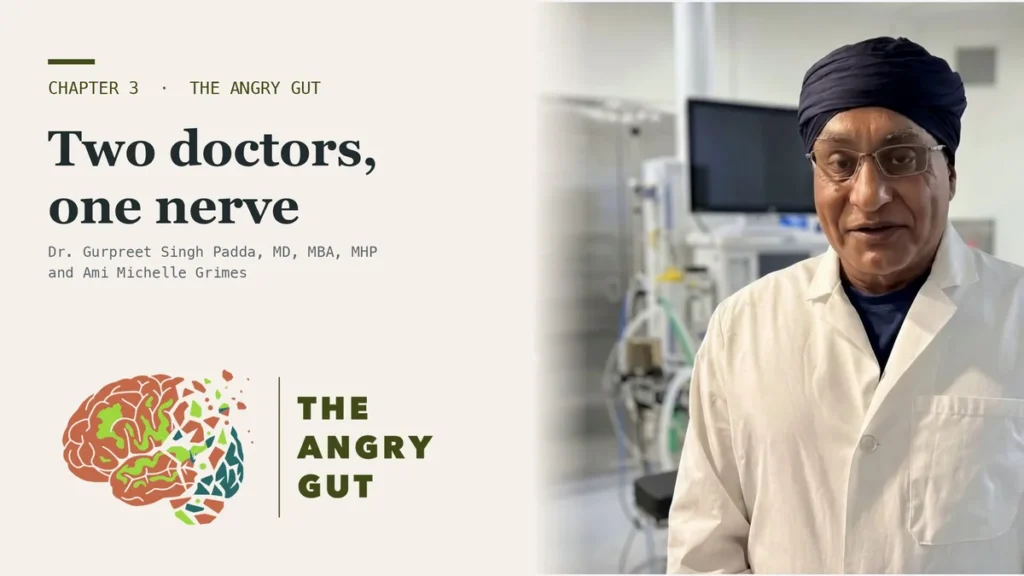
That line is why the vagus nerve and pain belong in the same conversation. In the video Two Doctors, One Nerve, I measured that nerve. What follows goes further for someone who hurts: what the wire carries, what moves it, and what lost to a sham.
A wire built mostly to report
The Angry Gut, by Dr. Gurpreet Singh Padda, MD, MBA, MHP, and Ami Michelle Grimes, calls the gut the first brain and the skull the second brain. The vagus is the cable between them. In the abdomen it is mostly slow, thin sensory fiber, so most of its traffic is news traveling up, not orders traveling down.
For a pain patient, that is the whole point. Pain is an interpretation built from incoming reports. Inflame the first brain and the reports change, and so does the interpretation. No amount of reassurance edits a report that is accurate.
The cleanest human evidence comes from a cohort of people with Crohn's disease, irritable bowel syndrome, or neither. In Crohn's, lower vagal tone went with higher tumor necrosis factor, an inflammatory messenger. In irritable bowel syndrome, lower tone went with higher epinephrine, the adrenaline of sympathetic overdrive. Vagal tone showed no relationship at all with anxiety or depression scores, in any group.
The same investigators found something quieter. Healthy controls with high vagal tone had lower evening cortisol than controls with low tone. In the patients, that coupling had vanished. Not a dial set too low: a circuit that had stopped linking.
The spleen story lost its anatomy, not its point
Ask why a nerve would care about inflammation and most sources give you the inflammatory reflex: the vagus signals the spleen, the spleen calms its macrophages, cytokines fall. I learned it that way, and for years I taught it that way.
The route did not hold. When investigators cut the vagus in rats before an endotoxin challenge, blood tumor necrosis factor did not change. Cutting the greater splanchnic nerve, a sympathetic nerve, sent it up roughly fivefold. In 2026, a four-method anatomical study in male mice found no meaningful vagal motor supply to the spleen at all.
A route fell. The reflex itself survived, running through sympathetic nerves, and the upward arm got stronger. In mice, one line of vagal sensory neurons is tuned to interleukin-10, the calming cytokine. Switching it on cut circulating inflammatory cytokines by more than 80% and protected the animals from colitis. Drive that same circuit during a Salmonella infection, though, and bacterial load climbed sharply. The brake on inflammation is also a brake on defense.
People supply one natural experiment. Surgeons once cut the vagus to treat ulcers, and a Swedish register followed those patients. Crohn's disease rose most after the operation that cut the whole trunk, with a hazard ratio of 3.63, and less after the selective operation that spared the abdominal branches, at 2.06. Absolute risk stayed under one percent. Cut the upward reports, and the gut loses a supervisor.
Why the vagus nerve and pain share one exam room
Put the pieces together and her two diagnoses become one picture, fed by three drivers.
- Inflammatory traffic. An inflamed lining sends cytokine news up a sensory cable, and the second brain turns up the gain on everything, including pain from the abdomen.
- Sympathetic overdrive. Adrenaline rises as vagal tone falls. The accelerator is down while the brake is off, and a body in that state guards, tenses and sleeps badly.
- A system that bills by organ. The bowel goes to one office and the panic to another, and nobody is paid to examine the wire. Two copays, two plans, one untreated loop.
Therapy stays in the plan. Acceptance and Commitment Therapy teaches the second brain to stop amplifying the alarm. It cannot, by itself, change what an inflamed first brain is reporting. Both ends of the wire need work.
Ear clip versus needles: what the sham arms showed
If the wire matters, can you move it? The best-controlled answer comes from rheumatoid arthritis, not the gut. An implanted neck stimulator beat sham in 242 patients, with response at three months of 35.2% against 24.2%. Its approval is narrow: adults who already failed advanced drug therapy.
The surface ear clip, tested with the same rigor in the same disease, did not work. Response was 25.0% with active stimulation and 26.9% with sham.
Needles through the skin of the ear are a different intervention, and they were tested in abdominal pain. In a sham-controlled trial of 115 adolescents with functional abdominal pain, a composite pain score fell from 24.5 to 8.4 with treatment and from 22.8 to 15.2 with sham. In the irritable bowel subgroup, 59% reached at least a 30% drop in worst pain, against 26% on sham.
The fuller record keeps this honest. In a registry of 292 children across seven centers, 61% had already failed four or more drugs, which tells you who actually ends up with the device. And 28% of treated children developed a tender ear, and those children did worse.
The device I use, and the limits I put on it
One device in this class is part of our practice: the NS100 [temporary percutaneous auricular nerve stimulator]. Four titanium electrodes go through the skin of the ear onto vagal and trigeminal branches, stimulate for 19 days, and come out.
Its published record is a retrospective chart review with no control group: 91 adult Native Americans living with type 2 diabetes and severe neuropathic pain. Pain scores fell from 7.92 to 1.04 at 90 days, and hemoglobin A1c fell from 8.9% to 5.8%. Patients were followed an average of 227 days. The authors name placebo response and regression to the mean as confounders they could not exclude.
That is a modest evidence tier, stated plainly. It is also built from the patient most trials screen out: diabetes and severe nerve pain in one body. I read it as two separate effects, one on blood sugar and one on neuropathic pain, neither the cause of the other. For burning feet from diabetes, the lasting repair is metabolic, which is why we treat the neuropathy and the blood sugar together.
One more finding keeps me from overselling any device. Pooled across 15 studies of every stimulation method, tumor necrosis factor, interleukin-6 and interleukin-1 beta showed no significant change, and studies at higher risk of bias reported bigger effects. Every device here is a bridge. It buys a calmer signal while the terrain producing the signal gets repaired.
What you can do with a nerve you cannot see
Breathing is still worth teaching, for a mechanical reason. In a randomized trial of 60 patients with reflux-driven chronic cough, diaphragm training raised the electrical activity of the diaphragm itself, the muscle that supports the valve at the bottom of the esophagus. Breathing earns its place. A stronger nerve is not why.
Practical steps:
- Treat the bowel and the anxiety as one case.
- If you wear a heart rate variability tracker, compare yourself with yourself, at the same time and in the same position. It reads the vagus at the heart, not at the gut.
- Before any device, ask three things: is it cleared for this condition at my age, what happened in the sham group, and was the outcome a symptom score or something a camera or lab measured.
- Look at what is feeding the first brain its bad news. The medicine cabinet is one source, covered in what a bag of nine prescriptions does to the gut lining. What slips through a damaged gut wall is another, in what crosses the intestinal barrier.
Every study behind these numbers, with what each one does and does not show, is in the Chapter 3 Deep Dive, including the trials that cut against the argument, along with questions worth taking to your physician. Change what the gut reports and the message on the wire changes. Keep treating the two ends separately, and you keep paying for the loop.
Frequently asked questions
Can IBS cause anxiety?
It can feed it. In irritable bowel syndrome, lower vagal tone tracks higher adrenaline, and the nerve between gut and skull mostly carries reports upward, so an irritated bowel keeps the second brain on alert. Anxiety scores did not track vagal tone in that research, which suggests the gut signal matters more than mood alone. Treat both ends at once. See how anxiety and chronic pain are treated as one problem.
Do ear vagus nerve stimulators work for pain?
It depends on the kind. A surface ear clip lost to sham in a rigorous rheumatoid arthritis trial. Stimulation through fine needles in the ear beat sham for abdominal pain in adolescents, and helped after two of three surgeries in adults. Ask whether a device goes through the skin, what condition it was tested in, and how the sham group did. Here is what a temporary nerve stimulator is actually testing.
Does low vagal tone cause inflammation?
The two travel together, and the influence runs both ways. In Crohn's disease, lower vagal tone went with higher tumor necrosis factor in the blood. In mice, cutting the upward vagal fibers stopped the brainstem from registering inflammation, and in people whose vagus was cut for ulcers, Crohn's disease became more common. Low tone is a marker worth taking seriously, not a diagnosis. Metabolic inflammation is the larger engine behind it.
Can breathing exercises stimulate the vagus nerve?
Breathing changes heart rate variability, but training named after vagal tone has not reliably raised the vagal index. In heart patients, biofeedback lowered blood pressure while high-frequency power did not move. Breathing still earns a place, especially diaphragm training for reflux-related symptoms, for mechanical reasons rather than a stronger nerve. Sleep and chronic pain run the same loop in both directions.
Can vagus nerve stimulation help diabetic nerve pain?
One chart review of 91 adults with type 2 diabetes and severe neuropathic pain reported large drops in pain scores and in hemoglobin A1c after a temporary ear stimulator. There was no control group, so placebo response and regression to the mean cannot be excluded. It is a promising bridge, not a replacement for repairing blood sugar. Why diabetic nerve pain burns at night.
One nerve, one evaluation
If your gut symptoms and your pain are being managed in separate offices, we will look at the wire between them and at what keeps feeding it bad news.
Request an appointment, call (314) 481-5000, or text (314) 886-5902.
Sources
- Pellissier, S., Dantzer, C., Mondillon, L., Trocme, C., Gauchez, A.-S., Ducros, V., Mathieu, N., Toussaint, B., Fournier, A., Canini, F., & Bonaz, B. (2014). Relationship between vagal tone, cortisol, TNF-alpha, epinephrine and negative affects in Crohn’s disease and irritable bowel syndrome. PLoS One, 9(9), e105328. https://doi.org/10.1371/journal.pone.0105328
- Martelli, D., Yao, S. T., McKinley, M. J., & McAllen, R. M. (2014). Reflex control of inflammation by sympathetic nerves, not the vagus. The Journal of Physiology, 592(7), 1677–1686. https://doi.org/10.1113/jphysiol.2013.268573
- Jin, H., Li, M., Jeong, E., Castro-Martinez, F., & Zuker, C. S. (2024). A body-brain circuit that regulates body inflammatory responses. Nature, 630(8017), 695–703. https://doi.org/10.1038/s41586-024-07469-y
- Liu, B., Wanders, A., Wirdefeldt, K., Sjölander, A., Sachs, M. C., Eberhardson, M., Ye, W., Ekbom, A., Olén, O., & Ludvigsson, J. F. (2020). Vagotomy and subsequent risk of inflammatory bowel disease: a nationwide register-based matched cohort study. Alimentary Pharmacology & Therapeutics, 51(11), 1022–1030. https://doi.org/10.1111/apt.15715
- Baker, M. C., Kavanagh, S., Cohen, S., Matsumoto, A. K., Dikranian, A., Tesser, J., Kivitz, A., Alataris, K., & Genovese, M. C. (2023). A randomized, double-blind, sham-controlled, clinical trial of auricular vagus nerve stimulation for the treatment of active rheumatoid arthritis. Arthritis & Rheumatology, 75(12), 2107–2115. https://doi.org/10.1002/art.42637
- Kovacic, K., Hainsworth, K., Sood, M., Chelimsky, G., Unteutsch, R., Nugent, M., Simpson, P., & Miranda, A. (2017). Neurostimulation for abdominal pain-related functional gastrointestinal disorders in adolescents: A randomised, double-blind, sham-controlled trial. The Lancet Gastroenterology & Hepatology, 2(10), 727–737. https://doi.org/10.1016/S2468-1253(17)30253-4
- Krasaelap, A., Sood, M. R., Li, B. U. K., Unteutsch, R., Yan, K., Nugent, M., Simpson, P., & Kovacic, K. (2020). Efficacy of auricular neurostimulation in adolescents with irritable bowel syndrome in a randomized, double-blind trial. Clinical Gastroenterology and Hepatology, 18(9), 1987–1994.e2. https://doi.org/10.1016/j.cgh.2019.10.012
- Staats, P. S., Staats, A., Mikhaiel, B., Chen, J., Azabou, E., & Rangon, C.-M. (2025). Combined minimally invasive vagal cranial nerve and trigeminocervical complex peripheral nerve stimulation produces prolonged improvement of severe painful peripheral neuropathy and hyperglycemia in type 2 diabetes. Frontiers in Neuroscience, 19, 1644961. https://doi.org/10.3389/fnins.2025.1644961
- de Melo, P. S., Gianlorenco, A. C., Marduy, A., Kim, C. K., Choi, H., Song, J.-J., & Fregni, F. (2024). A mechanistic analysis of the neural modulation of the inflammatory system through vagus nerve stimulation: A systematic review and meta-analysis. Neuromodulation: Journal of the International Neuromodulation Society, 28(1), 43–53. https://doi.org/10.1016/j.neurom.2024.03.002
- Kox, M., van Eijk, L. T., Zwaag, J., van den Wildenberg, J., Sweep, F. C., van der Hoeven, J. G., & Pickkers, P. (2014). Voluntary activation of the sympathetic nervous system and attenuation of the innate immune response in humans. Proceedings of the National Academy of Sciences of the United States of America, 111(20), 7379–7384. https://doi.org/10.1073/pnas.1322174111
Dr. Gurpreet Singh Padda, MD, MBA, MHP