Search for leaky gut symptoms and you get a long list of complaints. Almost everyone in chronic pain already has them. That is exactly why the list diagnoses nothing. A symptom tells you something is wrong. It does not tell you the gut wall is the reason.
The research offers something shorter and more useful. It names everyday exposures that measurably open the human gut wall. And it gives a short list of what follows when bits of bacteria get through:
- fever and an inflammatory surge
- falling insulin sensitivity
- slipping attention after a meal
- immune reactions in the lining within minutes of a food trigger
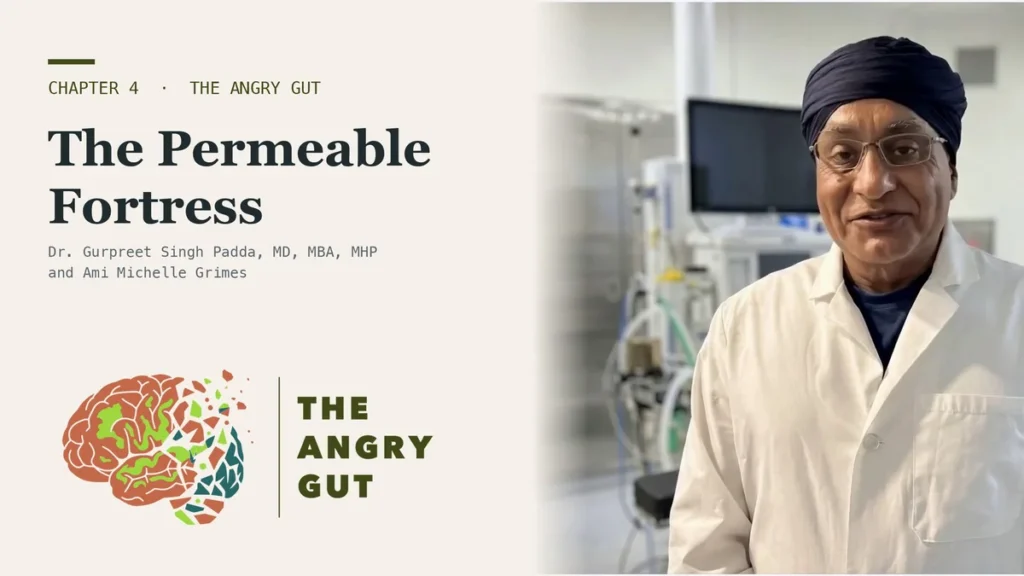
The video above is Chapter 4 of The Angry Gut, by Dr. Gurpreet Singh Padda, MD, MBA, MHP, and Ami Michelle Grimes. For a pain patient, what matters most is not the anatomy of the wall. It is how many of the things you do to survive a painful week are the same things that open it.
Leaky gut symptoms are not a checklist
The gut lining is one cell thick. It is the outer surface of the first brain. Its seal lives in the claudins, the proteins that keep the gaps between cells closed. When that seal loosens, what you feel depends on what gets across and on the immune cells waiting behind it.
Some reactions can be filmed. Doctors used a laser camera scope (a confocal laser endomicroscope). They dripped food proteins onto the gut lining of people with irritable bowel syndrome. Seventy-six of 108 reacted within minutes, most often to wheat. Biopsies showed the reactors had more claudin-2 (Fritscher-Ravens et al., 2019). The reactors also had more immune cells inside the lining, P = .001. Forty-seven of the 155 people enrolled never finished, so the true share is uncertain.
Now the counterexample. Nineteen women with constipation-type irritable bowel syndrome were compared with 18 healthy women. Researchers used five different methods, from tissue resistance in a chamber to sugar recovery in urine. Every method found a normal wall (Peters et al., 2017). The one problem was in fluid release, not structure. Same diagnosis, and the wall was intact.
The painkiller on the counter
In healthy volunteers, a single dose of an anti-inflammatory drug more than doubled small-bowel leakiness, from 0.030 to 0.071 on the sugar test (Vanuytsel et al., 2014). One dose, in people with no pain and no gut disease.
Bring that into a pain practice. Many people who come to us have taken an anti-inflammatory most days for years. They take it for a pain whose source nobody traced. It is a good drug. After an injury, for a week, it does exactly its job. But as a permanent floor under an unexplained pain, it holds a gate open that nobody is watching. In people with type 2 diabetes, the heart risk is its own problem, covered in our review of NSAIDs and heart failure risk.
The habit has a money engine. A bottle on a pharmacy shelf takes less time than a workup. And a system paid per visit rewards the refill over asking why the pain is still there. None of this is a reason to stop a medicine on your own. It is a reason to put the daily dose on the table with your physician and ask what the plan is for the cause.
Stress, and a finding that did not hold
Stress belongs on the list, and the evidence is messier than most accounts admit. In the first experiment, giving a public speech raised small-bowel leakiness to 0.059. An infusion of corticotropin-releasing hormone, the chemical that starts the stress response, did the same. A mast cell stabilizer blocked it (Vanuytsel et al., 2014).
I repeated that mast cell story for years as if it were settled. It is not. The same lab ran a double-blind rematch in 20 healthy volunteers. They gave 100 micrograms of the hormone into a vein and checked gut biopsies directly. Leakiness did not change. Mast cell counts did not move. Put straight on the tissue in a chamber, the hormone did lower barrier resistance, P = 0.010. And a mast cell blocker failed to stop it (Schol et al., 2025).
The fair summary: stress chemistry can open the wall under some conditions, and the mast cell explanation is no longer solid. For someone in chronic pain, that makes stress a body input to treat, not a character flaw.
What crosses the wall reaches a body already in pain
Endotoxin is a piece of the outer coat of certain gut bacteria. The immune system treats it as an invasion. Give 3 ng/kg into a vein in healthy volunteers, and they get a short, real illness. Interleukin-6, an inflammation signal, climbed from 3.2 to 1,607 at two hours. Core temperature rose from 36.5 to 37.7 degrees C. A day later, insulin sensitivity was down 35%, while the pancreas kept making insulin normally (Mehta et al., 2010).
Fever, an inflammatory surge and insulin resistance, in people, from one exposure. That dose is far bigger than anything a meal delivers, and that limit matters. But the direction still matches what we see. Insulin resistance shows up again and again in patients whose pain will not settle. The mechanism is laid out in how high insulin makes you hurt.
Everyday doses are smaller and more frequent. After one evening of vodka at 2 ml per kilogram of body weight, blood endotoxin rose in 25 healthy adults within 30 minutes. Bacterial DNA was still in the blood at 24 hours. Women took up more than men from the same weight-adjusted dose (Bala et al., 2014). Food moves the same system. Eighteen healthy men ate 760 extra calories a day for eight weeks. Their endotoxin after meals rose 160%. Yet only four of the eight men in the meal group mounted an inflammatory response (Laugerette et al., 2014).
That split is what most accounts miss. Exposure is not response. Everyone got the bacterial pieces. What differed was the terrain receiving them. That is why the same week hurts two people differently.
The second brain notices too. In one study, 51 women ate a high-saturated-fat meal and a high-oleic-oil meal on different days. Women with higher starting levels of LBP, the protein that carries endotoxin, had less steady attention after eating. Where LBP was high, the better oil lost its edge (Madison et al., 2020). Endotoxin itself was not measured, so read it as a signal, not proof.
When the gut is not the whole answer
A leaky wall is one road in, never the only one. Look at healthy relatives of people with Crohn’s disease. Those from families with several affected members had the highest risk. Yet their gut walls were no leakier than lower-risk relatives. What set them apart was low-grade inflammation and the bacteria living against the wall (Olivera et al., 2025).
Pain works the same way. A scan, a lab or a gut test can each point at something real that is not the whole story. That is the trap described in why your scan does not match your pain. The signal from the gut reaches the second brain by the vagus nerve, the tether traced in the previous chapter on the first brain and its wiring.
Closing the gates in a pain practice
Order matters. The wall gets attention early, because treatment stacked on an open gate keeps washing out. That starts with an honest look at your week. The daily anti-inflammatory and what it is covering. The drinks. The large fat-and-sugar meals. The heat loads. And a stress response that never switches off. Each has a measured effect in human volunteers.
Lifestyle work here is treatment, not aftercare, and each piece has a body-based reason. Smaller, whole-food meals avoid the endotoxin surge after meals that overeating causes. Managing stress chemistry removes one hormone key to the gate. And procedures that calm a pain source can cut the need for a daily anti-inflammatory. That removes the most common chemical key of all. The injection is not the treatment. It buys the window in which the gut, the metabolism and the nervous system can be retrained.
Then comes what already leaked through: the insulin resistance and the inflammation feeding sensitized nerves. That is covered in how metabolic inflammation sustains chronic pain. Every study above, including the failed rematch and the strongest case against the endotoxin story, is laid out with its full numbers in the Chapter 4 Deep Dive.
Frequently asked questions
Can leaky gut cause body aches and fatigue?
It can play a part, though symptoms alone cannot prove it. Healthy volunteers were given bacterial endotoxin, the piece that crosses a loosened gut wall. Within a day they had fever, a big inflammatory surge and lower insulin sensitivity. Those are the makings of feeling unwell. The same aches have many other causes. That is why a careful workup matters, as our guide to evaluating widespread pain explains.
Does ibuprofen cause leaky gut?
Anti-inflammatory drugs in that class open the gut wall measurably. In healthy volunteers, one dose more than doubled small-bowel leakiness on a sugar test. Short courses for an injury are what these drugs are for. The concern is the daily dose taken for years with no plan for the cause. Do not stop or change a medicine on your own. Review it with your physician, and read what long-term NSAID use does to the heart in diabetes.
Can stress cause leaky gut?
Sometimes. Public speaking raised small-bowel leakiness in healthy volunteers. A stress hormone infusion did the same in the first study. A later double-blind rematch from the same lab found no change in gut leakiness. So the mechanism is not settled. Chronic stress is still a body load worth treating, and loneliness is one of the heaviest, as social isolation as an inflammatory state describes.
Does alcohol make the gut leak?
Yes, and fast. In healthy adults, a single evening of heavy drinking raised blood endotoxin within half an hour. It left bacterial DNA in the blood the next day. Women were hit harder than men at the same weight-adjusted dose. For people in chronic pain, alcohol adds a second problem through its breakdown products, explained in alcohol, acetaldehyde and chronic pain.
Where does endotoxin from the gut go first?
To the liver. Blood draining the bowel travels through the portal vein to the liver before it reaches the heart or the rest of the body. So the liver filters bacterial pieces around the clock. When that filter is loaded with fat, things change. A fatty liver can form in people who never drink. That story is told in the next chapter on fatty liver and gut-made alcohol.
Find out what your week is doing to your pain
We look at the daily medicines, the gut, the metabolism and the pain source together. Treating one while the others keep the gate open does not hold.
Request an appointment, or call or text us.
Sources
- Vanuytsel, T., van Wanrooy, S., Vanheel, H., Vanormelingen, C., Verschueren, S., Houben, E., Salim Rasoel, S., Toth, J., Holvoet, L., Farre, R., Van Oudenhove, L., Boeckxstaens, G., Verbeke, K., & Tack, J. (2014). Psychological stress and corticotropin-releasing hormone increase intestinal permeability in humans by a mast cell-dependent mechanism. Gut, 63(8), 1293–1299. https://doi.org/10.1136/gutjnl-2013-305690
- Schol, J., Huang, I.-H., Balsiger, L., Toth, J., Van den Houte, K., Verheyden, A., Raymenants, K., Broeders, B., Vanuytsel, T., & Tack, J. (2025). The effect of corticotropin-release hormone on duodenal permeability and immune activation in healthy volunteers in a double-blind placebo-controlled study. American Journal of Physiology. Gastrointestinal and Liver Physiology, 328(5), G457–G464. https://doi.org/10.1152/ajpgi.00130.2024
- Mehta, N. N., McGillicuddy, F. C., Anderson, P. D., Hinkle, C. C., Shah, R., Pruscino, L., Tabita-Martinez, J., Sellers, K. F., Rickels, M. R., & Reilly, M. P. (2010). Experimental endotoxemia induces adipose inflammation and insulin resistance in humans. Diabetes, 59(1), 172–181. https://doi.org/10.2337/db09-0367
- Bala, S., Marcos, M., Gattu, A., Catalano, D., & Szabo, G. (2014). Acute binge drinking increases serum endotoxin and bacterial DNA levels in healthy individuals. PLoS One, 9(5), e96864. https://doi.org/10.1371/journal.pone.0096864
- Laugerette, F., Alligier, M., Bastard, J.-P., Drai, J., Chanséaume, E., Lambert-Porcheron, S., Laville, M., Morio, B., Vidal, H., & Michalski, M.-C. (2014). Overfeeding increases postprandial endotoxemia in men: Inflammatory outcome may depend on LPS transporters LBP and sCD14. Molecular Nutrition & Food Research, 58(7), 1513–1518. https://doi.org/10.1002/mnfr.201400044
- Madison, A. A., Belury, M. A., Andridge, R., Shrout, M. R., Renna, M. E., Malarkey, W. B., Bailey, M. T., & Kiecolt-Glaser, J. K. (2020). Afternoon distraction: A high-saturated-fat meal and endotoxemia impact postmeal attention in a randomized crossover trial. The American Journal of Clinical Nutrition, 111(6), 1150–1158. https://doi.org/10.1093/ajcn/nqaa085
- Fritscher-Ravens, A., Pflaum, T., Mösinger, M., Ruchay, Z., Röcken, C., Milla, P. J., Das, M., Böttner, M., Wedel, T., & Schuppan, D. (2019). Many patients with irritable bowel syndrome have atypical food allergies not associated with immunoglobulin E. Gastroenterology, 157(1), 109–118.e5. https://doi.org/10.1053/j.gastro.2019.03.046
- Peters, S. A., Edogawa, S., Sundt, W. J., Dyer, R. B., Dalenberg, D. A., Mazzone, A., Singh, R. J., Moses, N., Smyrk, T. C., Weber, C., Linden, D. R., MacNaughton, W. K., Turner, J. R., Camilleri, M., Katzka, D. A., Farrugia, G., & Grover, M. (2017). Constipation-predominant irritable bowel syndrome females have normal colonic barrier and secretory function. The American Journal of Gastroenterology, 112(6), 913–923. https://doi.org/10.1038/ajg.2017.48
- Olivera, P. A., Martinez-Lozano, H., Leibovitzh, H., Xue, M., Neustaeter, A., Espin-Garcia, O., Xu, W., Madsen, K. L., Guttman, D. S., Bernstein, C. N., Yerushalmi, B., Hyams, J. S., Abreu, M. T., Marshall, J. K., Wrobel, I., Mack, D. R., Jacobson, K., Bitton, A., Aumais, G., … Croitoru, K. (2025). Healthy first-degree relatives from multiplex families vs simplex families have higher subclinical intestinal inflammation, a distinct fecal microbial signature, and harbor a higher risk of developing Crohn’s disease. Gastroenterology, 168(1), 99–110.e2. https://doi.org/10.1053/j.gastro.2024.08.031
Dr. Gurpreet Singh Padda, MD, MBA, MHP