She is on her third biologic for Crohn’s disease. The first one quit after two years, the second one triggered antibodies, and the third is working. What she brought into my exam room was not the disease. It was the fear of the day the third drug stops.
Across eight years and four gastroenterologists, every part of her care was aimed at her immune system. Nobody asked what she ate, how she slept, or what the fat around her bowel was doing. An immune-only plan never needs those answers, so the questions never came up.
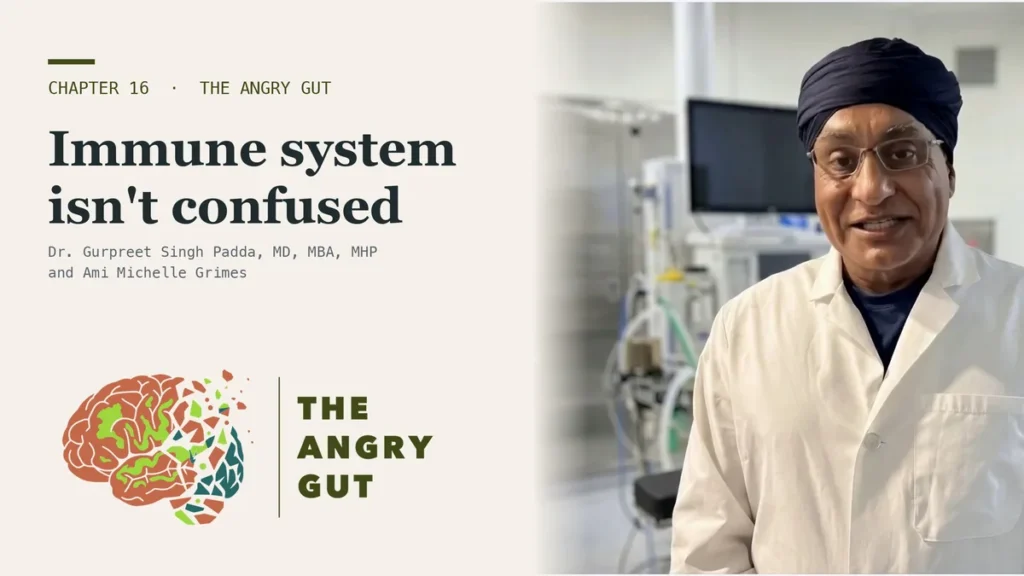
I’m Dr. Gurpreet Singh Padda, MD, MBA, MHP, and I wrote The Angry Gut with Ami Michelle Grimes. The video for Chapter 16, Your Immune System Is Not Confused, tells her story. Here I go where the video had no room: biologics for Crohn’s disease, how long they hold, what they cost the body, and what a pain practice does with the time they buy.
Your gut is your first brain, tethered by the vagus to the second brain in your skull. Years of inflammation in the first are felt in the second as pain and exhaustion.
Why biologics for Crohn’s disease work, and where they stop
Nothing here is a reason to stop a biologic. They hold an inflamed bowel still while it is still a working bowel. In the phase 3 induction trials of risankizumab, 45% of people with Crohn’s disease reached clinical remission by week 12, against 25% on placebo.
The ceiling arrives on schedule, though. A pooled analysis of 86 studies of anti-TNF drugs in Crohn’s disease found that among people who responded at first, loss of response reached 33% on infliximab, 30% on adalimumab and 41% on certolizumab pegol. About 34% needed a higher dose by a median of one year.
On a calendar, that works out to about 20.9% per patient-year. Roughly one person in five loses response each year. Her fear is the base rate.
The drugs also carry a bill. Among people with inflammatory bowel disease, lymphoma ran at 0.26 per 1000 person-years without these drugs, 0.41 on anti-TNF therapy alone, 0.54 on a thiopurine alone and 0.95 on both. In Swedish registers, serious infection on vedolizumab for Crohn’s disease ran at 5.18 per 100 person-years, against 0.75 in a matched general population.
Those terms are worth accepting. They are not a cure. A system paid per infusion has little reason to ask what lit the fire, so that question waits until the drug fails.
Antibodies against the drug are a base rate, not bad luck
Her second biologic failed because her immune system learned to recognize the drug itself. Patients often hear that as a personal defect. It is closer to a statistic.
A meta-analysis of 33 studies and 5,850 patients with inflammatory bowel disease measured how often anti-drug antibodies form on a single drug: 28.0% with infliximab, 7.5% with adalimumab, 6.2% with ustekinumab and 8.4% with vedolizumab. Once antibodies appeared, clinical response dropped (RR 0.75) and infusion reactions rose (RR 2.36). Adding an immunomodulator lowered antibody formation with infliximab (RR 0.52) and with adalimumab (RR 0.31).
Assays differ and some miss antibodies, so read those percentages as floors. The add-on that protects the drug brings its own lymphoma trade-off, and both facts belong in one conversation. If a biologic has faded, ask whether drug levels and antibodies were ever checked.
Choosing the next drug: what head-to-head trials found
In 386 adults with Crohn’s disease who had never taken a biologic, ustekinumab and adalimumab tied. Clinical remission at week 52 was 65% against 61% (p=0.42). The real gap was staying on treatment: 15% stopped ustekinumab early, against 24% on adalimumab.
In ulcerative colitis, 769 patients were randomized to vedolizumab or adalimumab. Vedolizumab won the headline, with remission at week 52 of 31.3% against 22.5%. Remission without corticosteroids was 12.6% on vedolizumab and 21.8% on adalimumab. The winner lost the steroid question, in a trial funded by the winner’s maker.
A network meta-analysis of 31 randomized trials in Crohn’s disease adds the finding I wish every clinic read aloud: in maintenance trials, the active drugs showed no differences. Drugs differ at getting you into remission. Once you are there, they look alike. That is why the plan for the day a biologic fades cannot be only another biologic.
Blocking one inflammatory signal has been tried in people
If a cytokine is the problem, why not block it? That has been tested in people.
Etanercept, a tumor necrosis factor blocker, went to 56 people with metabolic syndrome for four weeks. C-reactive protein fell sharply. Body composition and insulin sensitivity did not budge. Six months of it in 40 obese adults lowered fasting glucose and changed nothing structural. Canakinumab, given to 10,061 patients after a heart attack, cut cardiovascular events at a hazard ratio of 0.85. Deaths did not fall, and fatal infections rose.
Each attempt moved a marker. None repaired the ground underneath.
Why a pain practice watches the fat around the bowel
Belly fat is not a storage closet. It is immune tissue, and where it drains decides who hears it.
In severely obese adults having bariatric surgery, blood from the portal vein, which carries belly fat drainage straight to the liver, held about 50% more interleukin-6 than arterial blood. In mice, the same inflamed fat grafted where it drains to the liver caused insulin resistance. Grafted where it drains to the rest of the body, it did not. Fat taken from mice lacking interleukin-6 caused no such damage.
Under the skin, fat releases interleukin-6 but not tumor necrosis factor. The cytokine everyone names stays home; interleukin-6 is the one fat broadcasts. That broadcast reaches a nervous system already turned up by years of pain. So in our practice, a normal weight never ends the question. We look for the belly fat that feeds pain signals before we call anyone metabolically quiet. And the excess is not a character flaw. It is delivered: acellular carbohydrates and industrial seed oils, subsidized into the cheapest calories in the store, the same foods behind the hedonic substitution we see in pain patients.
A common pill that quietly breaks the small bowel
Low-dose daily aspirin looks harmless. In 205 people taking it for more than three months, capsule endoscopy found at least one break in the small bowel lining in 114 of 198 (57.6%). Most of them had no idea.
Proton pump inhibitor use carried an odds ratio of 2.04 for these breaks, and enteric-coated aspirin, which dissolves farther down, carried 4.05. The patients were older Japanese adults and the design was cross-sectional, so this is association, not cause. Upper endoscopy and colonoscopy never reach the small bowel. If you take daily aspirin and have unexplained anemia or belly pain, ask whether that stretch was ever examined, and change nothing without your physician.
What to do with the time the drug buys
I told her to stay on her biologic. Quitting a working drug to prove a point about food is how people lose a colon. Then we wrote the part of the plan nobody had written.
- Measure the terrain. Ask which fat was measured. If you have ever had a CT or MRI, ask whether the visceral fat was described in the report.
- Change what the lining is shown. In celiac disease, a gluten-free diet fully heals the lining in 0.65 of children but only 0.24 of adults. Removing a trigger works, and it works best early. What the modern plate does to an inflamed gut covers the food side.
- Fix the clock. Sleep debt is part of what the first brain is being shown. How a rotating work schedule sets up Crohn’s flares is next in the series.
- Treat behavior as treatment. Food, sleep, movement and connection change the inflammatory load the nervous system processes, so they belong in the protocol.
Doing nothing with the time costs a fourth biologic. For the wider thread, see how one inflammatory engine connects pain, opioids and diabetes. The Chapter 16 Deep Dive lays out every trial above in full, including what each one fails to prove.
Frequently asked questions
How long do biologics for Crohn’s disease usually keep working?
It varies widely from person to person. In pooled anti-TNF studies in Crohn’s disease, about a third of people who responded at first had lost that response by a median of one year, close to one in five per patient-year. Sleep timing is one variable almost nobody manages alongside the drug, and the link between shift work and Crohn’s flares explains why.
Why does the body make antibodies against a biologic?
The immune system can learn to treat the drug as foreign. Across 33 studies, antibody rates on a single drug ran from 6.2% with ustekinumab to 28.0% with infliximab, and those antibodies lowered response and raised infusion reactions. Adding an immunomodulator cuts the rate, with a lymphoma trade-off to weigh with your gastroenterologist. Why we treat insulin before we treat the joint shows the same whole-body logic.
Can changing my diet replace a biologic for Crohn’s disease?
Do not stop a working biologic to test a diet. Food change belongs alongside the drug, not in place of it. In celiac disease and eosinophilic esophagitis, removing a food trigger heals tissue, although adults heal less completely than children. The trial that would show trigger removal alone heals established Crohn’s disease has not been done. How the modern diet inflames the gut covers what to change.
Can daily low-dose aspirin damage the small intestine?
It can. In 198 long-term low-dose aspirin users examined by capsule endoscopy, 57.6% had at least one break in the small bowel lining, and enteric coating was tied to more breaks, not fewer. The patients were older and the study was cross-sectional, so it shows association. Never stop aspirin on your own. Why a breach in the gut barrier matters explains the stakes.
Is belly fat really an immune organ?
In practical terms, yes. In obese patients, fat inside the abdomen held twice as many macrophages as fat under the skin, and that burden tracked fasting glucose, insulin sensitivity and liver injury. Visceral fat also sends interleukin-6 straight to the liver through the portal vein. A bathroom scale cannot see any of this. Why fat behaves like an immune organ goes deeper.
Your biologic is holding. Use the time.
If you live with Crohn's disease and chronic pain, we look at the whole terrain around the drug: the fat, the sleep, the food and the nervous system that has been listening to all of it.
Request an appointment, call (314) 481-5000, or text (314) 886-5902.
Sources
- Bots, S. J., Parker, C. E., Brandse, J. F., Löwenberg, M., Feagan, B. G., Sandborn, W. J., Jairath, V., D’Haens, G., & Vande Casteele, N. (2021). Anti-drug antibody formation against biologic agents in inflammatory bowel disease: A systematic review and meta-analysis. BioDrugs, 35(6), 715-733. https://doi.org/10.1007/s40259-021-00507-5
- Endo, H., Sakai, E., Taniguchi, L., Kessoku, T., Komiya, Y., Ezuka, A., Kawamura, H., Taguri, M., Higurashi, T., Ohkubo, H., Yamada, E., Takahashi, H., Inamori, M., Maeda, S., Sakaguchi, T., Hata, Y., Nagase, H., & Nakajima, A. (2014). Risk factors for small-bowel mucosal breaks in chronic low-dose aspirin users: Data from a prospective multicenter capsule endoscopy registry. Gastrointestinal Endoscopy, 80(5), 826-834. https://doi.org/10.1016/j.gie.2014.03.024
- Fontana, L., Eagon, J. C., Trujillo, M. E., Scherer, P. E., & Klein, S. (2007). Visceral fat adipokine secretion is associated with systemic inflammation in obese humans.. Diabetes, 56(4), 1010-1013. https://doi.org/10.2337/db06-1656
- Karlqvist, S., Sachs, M. C., Eriksson, C., Cao, Y., Montgomery, S., Ludvigsson, J. F., Olén, O., & Halfvarson, J. (2024). Comparative risk of serious infection with vedolizumab vs anti-tumor necrosis factor in inflammatory bowel disease: Results from nationwide Swedish registers. The American Journal of Gastroenterology, 119(12), 2480-2492. https://doi.org/10.14309/ajg.0000000000002961
- Lemaitre, M., Kirchgesner, J., Rudnichi, A., Carrat, F., Zureik, M., Carbonnel, F., & Dray-Spira, R. (2017). Association between use of thiopurines or tumor necrosis factor antagonists alone or in combination and risk of lymphoma in patients with inflammatory bowel disease. JAMA, 318(17), 1679-1686. https://doi.org/10.1001/jama.2017.16071
- Qiu, Y., Chen, B.-L., Mao, R., Zhang, S.-H., He, Y., Zeng, Z.-R., Ben-Horin, S., & Chen, M.-H. (2017). Systematic review with meta-analysis: Loss of response and requirement of anti-TNFα dose intensification in Crohn’s disease. Journal of Gastroenterology, 52(5), 535-554. https://doi.org/10.1007/s00535-017-1324-3
- Ridker, P. M., Everett, B. M., Thuren, T., MacFadyen, J. G., Chang, W. H., Ballantyne, C., Fonseca, F., Nicolau, J., Koenig, W., Anker, S. D., Kastelein, J. J. P., Cornel, J. H., Pais, P., Pella, D., Genest, J., Cifkova, R., Lorenzatti, A., Forster, T., Kobalava, Z., … Glynn, R. J. (2017). Antiinflammatory Therapy with Canakinumab for Atherosclerotic Disease.. The New England Journal of Medicine, 377(12), 1119-1131. https://doi.org/10.1056/NEJMoa1707914
- Sands, B. E., Irving, P. M., Hoops, T., Izanec, J. L., Gao, L.-L., Gasink, C., Greenspan, A., Allez, M., Danese, S., Hanauer, S. B., Jairath, V., Kuehbacher, T., Lewis, J. D., Loftus, E. V., Mihaly, E., Panaccione, R., Scherl, E., Shchukina, O. B., & Sandborn, W. J. (2022). Ustekinumab versus adalimumab for induction and maintenance therapy in biologic-naive patients with moderately to severely active Crohn’s disease: A multicentre, randomised, double-blind, parallel-group, phase 3b trial. Lancet, 399(10342), 2200-2211. https://doi.org/10.1016/S0140-6736(22)00688-2
- Sands, B. E., Peyrin-Biroulet, L., Loftus, E. V., Danese, S., Colombel, J.-F., Törüner, M., Jonaitis, L., Abhyankar, B., Chen, J., Rogers, R., Lirio, R. A., Bornstein, J. D., & Schreiber, S. (2019). Vedolizumab versus adalimumab for moderate-to-severe ulcerative colitis. The New England Journal of Medicine, 381(13), 1215-1226. https://doi.org/10.1056/NEJMoa1905725
- Singh, S., Murad, M. H., Fumery, M., Sedano, R., Jairath, V., Panaccione, R., Sandborn, W. J., & Ma, C. (2021). Comparative efficacy and safety of biologic therapies for moderate-to-severe Crohn’s disease: A systematic review and network meta-analysis. The Lancet Gastroenterology & Hepatology, 6(12), 1002-1014. https://doi.org/10.1016/S2468-1253(21)00312-5
Dr. Gurpreet Singh Padda, MD, MBA, MHP