Her knee replacement was two years old and, by every surgical yardstick, a success. The pain was still worse than before the operation. It burned down the inner shin, flared when a bedsheet brushed the skin, and paid no attention to whether she had walked or rested. Anti-inflammatories and opioids had done nothing, and her chart used the word failed. One fingertip pressed below the joint line, over a small skin nerve crossing the incision, found the real source.
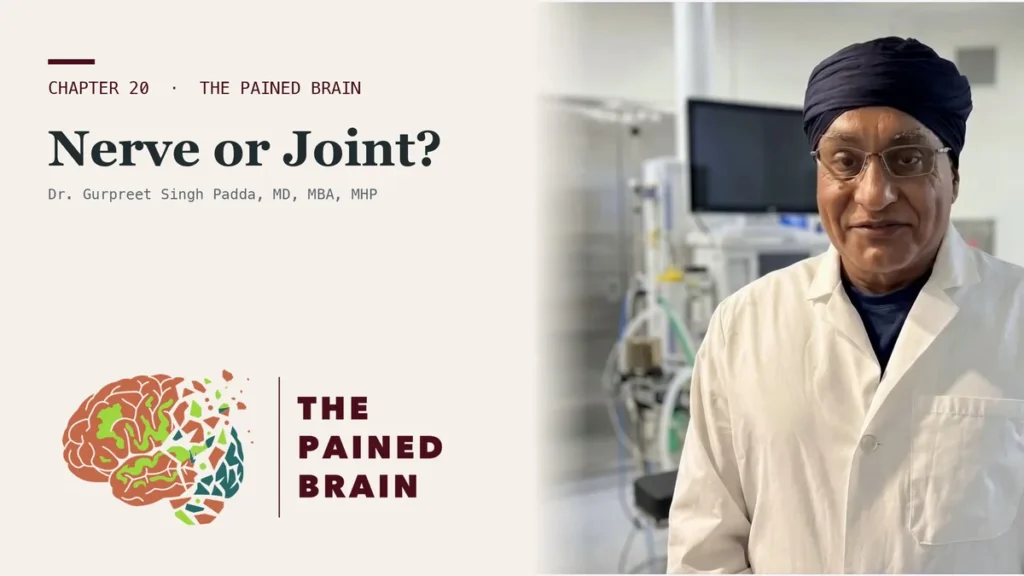
The video above, Nerve or Joint? Pain Speaks Two Languages, is Chapter 20 of The Pained Brain by Dr. Gurpreet Singh Padda, MD, MBA, MHP, and Dr. KrisJay Fucanan, MD. The nociceptive pain definition is the right starting point, because the medicine that helps depends on which kind of pain you have, and a large share of patients carry the other kind without anyone naming it.
The nociceptive pain definition and its neuropathic counterpart
The International Association for the Study of Pain defines nociceptive pain as pain arising from actual or threatened damage to tissue that is not nerve, signaled through activated pain receptors. Neuropathic pain is caused by a lesion or disease of the nervous system that carries sensation. The first is a working smoke detector reporting a real fire. The second is a detector whose own wiring is burning. A third mechanism, nociplastic pain, is an amplifier in the central nervous system with no lesion to find, explained in why nonspecific is not a diagnosis. One person can carry two at once, an overlap called mixed pain.
How a physician grades nerve pain at the bedside
Neuropathic pain is graded rather than detected by one test. A history of a relevant injury or disease, with pain in an anatomically sensible pattern, earns the grade possible. Matching sensory signs on examination in that same area earn probable, and probable is usually enough to begin treatment. A confirmatory test earns definite. The most telling sign is loss of sensation, although pain from light touch can be the only finding. A physician who never touches the leg cannot get past possible, and the examination takes about ninety seconds.
Questionnaires help decide where to press. The one she scored 21 out of 38 on has a sensitivity of 85 percent and a specificity of 80, so it misses some nerve pain and flags some that is not. What conventional electrical nerve testing can and cannot show is covered in what EMG and nerve conduction studies measure.
How often nerve pain hides inside joint and disc diagnoses
Far more often than its treatment suggests. Across 14,269 people with back pain, the pooled share with a neuropathic component was 47 percent, rising to 60 percent when pain ran into the leg and falling to 27 percent when it did not. After knee replacement with troublesome pain at three months, 53 to 74 percent screened neuropathic depending on the questionnaire, and in 56 percent of those it persisted through the next year. In British general practice, only 4.5 percent of chronic pain had ever received an adequate trial of a single drug designed for nerve pain.
Some of it is a trapped nerve filed under the spine. Among 834 consecutive low back pain patients, 14 percent met criteria for a superior cluneal nerve disorder, and 68 percent of those had more than half their pain relieved by up to three nerve blocks. The wider search for what drives pain after joint replacement is laid out in finding the real driver of persistent knee replacement pain.
What a damaged nerve does to the medicine
An injured nerve does not go quiet. In painful polyneuropathy, 40.5 percent of recorded C-fibers fired on their own, against 14.6 percent in the painless kind. In people with diabetes, 72 percent of pain-sensing fibers fired spontaneously in painful neuropathy against 15 percent in painless neuropathy, and in diabetic mice that firing tracked methylglyoxal, a toxin derived from sugar. That is the metabolic driver. The second driver sits at the receptor: after nerve injury, damaged neurons switch down the genes for their own opioid receptors, and roughly two in three neuropathic pain patients on current treatment call their control unsatisfactory. The target has stopped listening.
Damaged nerves also fail in different patterns. When 902 patients with peripheral neuropathic pain went through standardized sensory testing, 42 percent showed sensory loss, 33 percent an irritable nociceptor pattern, and 24 percent small-fiber loss with pain to light touch. Those profiles predicted which drug helped.
Does all pain live in the brain?
The strongest opposing view holds that the origin hardly matters because pain is registered in the brain. But imaging signatures of pain respond to any salient event, even in people born unable to feel pain, and signatures built for chronic pain separated back pain patients from healthy controls only 71 to 73 percent of the time. No imaging study tells nociceptive from neuropathic pain in a clinic.
The decisive evidence points to the periphery. In fourteen patients with painful peripheral neuropathy, a nerve block below the knee abolished the pain in every one within a median of ten minutes, at blood levels of anesthetic too low for any effect on the brain. In 31 amputees, dilute anesthetic applied to the dorsal root ganglion, the cluster of nerve cell bodies just outside the spine, extinguished phantom limb pain. Pain is experienced in the brain, yet in these patients it was being manufactured out at the nerve.
Why the wrong drug keeps winning
For nerve pain, oral anti-inflammatories have two small studies and no sign of meaningful relief, and acetaminophen with or without codeine has no qualifying study at all. Across 96 trials in chronic non-cancer pain, opioids beat placebo by 0.69 centimeters on a ten-centimeter scale, less than the smallest change a patient can feel. The drugs designed for nerves are better and modest: in the 2025 update, the number needed to treat was 4.6 for tricyclics, 7.4 for SNRIs, and 8.9 for gabapentinoids. Across 9 trials of anticonvulsants for low back pain and sciatica, 14 of 15 comparisons showed no effect, while diclofenac at 150 milligrams a day moved knee and hip arthritis pain by a standardized 0.57.
In a Swedish region of 1.7 million people, patients with lumbar spinal stenosis, a nerve diagnosis, were more often on an opioid than a neuropathic drug, 67.1 against 40.6 percent. Of 22,037 Medicare beneficiaries with a new diabetic neuropathy diagnosis, 23.42 percent began an opioid inside a year, while 4.56 percent began gabapentin. Part of the reason is economic: short visits reward the default prescription, and the ninety-second examination that sorts the two languages is the first thing a crowded schedule drops. None of this is a reason to change a medication on your own. It is a reason to ask your physician which kind of pain each drug on your list is meant to treat.
Matching the intervention to the mechanism
Once the mechanism is named, treatment can aim at the source. Stimulating the dorsal root ganglion produced treatment success in 81.2 percent at three months against 55.7 percent with conventional spinal cord stimulation, in an open-label, industry-sponsored trial. Destructive options belong last, because a cut nerve can become the next generator, which is exactly what happened to her.
She did not get a revision. A second diagnostic block confirmed the nerve, followed by a series of blocks and pulsed radiofrequency, done awake. Duloxetine came first, and gabapentin was added when that gave a partial answer, at lower doses of each. A high-concentration capsaicin patch went on the strip of shin the bedsheet had tormented, and under her physicians’ supervision she came off the oxycodone in eleven weeks and the meloxicam in one. Her A1c was 6.4. Bringing blood sugar down with food and daily walking matters here because sugar-derived toxins are part of what keeps injured fibers firing. I have watched good physicians treat a nerve as if it were a joint, and I have done it myself. Why nobody caught this sooner connects to what doctor reviews measure and miss, and why the mind and the metabolism cannot be separated comes next. Each study and its limits are in the Chapter 20 technical supplement.
Frequently asked questions
What is the difference between nociceptive and neuropathic pain?
Nociceptive pain comes from damaged or threatened tissue, such as an arthritic joint, sending signals through healthy nerves. Neuropathic pain comes from injury or disease of the nerves themselves, so the signaling system is the problem. They respond to different medicines, and many people have both. A physician sorts them with a history and a sensory examination rather than a scan. A broader overview of pain categories is in types of pain and why the category changes the treatment.
Why does my knee still hurt after a successful replacement?
A well-placed implant can still leave pain from another source. After knee replacement with troublesome pain at three months, 53 to 74 percent screened positive for neuropathic features, often from small skin nerves crossing the incision. Pressing along the nerve and a small numbing injection can show whether it is the generator before anyone discusses a revision. One way that nerve is tested and treated is described in what a 60-day nerve stimulator is actually testing.
What does nerve pain feel like?
People often describe burning, electric or shooting pain, pain from something as light as clothing or a bedsheet, and numbness in the same area. It often wakes people at night. Loss of sensation on examination is the most telling sign. A common example is explained in why diabetic nerve pain burns at night.
Do anti-inflammatories help nerve pain?
The evidence says probably not. Cochrane reviewers found only two small studies of oral anti-inflammatories for neuropathic pain and no sign of meaningful relief, even though surveys found 18 to 47 percent of affected people taking them for it. Any change to a medication belongs in a conversation with your physician. Hidden causes of nerve damage are worth ruling out too, including vitamin B12 neuropathy that a normal level can miss.
Can a trapped nerve be mistaken for back pain?
Yes. In one series of 834 consecutive low back pain patients, 14 percent met criteria for a superior cluneal nerve disorder, a small nerve crossing the rim of the pelvis, and nearly half of those had leg symptoms that suggested a spine problem. Up to three nerve blocks relieved more than half the pain in 68 percent of them. Diagnosis and treatment of that nerve are covered on the cluneal neuropathy page.
Name the Language Before the Prescription
If a joint or a disc has been blamed and nothing has worked, bring your medication list and your surgical history. We will examine for a nerve generator and match the treatment to the mechanism.
Request an appointment, call (314) 481-5000, or text (314) 886-5902.
Sources
- International Association for the Study of Pain (2020). IASP Terminology (revised definitions: nociceptive, neuropathic, nociplastic pain; allodynia; hyperalgesia). IASP website. https://www.iasp-pain.org/resources/terminology/
- Finnerup, N. B., Haroutounian, S., Kamerman, P., Baron, R., Bennett, D. L. H., Bouhassira, D., Cruccu, G., Freeman, R., Hansson, P., Nurmikko, T., Raja, S. N., Rice, A. S. C., Serra, J., Smith, B. H., Treede, R. D., & Jensen, T. S. (2016). Neuropathic pain: an updated grading system for research and clinical practice. Pain, 157(8), 1599–1606. https://doi.org/10.1097/j.pain.0000000000000492
- Gudala, K., Bansal, D., Vatte, R., Ghai, B., Schifano, F., & Boya, C. (2017). High Prevalence of Neuropathic Pain Component in Patients with Low Back Pain: Evidence from Meta-Analysis. Pain Physician, 20(5), 343–352. https://pubmed.ncbi.nlm.nih.gov/28727698/
- Bertram, W., Howells, N., White, S. P., Sanderson, E., Wylde, V., Lenguerrand, E., Gooberman-Hill, R., & Bruce, J. (2024). Prevalence and patterns of neuropathic pain in people with chronic post-surgical pain after total knee arthroplasty. Bone & Joint Journal, 106-B(6), 582–588. https://doi.org/10.1302/0301-620X.106B6.BJJ-2023-0889.R1
- Becker, A. K., Babes, A., Düll, M. M., Khalil, M., Kender, Z., Gröner, J., Namer, B., Reeh, P. W., & Sauer, S. K. (2023). Spontaneous activity of specific C-nociceptor subtypes from diabetic patients and mice: Involvement of reactive dicarbonyl compounds and (sensitized) transient receptor potential channel A1. Journal of the Peripheral Nervous System, 28(2), 202–225. https://doi.org/10.1111/jns.12546
- Baron, R., Maier, C., Attal, N., Binder, A., Bouhassira, D., Cruccu, G., Finnerup, N. B., Haanpää, M., Hansson, P., Hüllemann, P., Jensen, T. S., Freynhagen, R., Kennedy, J. D., Magerl, W., Mainka, T., Reimer, M., Rice, A. S. C., Segerdahl, M., Serra, J., … Treede, R. D. (2017). Peripheral neuropathic pain: a mechanism-related organizing principle based on sensory profiles. Pain, 158(2), 261–272. https://doi.org/10.1097/j.pain.0000000000000753
- Haroutounian, S., Nikolajsen, L., Bendtsen, T. F., Finnerup, N. B., Kristensen, A. D., Hasselstrøm, J. B., & Jensen, T. S. (2014). Primary afferent input critical for maintaining spontaneous pain in peripheral neuropathy. Pain, 155(7), 1272–1279. https://doi.org/10.1016/j.pain.2014.03.022
- Soliman, N., Moisset, X., Ferraro, M. C., de Andrade, D. C., Baron, R., Belton, J., Bennett, D. L. H., Calvo, M., Dougherty, P., Gilron, I., Hietaharju, A. J., Hosomi, K., Kamerman, P. R., Kemp, H., Enax-Krumova, E. K., McNicol, E., Price, T. J., Raja, S. N., Rice, A. S. C., … Haroutounian, S. (2025). Pharmacotherapy and non-invasive neuromodulation for neuropathic pain: a systematic review and meta-analysis. Lancet Neurology, 24(5), 413–428. https://doi.org/10.1016/S1474-4422(25)00068-7
- Nyqvist, L., Åkerstedt, J., & Thoreson, O. (2024). Current trends in the medical treatment of neuropathic low back pain: a Swedish registry-based study of 1.7 million people. BMC Musculoskeletal Disorders, 25(1), 486. https://doi.org/10.1186/s12891-024-07599-4
- Deer, T. R., Levy, R. M., Kramer, J., Poree, L., Amirdelfan, K., Grigsby, E., Staats, P., Burton, A. W., Burgher, A. H., Obray, J., Scowcroft, J., Golovac, S., Kapural, L., Paicius, R., Kim, C., Pope, J., Yearwood, T., Samuel, S., McRoberts, W. P., … Mekhail, N. (2017). Dorsal root ganglion stimulation yielded higher treatment success rate for complex regional pain syndrome and causalgia at 3 and 12 months: a randomized comparative trial. Pain, 158(4), 669–681. https://doi.org/10.1097/j.pain.0000000000000814
Dr. Gurpreet Singh Padda, MD, MBA, MHP