The TenJet procedure is a percutaneous tenotomy (tendon tissue removed through the skin with a needle). Under ultrasound, a 12-gauge needle sends a fine saline jet. The jet loosens soft, degenerated tendon tissue and suctions it out. Dense healthy tendon resists the stream. It treats chronic tendon pain as damaged tissue to remove, not inflammation to calm. A loading program follows.
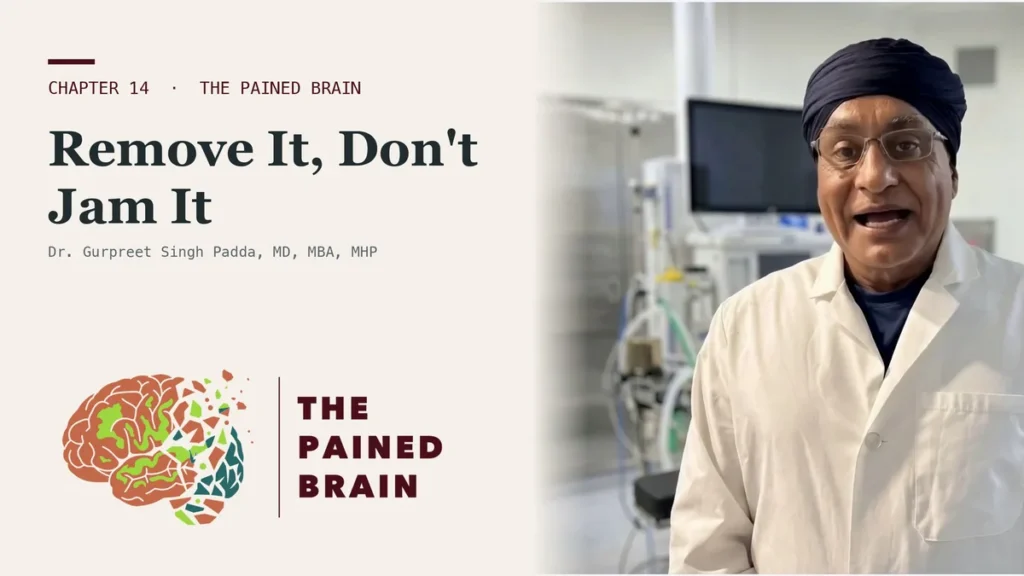
Chronic tendon pain is usually filed under the wrong word. Tendinitis implies an inflamed tendon that rest and anti-inflammatories will calm. When they do not, the offer steps up to a steroid shot and sometimes a nerve stimulator. The TenJet [high-pressure saline-jet tendon resection device] starts from a different idea. The painful part of a chronic tendon is damaged tissue that can be removed. The TenJet procedure removes it. That argument runs through Chapter 14 of The Pained Brain, the video above, by Dr. Gurpreet Singh Padda, MD, MBA, MHP, and Dr. KrisJay Fucanan, MD.
Tendinosis vs tendinitis: what the tissue actually shows
Pathologists examined chronically painful Achilles, patellar, elbow and rotator cuff tendons. They found broken, disorganized collagen and swollen ground substance (the gel between fibers). Tendon cells had turned plump and cartilage-like. New capillaries threaded through the lesion. The feature they called most significant was an absence: no inflammatory cells. Later biopsies refined that without reversing it. Immune cells are present, but in a chronic pattern that never resolves, not an acute flare. It is a failed repair with a low fire that never goes out. A small microdialysis study agrees. Glutamate, a pain-signaling chemical, ran about four times higher inside painful Achilles tendons than in controls. Prostaglandin E2, a marker of classic inflammation, did not differ.
What makes the lesion hurt is what grows into it. Doppler ultrasound found new vessels in 28 of 28 painful Achilles tendons and none of 20 normal ones. Pain-carrying nerve fibers ran beside them. Yet across 141 tendons, the amount of vessel did not track the pain score. The vessels mark where the lesion is, not how much it hurts.
Why a chronic tendon does not heal on its own
Carbon-14 left in the air by bomb tests works as a clock. In adult Achilles tendons, the core collagen matched the air from a median of 8 years after birth. The core is built during growth and almost never renewed. Among 174 patients with ultrasound-confirmed plantar fasciitis, 50.0 percent still had it at five years. In greater trochanteric pain syndrome (outer hip tendon pain), 45.0 percent still had it eleven years later, against 5.3 percent of controls.
In the placebo-controlled tennis elbow trial, one-year recurrence was 54 percent after steroid against 12 percent after a placebo injection. What that loan costs the tissue is laid out in what a cortisone shot costs the joint over time.
What a peripheral nerve stimulator does, and does not do
For some patients a stimulator is the right tool. Its theory is that input from large, non-pain fibers closes a gate on pain signals in the spinal cord. The most complete modern review still calls the exact mechanism largely unknown. Nothing in that literature describes tendon repair. Stimulation modulates a signal.
The randomized record shows real responders. It also shows a large expectation effect. In the key implanted peripheral trial, 38 percent responded at three months, against 10 percent on the control setting. In a blinded spinal cord stimulation crossover, the sham setting cut pain 34 percent. That matched two of three active settings. In the FDA device-report database, 43.8 percent of reported peripheral stimulator events ended in explantation (device removal). That is a share of reports, not a rate of how often it happens. At one center, 28 percent of implanted patients later needed an MRI, most of the scans for something unrelated to the device. No randomized trial has tested a nerve stimulator on a tendon lesion. What a spinal cord stimulator trial can and cannot tell you is worth reading before any implant.
How the TenJet procedure works and what its record shows
The device is a 12-gauge needle. It sends sterile saline at pressures up to 14,000 psi across a small window near its tip. Suction pulls loosened tissue back up the needle. Healthy tendon is dense and resists the stream. Degenerated tissue is soft and mucoid (slimy). In a bench model, the jet removed it while barely disturbing the healthy tissue around it. Ultrasound shows the gray lesion shrinking.
The published record is young. It should be stated at its true strength. In a series of 32 elbows paid for by the maker, pain fell from 5.1 to 0.5 at twelve months. But most of those patients received conscious sedation. In a 100-patient series under local anesthesia, the Oxford Elbow Score rose from a median of 23.5 to 45 at one year. None of the 100 needed open release. How bad the tendon looked on ultrasound at the start did not predict who improved. The older ultrasonic cousin holds its gains longest. In the original cohort of 20 patients followed to 90 months, hypervascularity (extra blood vessel growth) stayed resolved in 79 percent with no recurrence. In gluteal tendons, 29 patients went from a pain score of 5.86 to 2.82 at a mean of 22 months. And 3 went on to open repair.
The limits are real. The systematic reviews grade this body of evidence Level 4. These are before-and-after series, with no sham-controlled trial of tissue removal. In one survey after percutaneous tenotomy, median time to significant recovery was 58 days. And 26.1 percent of patients were not satisfied. Our practice performs the procedure awake under local anesthetic, without sedation, and patients drive home.
Why open surgery comes last for a tendon
One blinded trial looked at tennis elbow. In one group, degenerated tissue was cut out. In the other, the skin was simply opened and closed. The trial found no difference at any stage. Its authors estimated that more than 6,500 patients per group would be needed to show one. What open surgery reliably adds is recovery time and wound risk. In 432 open Achilles operations in a row, 11 percent had a complication. Percutaneous removal takes the same tissue out through a needle and leaves surgery for last.
Loading and the metabolic terrain decide the result
A tendon rebuilds in response to force. Its cells sense load and answer with new collagen, a process called mechanotransduction. So resting a chronic tendon with no end date withholds the signal that repairs it. In one post-procedure series, physical therapy accounted for 60 percent of the drop in elbow pain. In a gluteal tendinopathy trial, education plus a loading program beat a steroid injection by 20.4 percent at one year. The number needed to treat was 4.9. Pooled data favor added weight over body weight alone. They also favor loading less than daily over daily loading.
The load lands on a terrain. People with Achilles tendinopathy had higher triglycerides and lower HDL than controls matched for body mass index. That is the blood fat pattern of insulin resistance. In a Danish cohort, a hemoglobin A1c above 5.7 percent carried roughly three times the risk of a lower-limb tendon injury. Fluoroquinolone antibiotics raise the odds of Achilles tendinitis 3.95-fold. In one study, patients with metabolic syndrome did the same eccentric program as matched controls. They kept more pain and used more pain medication. The system adds its own drag. A procedure is a billable event. The months of coached loading that decide the outcome often go unplanned. Only 44 percent of published tenotomy protocols prescribed structured rehab. How high blood sugar stiffens tendons and nerve tunnels explains the chemistry.
What to ask before any tendon procedure
Ask whether anyone has imaged the tissue where you actually hurt. Ask for your hemoglobin A1c as a number and your triglyceride-to-HDL ratio, because not diabetic is not the same as a safe tendon. Bring your medication list and work any change through your physician. If a stimulator is proposed, ask for its responder rate and the MRI plan. If a resection (tissue removal) is proposed, ask who writes the loading program and when it starts. Lateral hip pain deserves a direct look, since lateral hip pain is rarely just bursitis. Needle accuracy is the step before all of it, covered in why a blind needle misses its target. Every study behind these numbers is in the Deep Dive to Chapter 14, with what each one does and does not show.
Frequently asked questions
What is the TenJet procedure?
It is a percutaneous tenotomy. Through a small skin nick and under ultrasound, a 12-gauge needle sends a fine saline jet. The jet loosens soft, degenerated tendon tissue and suctions it out. Dense healthy tendon resists the stream. It is used for chronic elbow, hip and other tendon lesions after conservative care has failed. A loading program follows. Pain down the side of the leg is not always the spine, as hip-related leg pain shows.
What is the difference between tendinosis and tendinitis?
Tendinitis means an inflamed tendon. Tendinosis is what chronic tendon pain usually looks like under the microscope. It shows disorganized collagen, cartilage-like cells, new vessels and nerves, and few classic inflammatory cells. A smoldering, unresolved inflammation sits inside that failed repair. The difference matters because rest and anti-inflammatories aim at inflammation. A degenerated tendon needs load and sometimes removal of damaged tissue. The exercise evidence for rotator cuff shoulder pain applies the same principle.
How long does recovery take after percutaneous tenotomy?
Expect weeks to months, not days. In one patient survey, median time to significant recovery was 58 days. About one in four patients were not satisfied. A 100-patient elbow series used a wrist brace for 7 to 10 days and began physical therapy around day 14. In another series, most of the improvement came from the rehabilitation that followed the procedure. Heel pain that is not plantar fasciitis shows why the tissue is identified before any procedure.
Does a peripheral nerve stimulator help tendon pain?
No randomized trial has tested one for a tendon lesion such as tennis elbow, plantar fasciitis or gluteal tendinopathy. The nearest evidence, electroacupuncture at the elbow, showed no effect different from zero. Stimulators modulate pain signals. They help a minority of patients with nerve-origin pain. But nothing in their described mechanism repairs tendon tissue. Here is what a 60-day nerve stimulator is actually testing.
Can a steroid injection make tendon pain worse over time?
In tennis elbow, the pattern points that way. Across 41 trials, corticosteroid gave a large short-term benefit. That benefit turned negative at intermediate and long-term follow-up. In a placebo-controlled trial, one-year recurrence was 54 percent after steroid against 12 percent after placebo. Serious harms were rare, with one tendon rupture among 991 participants. The problem is the reversal. Why each injection tends to buy less time than the last is covered here.
Find the Tissue, Then Treat It
If tendon pain has outlasted rest, steroid shots and therapy, an ultrasound exam can show whether damaged tissue is still sending the signal. Bring your lab results and medication list.
Request an appointment, or call or text us.
Sources
- Khan, K. M., Cook, J. L., Bonar, F., Harcourt, P., & Astrom, M. (1999). Histopathology of common tendinopathies. Update and implications for clinical management. Sports Medicine, 27(6), 393–408. https://doi.org/10.2165/00007256-199927060-00004
- Heinemeier, K. M., Schjerling, P., Heinemeier, J., Magnusson, S. P., & Kjaer, M. (2013). Lack of tissue renewal in human adult Achilles tendon is revealed by nuclear bomb (14)C. FASEB Journal, 27(5), 2074–2079. https://doi.org/10.1096/fj.12-225599
- Coombes, B. K., Bisset, L., Brooks, P., Khan, A., & Vicenzino, B. (2013). Effect of corticosteroid injection, physiotherapy, or both on clinical outcomes in patients with unilateral lateral epicondylalgia: a randomized controlled trial. JAMA, 309(5), 461–9. https://doi.org/10.1001/jama.2013.129
- Deer, T., Pope, J., Benyamin, R., Vallejo, R., Friedman, A., Caraway, D., Staats, P., Grigsby, E., Porter McRoberts, W., McJunkin, T., Shubin, R., Vahedifar, P., Tavanaiepour, D., Levy, R., Kapural, L., & Mekhail, N. (2016). Prospective, Multicenter, Randomized, Double-Blinded, Partial Crossover Study to Assess the Safety and Efficacy of the Novel Neuromodulation System in the Treatment of Patients With Chronic Pain of Peripheral Nerve Origin. Neuromodulation, 19(1), 91–100. https://doi.org/10.1111/ner.12381
- Sokal, P., Malukiewicz, A., Kierońska, S., Murawska, J., Guzowski, C., Rudaś, M., Paczkowski, D., Rusinek, M., & Krakowiak, M. (2020). Sub-Perception and Supra-Perception Spinal Cord Stimulation in Chronic Pain Syndrome: A Randomized, Semi-Double-Blind, Crossover, Placebo-Controlled Trial. Journal of Clinical Medicine, 9(9), Article jcm9092810. https://doi.org/10.3390/jcm9092810
- Cooper, A. N., Sen, H., Kanjanapanang, N., Saad, K., Wahl, G., Young, C., Essman, M., Fogarty, A. E., Burnham, T., Conger, A. M., McCormick, Z. L., & Glinka Przybysz, A. (2025). Adverse Events Associated With Peripheral Nerve Stimulation: An Analysis of the MAUDE Data base and Implications for Pain and Spine Clinicians. Neuromodulation, 28(4), 619–626. https://doi.org/10.1016/j.neurom.2025.02.002
- Strauser-Curtis, K., Varacallo, C. P., Voss, T. T., Stephens, C. B., & Kapteyn, R. W. (2022). Ultrasound-guided tenotomy via a hydrosurgery resection device improves symptoms of chronic elbow tendinopathy: A multi-center prospective study. Journal of Orthopaedic Experience & Innovation, 3(1), 34671. https://doi.org/10.60118/001c.34671
- Dakkak, M., Patel, V., King, D., & Genin, J. (2023). Ultrasound-guided tenotomy for lateral epicondylitis with TenJet improves physical functional and decreased pain outcomes at 1 year: a case series review. JSES International, 7(5), 872–876. https://doi.org/10.1016/j.jseint.2023.05.003
- Mellor, R., Bennell, K., Grimaldi, A., Nicolson, P., Kasza, J., Hodges, P., Wajswelner, H., & Vicenzino, B. (2018). Education plus exercise versus corticosteroid injection use versus a wait and see approach on global outcome and pain from gluteal tendinopathy: prospective, single blinded, randomised clinical trial. BMJ, 361, k1662. https://doi.org/10.1136/bmj.k1662
- Skovgaard, D., Siersma, V. D., Klausen, S. B., Visnes, H., Haukenes, I., Bang, C. W., Bager, P., Grävare Silbernagel, K., Gaida, J., Magnusson, S. P., Kjaer, M., & Couppé, C. (2021). Chronic hyperglycemia, hypercholesterolemia, and metabolic syndrome are associated with risk of tendon injury. Scandinavian Journal of Medicine & Science in Sports, 31(9), 1822–1831. https://doi.org/10.1111/sms.13984
Dr. Gurpreet Singh Padda, MD, MBA, MHP