Histamine and pain are linked by mast cells pressed against gut nerves. Mast cells are immune cells that sit in the gut wall. In IBS biopsies, only the mast cells within five micrometers of a nerve tracked how bad and how often the pain was. Histamine is just one of their weapons. That is why antihistamines alone fall short.
She is fifty. Her list of safe foods has been shrinking for three years. She flushes after meals. Belly pain lands within twenty minutes, and loose stool follows. Her allergy tests are negative. Two doctors called it anxiety.
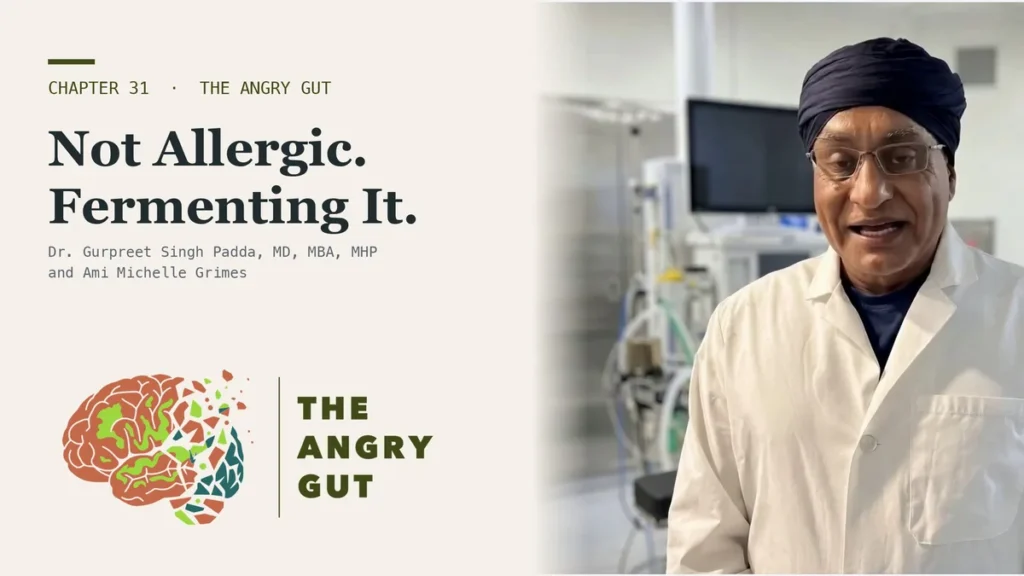
I’m Dr. Gurpreet Singh Padda, MD, MBA, MHP. Her case is the center of the video She’s Not Allergic to Her Food. She’s Fermenting It., from The Angry Gut, which I wrote with Ami Michelle Grimes. For a pain practice the key point is simple. Histamine and pain in the gut are joined by a cell, and that cell sits against a nerve.
Histamine and pain start with a cell pressed against a nerve
Researchers took biopsies from people with irritable bowel syndrome (IBS). In 34 of 44, mast cells took up more of the gut lining than in healthy people: 9.2% of the surface against 3.3%. But the total count did not track belly pain. What tracked it were the mast cells lying within five micrometers of a nerve. There were 7.14 per field in IBS against 2.27 in controls. Only those cells next to nerves matched how bad and how often the pain was.
The chemicals fired nerves directly. Fluid from the patients’ gut lining was put on rat gut nerves. It drove firing at 14.7 impulses per second, against 2.8 for control fluid. And 64% of the nerves that fired were capsaicin-sensitive pain fibers. It was human fluid on a rat nerve.
Here is the number a pain patient should notice. Blocking the histamine H1 receptor cut that nerve firing by 51.7%. Shutting off the mast cell’s proteases (enzymes that cut proteins) cut it by 74.5%. Histamine is just one of the weapons. That helps explain why three antihistamines gave her about a third of the relief she needed, and no more.
One event that gets treated as three problems
Mast cells are not just allergy cells. They sit where the body’s two immune systems meet, the fast built-in one and the learned one. They respond to far more triggers than IgE, the allergy antibody. They also trade signals with sensory nerves. In the first brain, the gut, they are guards posted downstream of the white blood cells called lymphocytes. The chemicals they release drive both pain and a leaky lining. Histamine and proteases cause much of their pain through prostaglandins made inside the mast cell itself.
So her pain, her loose stool and her leaky gut wall are one process with three names. Each name got its own prescription. The second brain, the one in her skull, was checked for anxiety. Meanwhile the alarm kept ringing below.
Pain medicine has its own version of this. Some drugs fire mast cells directly through a receptor called MRGPRX2. No antibody is involved. Morphine, vancomycin, rocuronium and atracurium are among the named drugs. A negative allergy test does not clear them. Naloxone does a poor job of reversing morphine’s itch, flushing and low blood pressure. Fentanyl does not act at that receptor, and it does not cause the same picture.
Where the gut’s histamine is really made
In a placebo-controlled challenge, patients sent in for histamine intolerance were tested against a placebo. For most of them, the diagnosis fell apart. Most reacted to the placebo. The source that holds up better is the gut’s bacteria.
Germ-free mice got stool from IBS patients with high histamine in their urine. The mice developed gut pain hypersensitivity and mast cell activation. Mice given stool from low-histamine patients did not. Blocking the histamine H4 receptor reversed it. In people with IBS, cutting fermentable carbs lowered both pain and urine histamine. Her bacteria were making histamine out of what she ate.
That shifts the job. The food the bacteria ferment comes down. The overgrowth gets treated. The gut wall gets repaired, the work of Chapter 29 on the gut barrier. Bacterial pieces crossing a leaky wall help keep the lining’s immune cells primed. That thread starts in Chapter 4.
The incentives point the wrong way. A list of foods to avoid costs the system nothing to hand out. Antihistamines refill forever. And the hour it takes to learn why the cells are firing is the hour nobody pays for.
What low-dose naltrexone does, link by link
Link one: the rebound. A brief opioid block prompts the body to raise its own endorphin. Researchers measured this in human spinal fluid. Naltrexone at a standard dose raised beta-endorphin from 1.15 to 2.03 fmol/mL. Its parent molecule stayed flat, so the endorphin-to-parent ratio rose 80%. The effect held after two and seven days of treatment. That is human data, at a dose above the low-dose range.
Link two: the dose. Decades of lab work point to how long the receptor stays blocked, not the size of the dose. That is what decides the response. Short blocks at low doses and steady blocks at high doses pushed cell growth in opposite directions. At the full 100 mg dose, naltrexone fills 92% of kappa receptors. But nobody has measured how many it fills at 1.5 to 4.5 mg in a living person. That gap is real.
Link three: lymphocytes and regulatory T cells. This is the least settled link. Experts still argue over whether human immune cells carry opioid receptors. In female mice, regulatory T cells made their own enkephalin, a natural opioid. It acted on delta opioid receptors on sensory nerves to hold pain down. That job was separate from their immune role. What can be measured in people is output. Women with fibromyalgia took low-dose naltrexone for eight weeks. Blood levels of eighteen inflammatory signals fell, including IL-1β, IL-6, IL-17A and TNF-α. Pain fell 15%. It was a small pilot, so read it as a signal.
Link four: TLR4. Naltrexone blocks Toll-like receptor 4. That is the sensor for lipopolysaccharide, a toxin from bacterial walls. In the key cell experiment, every mirror-image form of the drug blunted that signal by non-competitive inhibition, including the clinical one. The animal work used other forms. It is a weak blocker, and no human study has shown low-dose naltrexone doing this. The evidence is cell and animal work.
Why low-dose naltrexone is not a mast cell stabilizer
Naltrexone does nothing at MRGPRX2, the receptor opioids use to make mast cells burst and dump their contents. In animal work it did not stop morphine from setting off that burst. Cromolyn, a true mast cell stabilizer, did. Anyone who calls low-dose naltrexone a direct mast cell stabilizer has the drug science wrong.
The mechanism that survives is indirect and upstream. Rebound endorphin works on lymphocytes, including regulatory T cells. Blocking TLR4 lowers the load of inflammatory signals that keeps gut mast cells on a hair trigger. Quiet the signals that arm the guards, and they fire less often. The drug never touches the mast cell itself. For an earlier look at the drug in pain care, see low-dose naltrexone in intractable pain.
What the pain trials actually show
In fibromyalgia, the randomized record is four trials and 222 patients. Pooled together, pain dropped 0.86 points. Pressure pain threshold also improved on an algometer, a device that presses on the skin. The largest single trial gave women 6 mg for twelve weeks. It missed its primary endpoint (main goal). Pain fell 1.3 points on the drug and 0.9 on placebo. In IBS the only record is an open-label pilot (no placebo) at 0.5 mg daily. Overall, 76% of 42 patients got better. In a survey of 553 people with mast cell activation syndrome, self-rated benefit averaged 5.6 out of 10. That is the same as benzodiazepines. Antihistamines scored 6.3.
That is a modest drug with a good safety record under 5 mg. The strength of the evidence should be explained to every patient plainly.
What changed for her, and what you can take from it
Her antihistamines stayed, as a bridge. The low-histamine list came off. The food her bacteria fermented came down. The overgrowth was treated. The gut wall work began. Low-dose naltrexone started at 1.5 mg and was raised step by step. At five months she had added back nineteen foods and stopped flushing. That is one patient, not a trial, and individual results vary.
If your gut pain has been labeled stress, you can ask sharper questions. Has anyone looked at mast cells, not just allergy antibodies? Could a drug reaction in your past be the receptor-driven kind? Did the reactions start after antibiotics, a gut infection or a surgery? Work any medicine question through with your physician. Chapter 30 covers the daily upkeep under all of this. Chapter 32 turns to the bowel that will not move at all. Every study above is laid out in the Chapter 31 Deep Dive, with the full numbers and what each trial does not show.
Frequently asked questions
Can histamine cause abdominal pain?
Yes, and not only through allergy. In irritable bowel syndrome, mast cells release histamine and proteases. These fire pain nerves directly. The cells lying closest to nerves track how bad the pain is. Histamine causes part of that nerve firing, and proteases cause more. Read how pain-sensing neurons interact with gut inflammation.
Why don’t antihistamines fully stop gut pain?
They block one receptor while the cell keeps releasing everything else. In IBS tissue studies, blocking histamine H1 receptors cut nerve firing by about half. Shutting off mast cell proteases cut it by more. Antihistamines can be a fair bridge. But the lasting work is finding out why the cells are firing and removing those triggers. Understand why a sensitized nervous system amplifies gut signals.
Is low-dose naltrexone a mast cell stabilizer?
No. Naltrexone does nothing at MRGPRX2, the receptor opioids use to trigger mast cells. It did not block that burst in lab studies. Its proposed benefit runs upstream. The body’s own endorphin rises in a rebound and acts on lymphocytes. And blocking TLR4 lowers the inflammatory signals that keep mast cells primed. The TLR4 link rests on cell and animal evidence so far. See how low-dose naltrexone has been used for intractable pain.
Why can a drug reaction look like an allergy when allergy testing is negative?
Some drugs set off mast cells directly through a receptor called MRGPRX2. No antibody and no earlier exposure are needed. The reaction can look like allergy, with itching, flushing and a drop in blood pressure. Yet there is nothing for an allergy test to find. Morphine, vancomycin, rocuronium and atracurium are among the drugs named in that pathway. Find out whether a pain medication could be making pain worse.
Can gut bacteria make histamine that causes pain?
In mouse studies, yes. Germ-free mice got stool from IBS patients with high histamine in their urine. The mice developed gut pain hypersensitivity and mast cell activation. Blocking the histamine H4 receptor reversed it. In people with IBS, cutting fermentable carbs lowered pain and urine histamine together. The histamine that matters may be made in the gut, not eaten. Learn what breath testing reveals about gut fermentation.
Stop soundproofing the alarm
Have your gut pain, flushing and shrinking food list been written off as anxiety? We look for why the cells are firing. Then we treat the source along with the pain.
Request an appointment, or call or text us.
Sources
- Barbara, G., Stanghellini, V., De Giorgio, R., Cremon, C., Cottrell, G. S., Santini, D., Pasquinelli, G., Morselli-Labate, A. M., Grady, E. F., Bunnett, N. W., Collins, S. M., & Corinaldesi, R. (2004). Activated mast cells in proximity to colonic nerves correlate with abdominal pain in irritable bowel syndrome. Gastroenterology, 126(3), 693-702. https://doi.org/10.1053/j.gastro.2003.11.055
- Barbara, G., Wang, B., Stanghellini, V., de Giorgio, R., Cremon, C., Di Nardo, G., Trevisani, M., Campi, B., Geppetti, P., Tonini, M., Bunnett, N. W., Grundy, D., & Corinaldesi, R. (2007). Mast cell-dependent excitation of visceral-nociceptive sensory neurons in irritable bowel syndrome. Gastroenterology, 132(1), 26-37. https://doi.org/10.1053/j.gastro.2006.11.039
- De Palma, G., Shimbori, C., Reed, D. E., Yu, Y., Rabbia, V., Lu, J., Jimenez-Vargas, N., Sessenwein, J., Lopez-Lopez, C., Pigrau, M., Jaramillo-Polanco, J., Zhang, Y., Baerg, L., Manzar, A., Pujo, J., Bai, X., Pinto-Sanchez, M. I., Caminero, A., Madsen, K., … Bercik, P. (2022). Histamine production by the gut microbiota induces visceral hyperalgesia through histamine 4 receptor signaling in mice. Science Translational Medicine, 14(655), eabj1895. https://doi.org/10.1126/scitranslmed.abj1895
- Gordon, R. J., Panigrahi, S. K., Meece, K., Atalayer, D., Smiley, R., & Wardlaw, S. L. (2017). Effects of opioid antagonism on cerebrospinal fluid melanocortin peptides and cortisol levels in humans. Journal of the Endocrine Society, 1(10), 1235-1246. https://doi.org/10.1210/js.2017-00289
- Midavaine, E., Moraes, B. C., Benitez, J., Rodriguez, S. R., Braz, J. M., Kochhar, N. P., Eckalbar, W. L., Tian, L., Domingos, A. I., Pintar, J. E., Basbaum, A. I., & Kashem, S. W. (2025). Meningeal regulatory T cells inhibit nociception in female mice. Science, 388(6742), 96-104. https://doi.org/10.1126/science.adq6531
- Parkitny, L., & Younger, J. (2017). Reduced pro-inflammatory cytokines after eight weeks of low-dose naltrexone for fibromyalgia. Biomedicines, 5(2), 16. https://doi.org/10.3390/biomedicines5020016
- Hutchinson, M. R., Zhang, Y., Brown, K., Coats, B. D., Shridhar, M., Sholar, P. W., Patel, S. J., Crysdale, N. Y., Harrison, J. A., Maier, S. F., Rice, K. C., & Watkins, L. R. (2008). Non-stereoselective reversal of neuropathic pain by naloxone and naltrexone: Involvement of toll-like receptor 4 (TLR4). The European Journal of Neuroscience, 28(1), 20-29. https://doi.org/10.1111/j.1460-9568.2008.06321.x
- Lansu, K., Karpiak, J., Liu, J., Huang, X.-P., McCorvy, J. D., Kroeze, W. K., Che, T., Nagase, H., Carroll, F. I., Jin, J., Shoichet, B. K., & Roth, B. L. (2017). In silico design of novel probes for the atypical opioid receptor MRGPRX2. Nature Chemical Biology, 13(5), 529-536. https://doi.org/10.1038/nchembio.2334
- Vatvani, A. D., Patel, P., Hariyanto, T. I., & Yanto, T. A. (2024). Efficacy and safety of low-dose naltrexone for the management of fibromyalgia: a systematic review and meta-analysis of randomized controlled trials with trial sequential analysis. The Korean Journal of Pain, 37(4), 367-378. https://doi.org/10.3344/kjp.24202
- Weinstock, L. B., Afrin, L. B., Reiersen, A. M., Brook, J., Blitshteyn, S., Ehrlich, G., Schofield, J. R., Kinsella, L., Kaufman, D., Dempsey, T., & Molderings, G. J. (2025). Prevalence and treatment response of neuropsychiatric disorders in mast cell activation syndrome. Brain, Behavior, & Immunity – Health, 48, 101048. https://doi.org/10.1016/j.bbih.2025.101048
Dr. Gurpreet Singh Padda, MD, MBA, MHP