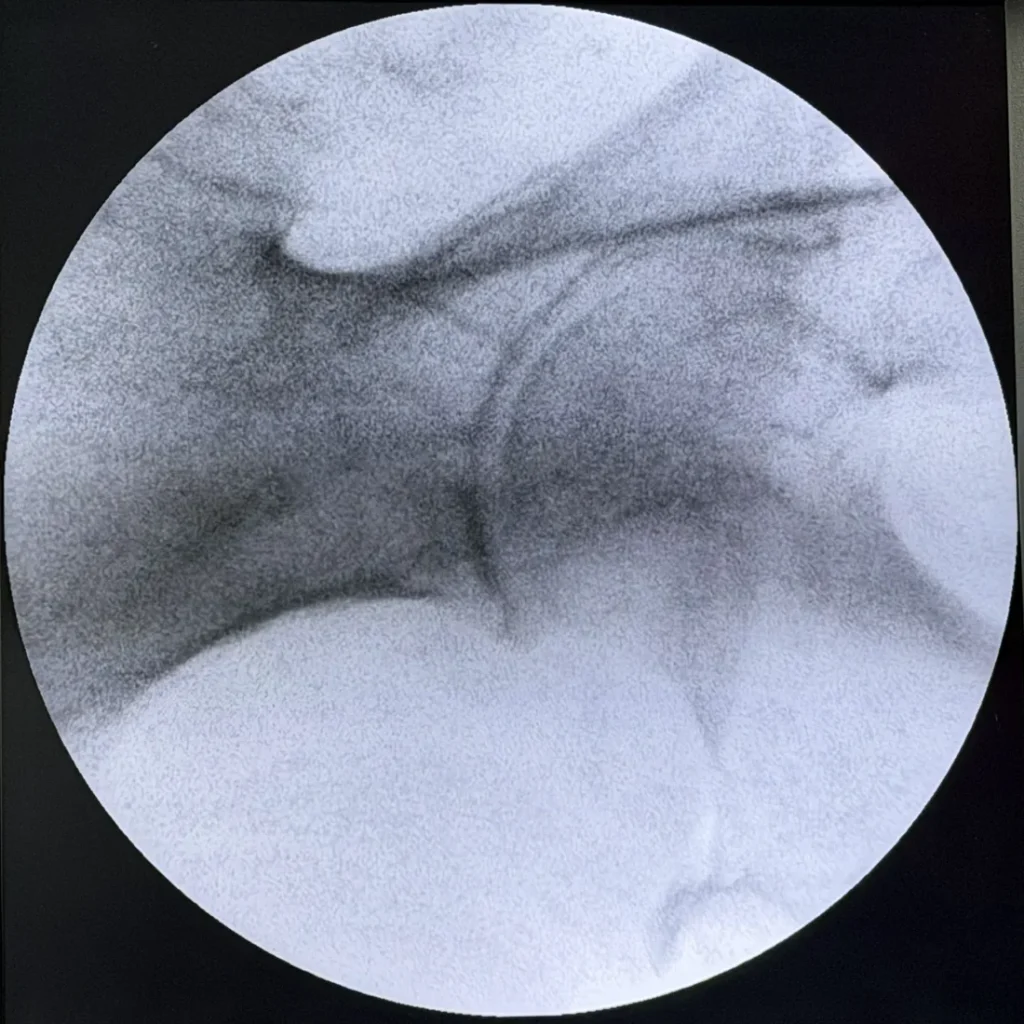
An arthritic hip can send pain into the buttock and down the thigh that reads exactly like sciatica. The exam tells them apart. Hip pain stops at the knee, limits inward rotation, and gets worse with pivoting and standing on the leg. A nerve sends pain below the knee, with numbness, tingling or weakness.
A patient has pain in the buttock that runs down the back of the thigh. It is worse getting out of a car and worse after walking. Someone says the word sciatica. A lumbar MRI is ordered. Wear-and-tear change is found. For the next several months, treatment is aimed at the spine.
Sometimes the problem was the hip joint all along.
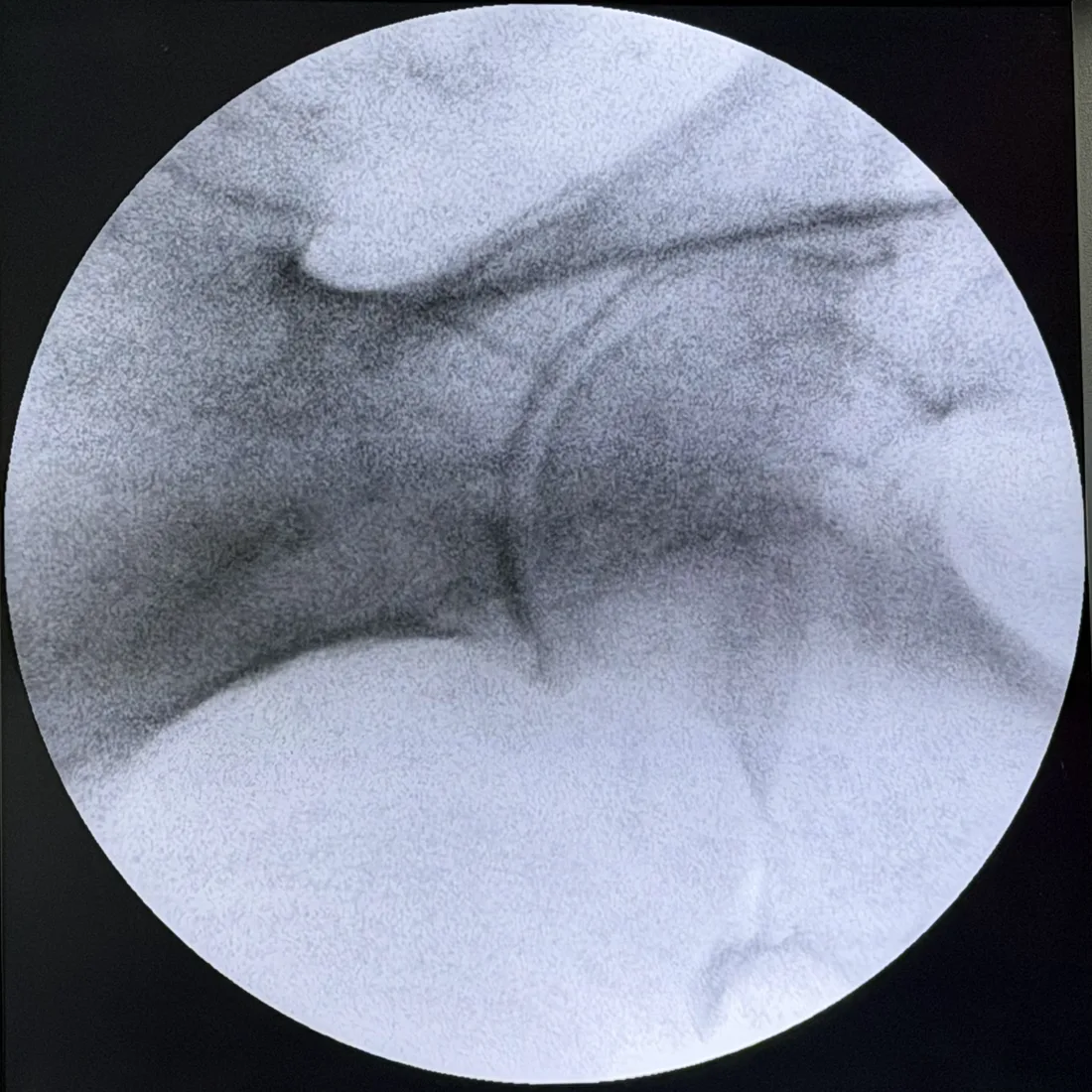
Why the hip refers pain into the buttock
The textbook sign of hip osteoarthritis is groin pain. When a patient describes that, the diagnosis is usually simple. The trouble is that branches of several nerves supply the hip joint. So its pain does not stay in the textbook spot. Buttock pain is a known pattern. So is pain sent down the front or outer thigh toward the knee.
What the hip joint does not usually do is cause symptoms below the knee. It does not usually cause numbness and tingling along one nerve’s strip of skin, or foot weakness. Those findings point to a nerve. Ask about them directly, because patients do not bring them up.
The examination that separates them
This is where the line is usually drawn. It takes a few minutes, not a scan.
- Hip range of motion, compared side to side. Inward rotation is the telling one. A hip that is stiff and painful at the end of its range is acting like a joint problem.
- What provokes it. Pivoting, rotation and standing on the leg point to the joint. Long sitting, bending the spine forward or back, and coughing point to the spine or the deep gluteal space.
- Where it stops. Pain that ends at the knee acts differently from pain that runs into the calf and foot.
- Neurologic examination. Reflexes, strength and feeling. A joint does not weaken an ankle reflex.
- Gait. A limp that cuts short the time spent on one leg is a joint sign.
Why imaging does not close the question
Both suspects share the same problem: they look abnormal in people who feel fine. Wear-and-tear change on a lumbar MRI is near-universal past forty. Hip arthritis on X-ray is common in people with no hip complaint at all. Two scans, two plausible findings, and no answer about which one is making the pain.
That is not an argument against imaging. It is an argument for reading imaging as a list of suspects, not a verdict. That step gets skipped when a scan finally shows something after months of doubt.
Where the deep gluteal muscles fit
The hip joint and the lumbar spine are not the only two options. Deep gluteal syndrome covers pinching of the sciatic or pudendal nerve by pelvic causes other than a disc. It includes piriformis syndrome, gemelli-obturator internus syndrome, ischiofemoral impingement and proximal hamstring syndrome. The review that grouped them notes that this syndrome has often gone undiagnosed or been mistaken for other conditions.1
Ischiofemoral impingement deserves its own mention here, because it sits right on the line of this article’s question. It is a narrowing of the space between the ischium (the sit bone) and the lesser trochanter (a knob on the upper thigh bone). So it is a hip-region problem that causes buttock pain, yet acts like neither a joint nor a disc.
How the question actually gets answered
When the exam points clearly at one structure, treatment follows. Often it does not, because two or three plausible suspects exist at once. Then a targeted, image-guided diagnostic injection is the tool that pins down the pain. Numbing medicine placed exactly into one structure answers a question no scan can: with this one thing silenced, does your pain change?
That approach matters more here than elsewhere. For the deep gluteal suspects there is no confirming test at all. No well-accepted study establishes piriformis syndrome. Nerve testing is used to rule out a lumbar root lesion, not to confirm the muscle.2 When nothing rules a diagnosis in, a clear response to a targeted block is the closest thing we have.
Done into the hip joint, a clear response points to the joint. Done into the piriformis, a clear response points to the muscle. And a well-placed injection that changes nothing takes a suspect off the list. That is progress, even though it does not feel like it.
The failure mode to avoid
The costly pattern is not choosing wrong at first. It is never going back to the choice. Say a spinal procedure was done because of an MRI finding, and the leg pain is the same afterward. That outcome tells you something about the diagnosis. The smart next step is a fresh exam, not a repeat of the same treatment.
Frequently asked questions
Can hip arthritis cause sciatica-like pain down the leg?
Yes, and it is one of the more common reasons a sciatica diagnosis turns out to be wrong. Hip joint pain is classically felt in the groin. But many people with an arthritic hip feel it in the buttock, and some feel it run down the thigh toward the knee. What it usually does not do is travel below the knee into the foot. It also does not usually cause numbness and tingling along a nerve’s path. Those point back to a nerve cause. Learn more: the deep gluteal differential.
What is the difference between hip pain and sciatica?
The most useful clues are mechanical, not how the pain feels. Hip joint pain tends to track with standing on the leg and rotation: pivoting, getting out of a car, putting on socks and shoes. Hip range of motion is stiff and painful, most of all inward rotation. Nerve-driven leg pain is more likely to follow a band down the leg and go below the knee. It may bring numbness or tingling. It tends to change with spine position, not with hip rotation. Learn more: the structures that actually generate leg pain.
Can you have hip arthritis and a disc problem at the same time?
Often, and this is where one-diagnosis thinking causes the most trouble. Both conditions get more common with age. So an adult over sixty may truly have wear-and-tear change in the lumbar spine and an arthritic hip at the same time. The question is not which one exists. It is which one is making the pain you actually came in with. When both are present, a diagnostic injection into one of them is often the cleanest way to find out. Learn more: what a diagnostic injection result tells you.
Does an X-ray of the hip settle it?
It helps, but it does not settle it. Arthritis on X-ray is common in people who have no hip pain at all. So a film showing joint space narrowing does not prove the joint is your pain generator. A wear-and-tear lumbar MRI does not prove the disc is, either. Imaging narrows the list. The exam and the response to a targeted injection are what pin down the pain. Learn more: hip joint injection.
Why did my back surgery or epidural not help my leg pain?
One real possibility is that the target was wrong. If leg pain stays the same after a well-done spinal procedure, that result means something. It argues against the structure that was treated. It argues for a fresh look at the hip joint, the sacroiliac joint and the deep gluteal muscles. Repeating the same spinal treatment because it should have worked is the most common way this drags on. Learn more: how a diagnostic injection is performed.
To discuss your own case, request an appointment through the appointment request form, call (314) 481-5000, or text (314) 886-5902. You can review the full range of pain treatments, read about the pain management doctors in St. Louis, or find both offices on the locations page.
Sources
- Park JW, Lee YK, Lee YJ, Shin S, Kang Y, Koo KH. “Deep gluteal syndrome as a cause of posterior hip pain and sciatica-like pain.” The Bone & Joint Journal. 2020;102-B(5):556–567. doi:10.1302/0301-620X.102B5.BJJ-2019-1212.R1
- Lo JK, Robinson LR. “Piriformis syndrome.” Handbook of Clinical Neurology. 2024;201:203–226. doi:10.1016/B978-0-323-90108-6.00002-8
Dr. Gurpreet Singh Padda, MD, MBA, MHP