There is a quiet paradox in chronic pain care: the patient whose dose keeps climbing while the pain keeps worsening. It is usually read as disease progression or drug-seeking. Often it is neither. It is pharmacology doing exactly what it does when a receptor is never allowed to rest.
The receptor needs to cycle
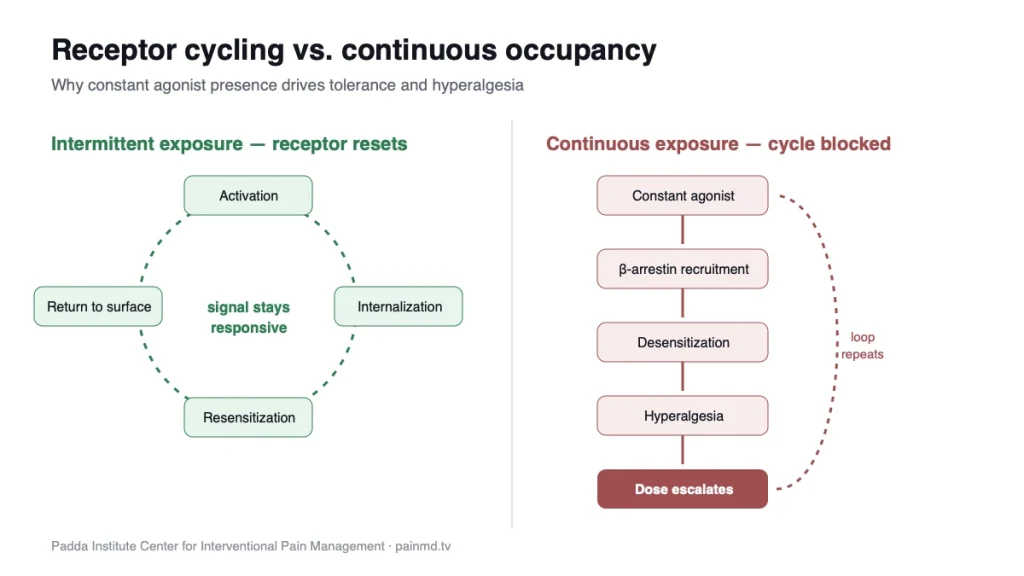
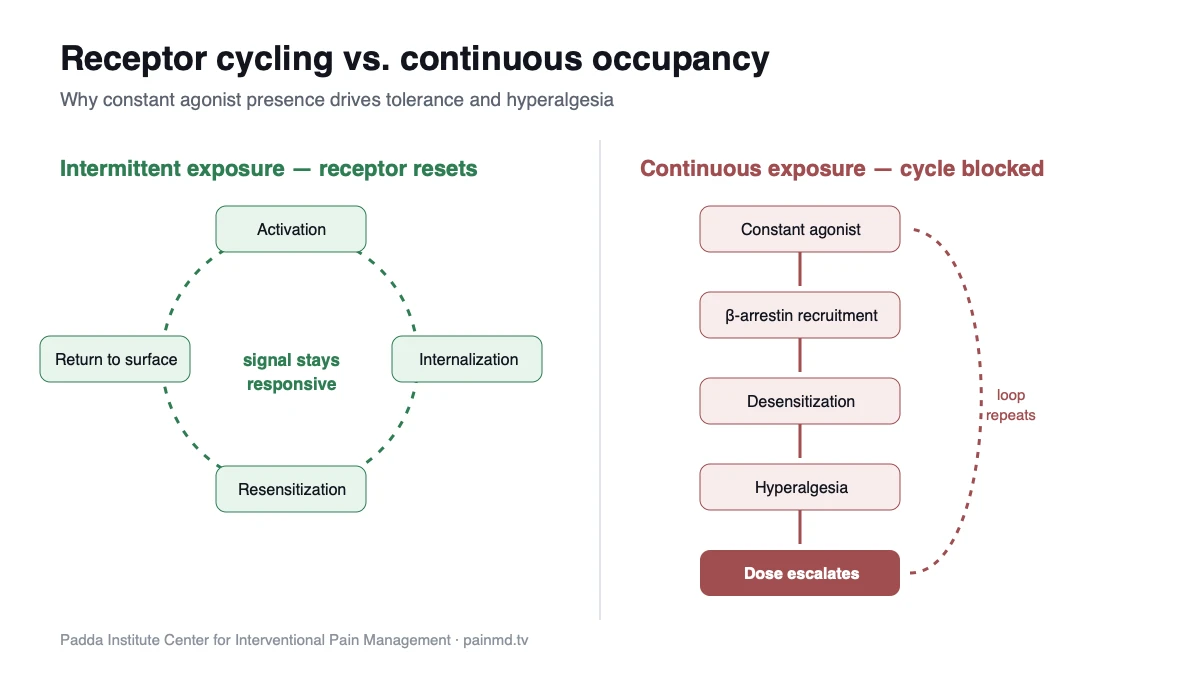
The mu-opioid receptor is a G-protein-coupled receptor. Its regulation depends on phosphorylation of the C-terminal tail domain, which recruits beta-arrestin proteins and drives receptor internalization. That cycle — activation, internalization, resensitization, return to the surface — is not a defect. It is how the system stays responsive.
When an agonist is constantly present, the loop cannot complete. The receptor desensitizes and uncouples, and the signal it was built to carry degrades.
How that becomes more pain, not less
The downstream consequence is opioid-induced hyperalgesia — a paradoxical increase in pain sensitivity despite escalating doses. The patient hurts more, so the dose rises, so the receptor is occupied more continuously, so sensitivity increases further.
Alongside it runs central sensitization: the nervous system amplifying signals it once filtered. The analgesic return diminishes while the underlying pain state worsens.
Why long-acting formulations are the harder problem
Short-acting and long-acting opioids are not simply different schedules of the same drug. Long-acting agents produce near-continuous receptor occupancy, and in doing so they deny the nervous system the pharmacological rest periods required for resensitization and homeostasis.
Chronic exogenous stimulation also suppresses the body’s own production of endorphins and enkephalins. The endogenous system becomes less responsive to natural stimuli such as stress or physical activity, and patients lose the capacity for innate pain and mood modulation — a state best described as physiological insolvency. The external supply is losing power at the same time the internal supply is being spent down.
The pill-count paradox
Here is where clinical reality collides with metrics. Enforcement headlines quote raw tablet numbers, which pushes dispensing partners to encourage fewer units. The straightforward way to reduce unit count is to consolidate a patient onto longer-acting medication — which improves the prescribing ratio on paper while producing exactly the continuous receptor occupancy described above.
A lower pill count is not the same as a lower risk. We would rather defend a higher unit count at a genuinely low total morphine-equivalent dose than accept a tidier number achieved through receptor saturation. Our full protocol is set out for dispensing partners in our opioid stewardship guide.
What we do instead
We do not offer medication-only management. Opioids, where used at all, sit inside an interventional and metabolic program, at doses we work continuously to reduce — typically under 30–40 MME, with an average nearer 27–32.5 MME.
Patients typically arrive on more than 90 MME per day, after more than two and a half years in pain. Within 90 days of active interventional treatment, 21% are completely weaned off opioid pain medication; within one year, 34% are completely weaned off all opioid pain medication. Of those who cannot be fully weaned, the large majority are brought below 30 MME per day. The full breakdown is set out in our pill counts vs. pharmacology discussion. These are practice-reported figures from our own population, not trial outcomes, and individual results vary; they were published publicly on International Overdose Awareness Day, August 31, 2026 — see the announcement.
Restoring the endogenous system matters as much as reducing the exogenous one. Sleep and circadian health are central to that, because deep sleep is when the body recharges its own pain-relieving chemistry — see circadian rhythm disruption and chronic pain and artificial light at night.
Frequently asked questions
What is opioid-induced hyperalgesia?
It is a paradoxical state in which pain sensitivity increases despite escalating opioid doses. It arises when continuous receptor occupancy causes desensitization and uncoupling of the mu-opioid receptor, so the same or higher dose produces less relief and greater sensitivity. Individual results vary.
The detail is in Is Your Pain Medication Making Your Pain Worse?.
Does this mean opioids are always harmful?
No. Opioids have a legitimate role, particularly in acute, cancer and perioperative pain. The concern is chronic, continuous exposure without a plan to reduce it, and especially long-acting formulations that never allow receptor resensitization. Do not start, stop, or change any prescribed medication on your own — that decision belongs with your physician.
Pill Counts vs. Pharmacology: What Pharmacists and Referring Physicians Should Know goes through it in detail.
If my pill count went down, isn’t that safer?
Not necessarily. Unit count and pharmacological risk are different measures. Consolidating onto longer-acting medication lowers the tablet number while increasing continuous receptor occupancy. Total morphine-equivalent dose and the pattern of exposure matter more than the number of tablets.
Where are you located and how do I make an appointment?
Padda Institute Center for Interventional Pain Management, 4477 Woodson Rd, Suite 100, St. Louis, MO 63134. Book at painmd.tv/appointment/ or call (314) 481-5000.
Addresses, hours and directions are listed on our Locations page.
Key takeaways
- The mu-opioid receptor depends on a cycle of internalization and resensitization to stay responsive.
- Continuous agonist presence causes desensitization, contributing to opioid-induced hyperalgesia.
- Long-acting formulations deny the nervous system the pharmacological rest that cycle requires.
- Chronic exposure also suppresses endogenous endorphins — a state of physiological insolvency.
Medically reviewed by Dr. Gurpreet Singh Padda, MD, MBA, MHP — Board Certified in Anesthesiology, Pain Medicine, Interventional Pain Management, Addiction Medicine, and Obesity Medicine. Last reviewed July 2026.
This article is educational and is not a substitute for evaluation, diagnosis, or treatment by a physician. Individual results vary. Do not start, stop, or change any medication without consulting your physician.
References
Ray 2016 and Miller 2015 are observational and cannot exclude confounding by indication; Birdsong 2015 is cellular work describing a receptor mechanism, not a clinical outcome. Reference 8 is included as counter-evidence.
- Birdsong WT, Arttamangkul S, Bunzow JR, Williams JT. Agonist binding and desensitization of the μ-opioid receptor is modulated by phosphorylation of the C-terminal tail domain. Mol Pharmacol. 2015 Oct;88(4):816–24. PMID 25934731.
- Angst MS, Clark JD. Opioid-induced hyperalgesia: a qualitative systematic review. Anesthesiology. 2006 Mar;104(3):570–87. PMID 16508405.
- Higgins C, Smith BH, Matthews K. Evidence of opioid-induced hyperalgesia in clinical populations after chronic opioid exposure: a systematic review and meta-analysis. Br J Anaesth. 2019 Jun;122(6):e114–e126. PMID 30915985.
- Mercadante S, Arcuri E, Santoni A. Opioid-induced tolerance and hyperalgesia. CNS Drugs. 2019 Oct;33(10):943–55. PMID 31578704.
- Clauw D. Hijacking the endogenous opioid system to treat pain: who thought it would be so complicated? Pain. 2017 Dec;158(12):2283–4. PMID 28957836. (Editorial.)
- Ray WA, Chung CP, Murray KT, Hall K, Stein CM. Prescription of long-acting opioids and mortality in patients with chronic noncancer pain. JAMA. 2016 Jun 14;315(22):2415–23. PMID 27299617.
- Miller M, Barber CW, Leatherman S, Fonda J, Hermos JA, Cho K. Prescription opioid duration of action and the risk of unintentional overdose among patients receiving opioid therapy. JAMA Intern Med. 2015 Apr;175(4):608–15. PMID 25686208.
- Chu LF, D’Arcy N, Brady C, et al. Analgesic tolerance without demonstrable opioid-induced hyperalgesia: a double-blinded, randomized, placebo-controlled trial of sustained-release morphine for chronic nonradicular low-back pain. Pain. 2012 Aug;153(8):1583–92. PMID 22704854. Counter-evidence — found tolerance without demonstrable hyperalgesia.
Find the source of your pain — not just the signal
Padda Institute Center for Interventional Pain Management builds a customized, root-cause plan for each patient. Interventional care and metabolic medicine, under one roof in St. Louis.
Or call (314) 481-5000 or text (314) 886-5902 — 4477 Woodson Rd, Suite 100, St. Louis, MO 63134.
Msg & data rates may apply. Reply STOP to opt out, HELP for help. Text is not a secure channel — please don’t send medical or personal health information by text, and don’t use text for emergencies.
Opioid stewardship & pain neurobiology
- Is your pain medication making your pain worse?
- Opioid bankruptcy: why opioids stop working
- Pill counts vs. pharmacology: what pharmacists should know
- Why long-acting opioids can make pain worse
- Opioid stewardship: what pharmacists and referring physicians should know
Dr. Gurpreet Singh Padda, MD, MBA, MHP