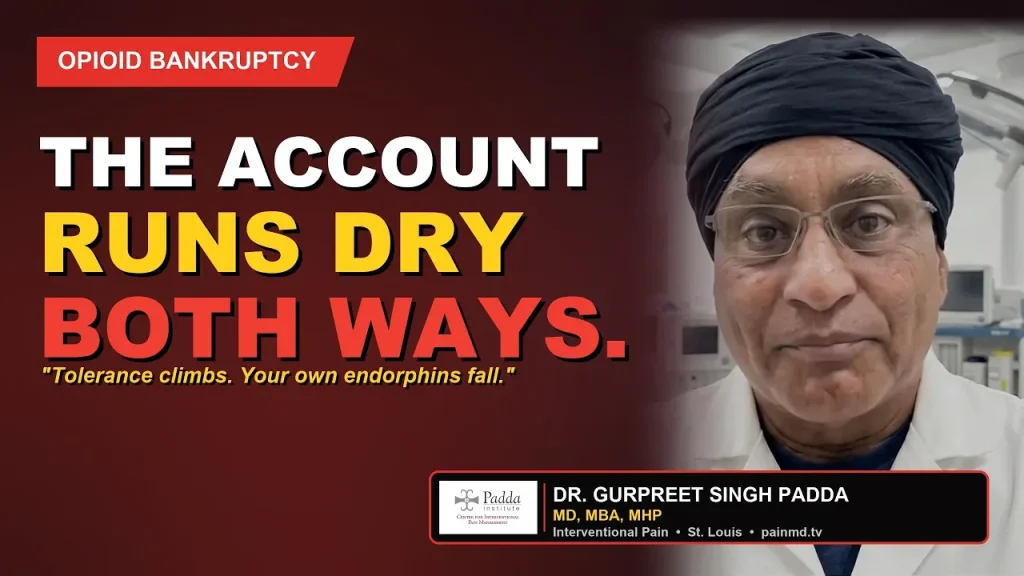
Bankruptcy is not the same as spending too much. Bankruptcy is what happens when income collapses at the same time as expenses rise — two things going wrong at once, from opposite directions, until the account cannot be balanced.
That is a useful way to describe what long-term opioid therapy can do to your pain-control system, and it is why some patients reach a point where nothing works and every dose feels smaller than the last.
Side one: the external supply loses power
This side is not controversial. Give the nervous system a narcotic and it begins adapting immediately. Receptors desensitize, signaling downregulates, and the same dose does less. The dose has to climb to achieve the same effect.
That escalation is not a sign of weakness or drug-seeking. It is predictable neurobiology. The receptor-level detail is covered in why long-acting opioids can make pain worse, and the way it can tip into amplified pain is covered in Is your pain medication making your pain worse?.
Side two: the internal supply is depleted
This is the half almost nobody explains to patients, and it is where the word bankruptcy earns its keep. You are not a passive recipient of pain relief — you manufacture your own. Your body produces endorphins and enkephalins, endogenous opioids, and they are a major part of why you are not in pain all of the time.
Chronic external opioid exposure suppresses that internal machinery, and here the evidence is genuinely strong because it has been measured in the endocrine system. Vuong and colleagues reviewed the effects of opioids on human endocrine function in Endocrine Reviews; chronic therapy suppresses the hypothalamic-pituitary-gonadal axis, and the clinical form — opioid-induced androgen deficiency — has its own literature. Low testosterone, fatigue, flat mood and poor recovery belong to that picture.
Then add sleep, which is where the account really drains. Deep sleep is when the body recharges its own pain-control systems. Krause and colleagues showed in the Journal of Neuroscience that sleep deprivation amplifies pain reactivity while blunting the circuits that normally dampen it. One bad night measurably lowers the pain threshold the next day.
Stack it together: suppressed endogenous signaling, a suppressed hormonal axis, disrupted sleep — while the external drug loses potency and the dose climbs. Income down, expenses up.
Where this model stops
We should be straight about the limits. “Opioid bankruptcy” is a clinical framework that describes two documented processes happening together. It is not one proven mechanism. A careful experimental study by Chu and colleagues found that the endogenous opioid system did not appear to mediate opioid-induced hyperalgesia specifically, so the mechanisms are separable and the science is still being worked out.
What is not in doubt: tolerance is real, endocrine suppression is real, and sleep loss lowering pain threshold is real. Whether the combination is called bankruptcy is a matter of language. Whether it is happening is not.
Why the weight comes on
Your endogenous opioid system does not only handle pain. It handles pleasure — specifically the liking of things. Work from Berridge and colleagues mapped what they call hedonic hotspots, brain regions where mu-opioid signaling directly amplifies how pleasurable something feels. That is animal work, and we flag it as such, but it establishes the principle: mu-opioid signaling is a pleasure-amplification system, not only an analgesic one.
Suppress it with chronic external opioids and baseline pleasure flattens. The body then looks for something that still works, and highly palatable, refined food works quickly and reliably. We call this hedonic substitution, and it is common in patients who are gaining weight on long-term opioids and being told they lack discipline. They do not lack discipline — their reward system has been flattened and food is the most available lever left. The weight gain then drives more metabolic inflammation, which drives more pain.
Exposure is not destiny
This leads to the thing most worth changing in how addiction is discussed. We tend to treat it as purely a matter of exposure — as though the molecule reliably produces the disease and the only variable is how much was given. That model is why the national response was to reduce prescriptions and expect the crisis to resolve. It did not resolve.
The exposure model is contradicted by one of the best natural experiments in addiction medicine. In 1971, amid alarm about heroin use among American soldiers in Vietnam, Lee Robins — an epidemiologist at Washington University in St. Louis — was funded by the Department of Defense, the National Institutes of Health and the Veterans Administration to follow these men home. Roughly 20% had become addicted to opioids in-theater. In the first year home only about 5% had relapsed into addiction; after three years, about 12%. Most received no treatment at all.
It was not a fluke. It was a change of context. The molecule did not change — the cues, the stress, the availability, the peer group and the absence of purpose did. Volkow, Koob and McLellan set out the modern version of this in the New England Journal of Medicine: a model that explicitly incorporates social and environmental determinants rather than treating exposure as destiny.
Which is why, when we ask about your sleep, your food, your work and who is at home, it is not small talk. It is the terrain that will determine whether you recover.
Rebuilding the account
Restoring the internal system is most of what treatment actually is: protect deep sleep and correct circadian misalignment; eat whole food with adequate protein and healthy fat; move, because physical activity supports endogenous opioid signaling; treat the structural pain generator directly so the medication has less work to do; and address the psychological and social load with real support.
Then reduce the external supply slowly, as the internal supply comes back online — never on your own, and never on an arbitrary schedule. Accounts can be rebuilt.
Related reading: Pill counts vs. pharmacology sets out what we tell pharmacists and referring physicians, and our opioid stewardship protocol is published in full. See also interventional pain management in St. Louis and our pain treatment FAQs.
Frequently asked questions
What does “opioid bankruptcy” mean?
It describes the account running dry from both ends. On one side, escalating opioid doses drive tolerance as the nervous system adapts. On the other, your body has its own internal opioid system, and chronic external opioids plus disrupted sleep and circadian misalignment impair it. So the external supply loses power while the internal supply is being depleted. It is a clinical framework describing two documented processes together, not a single proven mechanism with one lab test.
Is there real evidence that opioids suppress your own system?
Yes, and it is strongest in the endocrine data. Chronic opioid therapy suppresses the hypothalamic-pituitary-gonadal axis; the clinical form has a name, opioid-induced androgen deficiency, and has been reviewed repeatedly. Low testosterone, fatigue, low mood, low libido and poor recovery are part of that picture rather than incidental to it.
How does sleep affect my pain threshold?
Deep sleep is when the body recharges its own pain-control systems. Experimental work has shown that sleep deprivation amplifies pain reactivity in the brain’s sensory regions while blunting the circuits that normally dampen that signal. One poor night measurably lowers pain threshold the next day, which is why sleep and circadian repair are treated as part of the plan rather than lifestyle advice.
Why do I keep gaining weight on long-term opioids?
Your endogenous opioid system does not only handle pain — it amplifies pleasure. Animal work has mapped brain regions where mu-opioid signaling directly increases how pleasurable something feels. When that system is suppressed by chronic external opioids, baseline pleasure flattens and highly palatable food is the most available substitute. That is a physiological pattern, not a failure of discipline, and the resulting weight gain drives more metabolic inflammation and more pain. Individual results vary.
Isn’t addiction just a matter of how much opioid someone was given?
The evidence says exposure is not destiny. Roughly 20% of American enlisted men became addicted to opioids while serving in Vietnam. After returning home, only about 5% had relapsed within the first year and about 12% within three years — most with no treatment at all. The molecule did not change; the environment did. Addiction is better understood as a metabolic and social phenomenon expressed through neurobiology than as a simple dose-response.
Where are you located and how do I make an appointment?
Padda Institute Center for Interventional Pain Management, 4477 Woodson Rd, Suite 100, St. Louis, MO 63134. Book at painmd.tv/appointment/, call (314) 481-5000 or text (314) 886-5902.
Key takeaways
- Long-term opioid therapy can drain pain control from both ends: tolerance rises while endogenous opioid and hormonal signaling falls.
- The endocrine half is well documented — chronic opioids suppress the hypothalamic-pituitary-gonadal axis.
- Sleep loss measurably lowers pain threshold, which is why sleep repair is treatment rather than advice.
- Weight gain on opioids often reflects hedonic substitution — a flattened reward system, not a failure of willpower.
- The Vietnam veteran data shows exposure is not destiny: about 20% were addicted in-theater, roughly 5% relapsed in the first year home.
- Rebuilding sleep, nutrition, movement and the social terrain is what allows the external dose to come down safely.
Services referenced in this article
- Counseling for chronic pain — in-house psychological support
- Lifestyle medicine — sleep, nutrition, movement and metabolic markers
- Medical weight loss — physician-led, coaching through medication
Find what is driving the pain — not just the signal
The Padda Institute builds a physician-led plan that treats the pain generator and the metabolic terrain around it, so medication has less work to do.
Or call (314) 481-5000 or text (314) 886-5902 — 4477 Woodson Rd, Suite 100, St. Louis, MO 63134.
Msg & data rates may apply. Reply STOP to opt out, HELP for help. Text is not a secure channel — please don’t send medical or personal health information by text, and don’t use text for emergencies.
Medically reviewed by Dr. Gurpreet Singh Padda, MD, MBA, MHP — Board Certified in Anesthesiology, Pain Medicine, Interventional Pain Management, Addiction Medicine, and Obesity Medicine. Last reviewed July 2026.
This article is educational and is not a substitute for evaluation, diagnosis, or treatment by a physician. Individual results vary. Do not start, stop, or change any medication without consulting your physician. Opioid withdrawal can be medically hazardous and abrupt discontinuation carries real risk.
References
- Vuong C, Van Uum SH, O’Dell LE, Lutfy K, Friedman TC. The effects of opioids and opioid analogs on animal and human endocrine systems. Endocr Rev. 2010;31(1):98–132. PMID 19903933.
- Smith HS, Elliott JA. Opioid-induced androgen deficiency (OPIAD). Pain Physician. 2012;15(3 Suppl):ES145–56. PMID 22786453.
- Antony T, Alzaharani SY, El-Ghaiesh SH. Opioid-induced hypogonadism: pathophysiology, clinical and therapeutics review. Clin Exp Pharmacol Physiol. 2020;47(5):741–50. PMID 31886562.
- Krause AJ, Prather AA, Wager TD, Lindquist MA, Walker MP. The pain of sleep loss: a brain characterization in humans. J Neurosci. 2019;39(12):2291–2300. PMID 30692228.
- Castro DC, Berridge KC. Opioid and orexin hedonic hotspots in rat orbitofrontal cortex and insula. PNAS. 2017;114(43):E9125–34. PMID 29073109. Animal study.
- Robins LN. Vietnam veterans’ rapid recovery from heroin addiction: a fluke or normal expectation? Addiction. 1993;88(8):1041–54. PMID 8401158.
- Volkow ND, Koob GF, McLellan AT. Neurobiologic advances from the brain disease model of addiction. N Engl J Med. 2016;374(4):363–71. PMID 26816013.
- Chu LF, Dairmont J, Zamora AK, Young CA, Angst MS. The endogenous opioid system is not involved in modulation of opioid-induced hyperalgesia. J Pain. 2011;12(1):108–15. PMID 20864417. Counter-evidence to the depletion framing.
Dr. Gurpreet Singh Padda, MD, MBA, MHP