This is a long-form interview on a channel that advocates a carnivore diet. The section below on elimination diets sets out where I agree with that position and where I think the evidence does not yet support it.
Obesity, type 2 diabetes and metabolic syndrome are treated in most clinics as chronic conditions to be managed indefinitely with escalating medication. The alternative position is that they are substantially driven by diet, and that changing the input can change the disease rather than only its markers.
That is a strong claim. This article sets out the case for it, and is specific about its limits.
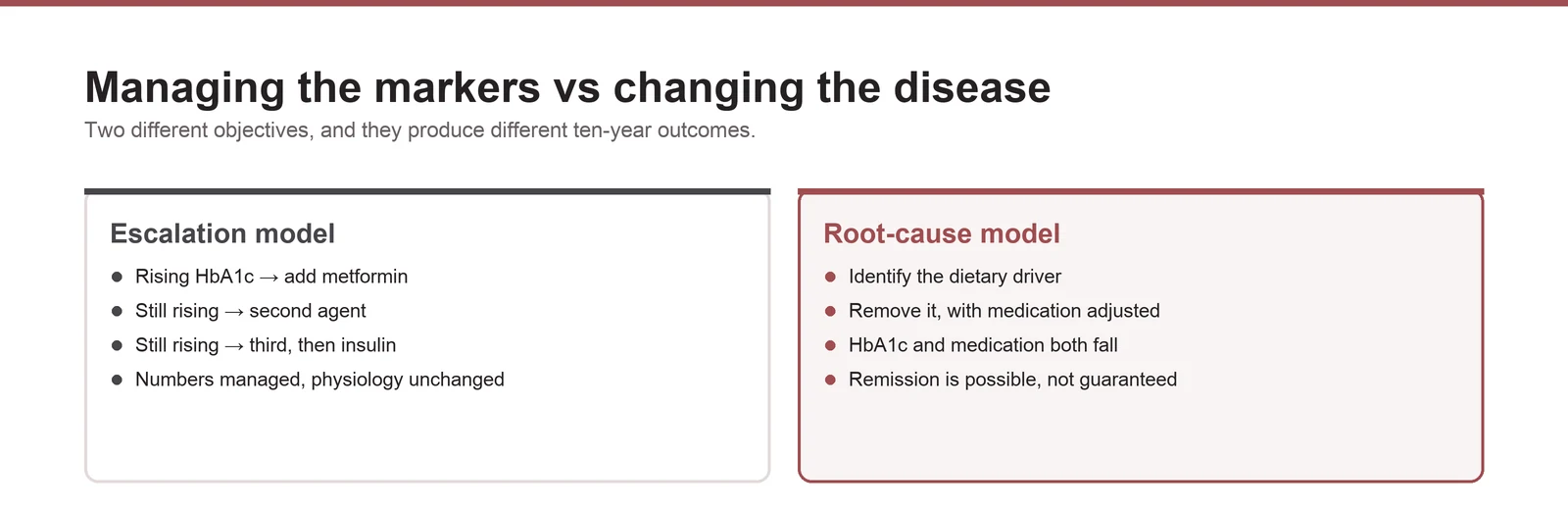
Managing markers versus changing the disease
Consider what standard management optimizes for.
A patient with rising HbA1c receives metformin. If HbA1c continues to rise, a second agent is added, then a third, then insulin. Each step improves the number. Very few of those steps address why glucose is rising in the first place.
That is not a criticism of the individual physicians making those decisions — within a fifteen-minute visit and a system that reimburses prescribing far better than it reimburses dietary work, escalation is the path of least resistance.
But it produces a specific outcome: a patient whose numbers look managed, on more medication every year, whose underlying physiology is unchanged or worse.
Why the dietary lever is the strongest one available
Three pieces of evidence make diet the highest-leverage intervention for this cluster.
Carbohydrate restriction outperforms on the markers that matter. A 2015 position paper by Feinman and twenty-five co-authors argued that dietary carbohydrate restriction is the single most effective intervention for reducing the features of metabolic syndrome, with the largest reductions in HbA1c and in medication requirement — and critically, these occur independently of weight loss.<sup>1</sup> It is a position paper rather than a single trial, and should be weighed as an argued case.
Remission is achievable, and has been demonstrated in trials. The DiRECT trial produced remission of type 2 diabetes in 46% of intervention participants at 12 months, against 4% of controls, using primary-care-delivered weight management.<sup>2</sup> Virta’s continuous-care model with nutritional ketosis reported that 94% of patients on insulin reduced or eliminated it at one year.<sup>3</sup> These are real, published, and considerably better than the “chronic progressive disease” framing most patients are given.
Low-fat guidance, the main dietary alternative, failed when tested. Fifty-three randomized trials and 68,128 participants found no long-term weight advantage for low-fat diets.<sup>4</sup> The Women’s Health Initiative sustained a low-fat diet in 48,835 women for eight years and produced no significant weight loss and no cardiovascular benefit.<sup>5</sup>
Where I agree with the carnivore position, and where I do not
This interview was recorded on a channel that advocates an all-meat diet, so it would be evasive not to address it directly.
Where the reasoning holds. Radical elimination of refined carbohydrate, added sugar and industrial seed oil produces rapid and often dramatic metabolic improvement. Patients who adopt very restrictive animal-based diets frequently see fast falls in glucose, insulin, triglycerides and inflammatory markers, and often report reduced pain. The direction of that effect is consistent with everything above, and it is not mysterious — removing the drivers works.
Where the evidence does not go. There is no long-term randomized trial of a carnivore diet. The available human data is largely self-reported survey work in self-selected enthusiasts, which cannot establish safety or efficacy. Legitimate open questions remain about fiber intake, the microbiome, micronutrients and long-term cardiovascular outcomes.
My clinical read is that the elimination is doing most of the work — removing sugar, refined grain and seed oil — rather than the exclusivity of meat specifically. That distinction matters, because it means most of the benefit is available from a less restrictive diet that is easier to sustain and has better long-term evidence behind it.
If a patient does well on a very restrictive approach and is monitored, I do not argue with results. I would not present it as established medicine, and anyone doing so is going past the data.
Safety, which is not optional here
Dietary change of this magnitude is a medical intervention and needs to be supervised when you are on medication.
Carbohydrate restriction lowers blood glucose quickly. On insulin or a sulfonylurea, that risks hypoglycemia. SGLT2 inhibitors carry a specific risk of euglycemic ketoacidosis when carbohydrate intake drops. Blood pressure often falls too, so antihypertensive doses may need reducing.
The correct sequence is to change the diet with your prescriber, adjusting medication as the numbers move. Do not start, stop, or change any medication on your own.
Frequently asked questions
Can type 2 diabetes actually be put into remission?
Yes, and it has been shown in trials. DiRECT achieved remission in 46% of intervention participants at 12 months versus 4% of controls, defined as HbA1c below 6.5% after at least two months off all diabetes medication. Remission is not the same as cure — it can be lost if the driving conditions return. Individual results vary.
See Type 2 Diabetes Remission and What It Does to Chronic Pain.
Is the carnivore diet proven to treat metabolic disease?
No. There is no long-term randomized trial of a carnivore diet, and the available human data is mostly self-reported survey work in people who chose it. Rapid improvement is frequently observed, and my read is that most of it comes from eliminating sugar, refined grain and seed oil rather than from eating only meat. That benefit is largely available from less restrictive approaches with better evidence.
This is set out in Sugar, Refined Grain and Seed Oil: The Mechanism Behind Each One.
Do I have to eliminate all carbohydrate to benefit?
No. Carbohydrate tolerance varies widely between individuals, and benefit appears on a dose-response curve rather than at a single threshold. The largest HbA1c and medication reductions are seen at ketogenic levels, but meaningful improvement occurs well short of that. The practical question is how much your metabolism tolerates.
There is more on this in Sugar, Refined Grain and Seed Oil: The Mechanism Behind Each One.
Is it safe to make these changes while on diabetes medication?
Only with supervision. Carbohydrate restriction lowers glucose fast, which risks hypoglycemia on insulin or a sulfonylurea, and SGLT2 inhibitors carry a risk of euglycemic ketoacidosis. Doses frequently need reducing as the diet changes. Do not start, stop, or change any medication without consulting your physician.
Type 2 Diabetes Remission and What It Does to Chronic Pain goes through it in detail.
Where can I do this with medical supervision?
Padda Institute Center for Interventional Pain Management is at 4477 Woodson Rd, Suite 100, St. Louis, MO 63134, next to St. Louis Lambert International Airport, with a second location at 12174 Natural Bridge Rd, St. Louis, MO 63044. The practice serves the St. Louis region across Missouri and Illinois. Call (314) 481-5000 or text (314) 886-5902, Monday to Friday, 8:00 AM to 5:00 PM.
The detail is in What 53 Trials and 68,128 People Actually Showed About Low-Fat Diets.
Key takeaways
- Standard escalation optimizes the numbers without addressing why they are rising.
- Carbohydrate restriction produces the largest HbA1c and medication reductions, independently of weight loss.
- Remission is real and trial-demonstrated: 46% at 12 months in DiRECT; 94% of insulin users reduced or eliminated insulin in Virta’s cohort.
- Carnivore diets lack long-term trial evidence; the elimination is likely doing the work, not the exclusivity.
- Dietary change of this size is a medical intervention — medication needs adjusting alongside it.
Medically reviewed by Gurpreet Singh Padda, MD — Board Certified in Anesthesiology, Pain Medicine, Interventional Pain Management, Addiction Medicine, and Obesity Medicine. Last reviewed July 2026.
This article is educational and is not a substitute for evaluation, diagnosis, or treatment by a physician. Individual results vary. Do not start, stop, or change any medication without consulting your physician. To be evaluated, request an appointment or call (314) 481-5000.
References
- Feinman RD, Pogozelski WK, Astrup A, et al. Dietary carbohydrate restriction as the first approach in diabetes management: critical review and evidence base. Nutrition. 2015;31(1):1–13.
- Lean MEJ, Leslie WS, Barnes AC, et al. Primary care-led weight management for remission of type 2 diabetes (DiRECT): an open-label, cluster-randomised trial. The Lancet. 2018;391(10120):541–551.
- Hallberg SJ, McKenzie AL, Williams PT, et al. Effectiveness and safety of a novel care model for the management of type 2 diabetes at 1 year: an open-label, non-randomized, controlled study. Diabetes Therapy. 2018;9(2):583–612.
- Tobias DK, Chen M, Manson JE, Ludwig DS, Willett W, Hu FB. Effect of low-fat diet interventions versus other diet interventions on long-term weight change in adults. Lancet Diabetes & Endocrinology. 2015;3(12):968–979.
- Howard BV, Manson JE, Stefanick ML, et al. Low-fat dietary pattern and weight change over 7 years: the Women’s Health Initiative Dietary Modification Trial. JAMA. 2006;295(1):39–49.
Get evaluated by a physician who treats the terrain, not just the signal
Chronic pain, metabolic disease and trauma physiology reinforce each other. At the Padda Institute they are assessed together, because treating one alone underperforms.
Or call or text (314) 481-5000.
For patients seen here, dietary root-cause work is delivered through physician-led medical weight loss and lifestyle medicine alongside pain care.
Dr. Gurpreet Singh Padda, MD, MBA, MHP