She is fifty-one. Vegetables at every meal, whole grains, beans, almost nothing out of a packet, and three years of bloating and loose stools nobody has explained. If you searched glyphosate side effects after reading a label like hers, the answer starts where she was not looking: on the produce, not in the packet.
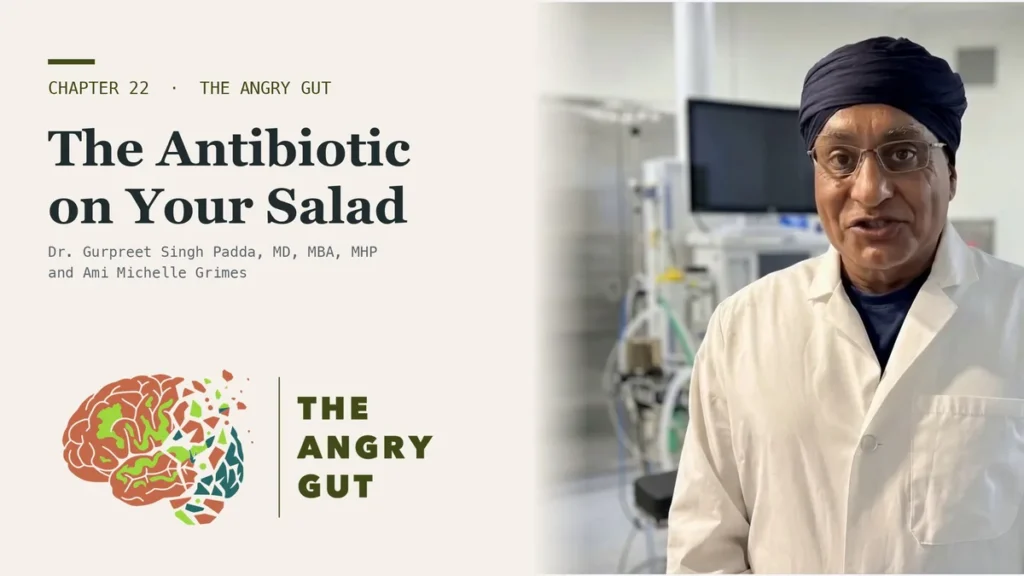
The chapter video, The Antibiotic on Your Salad, makes the case in under ten minutes. What follows is what a pain practice needs from it, because a first brain under selective pressure does not keep the trouble inside the abdomen.
The intake form counts antibiotic courses. I ask everyone how many rounds of amoxicillin they have swallowed, and for most of my career I never asked what had been sprayed on their salad.
The enzyme you do not own, and your bacteria do
Glyphosate does one thing. It blocks 5-enolpyruvylshikimate-3-phosphate synthase, the enzyme plants and microbes use to build phenylalanine, tyrosine and tryptophan through the shikimate pathway. Human cells never had that pathway, which is the entire safety argument, and on the human cell it is true. You cannot jam a lock you do not have.
Then finish the sentence. Sorted into sensitive and resistant structural classes across thousands of species, 54% of the species in the core human gut microbiome land in the sensitive column, and the authors called that conservative. Your cells do not carry the target. Half your commensals do, and only the first half of that sentence was ever tested. The compounds engineered into packaged food were at least tested in something alive. This one was built to kill bacteria, then sprayed across the food supply for fifty years without ever being tested against a human gut community.
The objection is fair and it belongs here. A second group read expression rather than gene presence, across 734 paired metagenomes and 2,144 human fecal metagenomes, and found most gut bacteria lack a complete shikimate pathway, that where it exists it is largely switched off, and that most scavenge aromatic amino acids instead. Two computer surveys, opposite answers, neither one measuring a living community. That is the tier, which is why the tiebreaker has to be an animal.
The vacancy is the injury, not the kill
The culture work behind the popular version had the damage running in the worst direction. In broth, Salmonella Enteritidis, Salmonella Typhimurium and Clostridium perfringens were highly resistant, while Enterococcus faecalis, Enterococcus faecium, Bifidobacterium adolescentis and the Lactobacillus species were susceptible. Those were poultry isolates in a dish in 2013, before the class framework existed, so susceptibility there is phenotype and nothing more, and Campylobacter was susceptible too.
The direction still matters, because it is the reverse of what you want from anything in food. The authors read the loss of Enterococcus as what lets clostridia expand. A pressure that clears the organisms holding a niche and spares the ones waiting to take it does not sterilize a gut. It re-staffs the community, and whoever ends up holding the niche is what you live with for years.
Measured in the gut, invisible in the blood
Two rodent experiments sit at doses a regulator signed off on. Mice at roughly the American acceptable daily intake of 1.75 mg/kg showed altered gut microbiota composition, more pro-inflammatory CD4 IL-17A T cells and more lipocalin-2, a marker of intestinal inflammation. That is a mouse, and the word low-dose in its title needs a footnote the title never gives it: the dose runs on the order of a hundred times realistic human intake.
Rats drank it for ninety days at the European daily allowance and at two higher no-effect levels. Shikimic acid and 3-dehydroshikimic acid piled up in the cecum, the pouch where the colon begins. That is the fingerprint of the target enzyme being blocked inside a living mammal at a legal dose, and those altered cecal metabolites were not reflected in serum. One detail cuts against the tidy version: shikimic acid itself could not be quantified in serum because protein interference compromised recovery, so part of that silence is the assay rather than the animal.
Safety testing looks in blood. The measurable event is downstream in the cecum. The ninety-day dog work that anchors the European limit was built to watch a dog, and nobody then believed its flora was worth counting. Follow the incentive rather than a villain: a compound that is cheap and effective gets used at scale, and no line item pays anyone to sample a cecum. That is an accounting decision, not a conspiracy.
The window where a pain patient is most exposed
Here is the part the surveys cannot settle, and the part that turns clinical. Expression measured in a settled adult gut reports what the pathway does today, in people who are not sick. It says nothing about a community rebuilding after antibiotics, after abdominal surgery, after an inpatient stay, the moments when bacteria must build their own aromatic amino acids rather than scavenge them. Silence at rest is not silence under load, and my patients live in that window.
Exposure itself is not in question. In a nationally representative American sample of 2,310 urine specimens, glyphosate was detectable in 81.2% of people aged six and older, at a median of 0.392 micrograms per liter, and people who had fasted more than eight hours had significantly lower levels. Fast and the number falls, which is how you know it came in with lunch.
The study that would settle this in a person has never been run, and not because the answer came back negative. Its entry criteria would exclude anyone with a disturbed bowel, a metabolic disease, a psychiatric diagnosis or a long medication list, which describes the patient carrying the symptoms. We use the measured mechanism instead and name the tier out loud, the same way we do when an exposure jams energy production before any panel flags it.
The thing sprayed is not the thing tested
No tank holds the pure molecule. What gets sprayed is a product, and the soap-like additives in it are there to help it soak into a leaf. Polyethoxylated amine surfactants, the first generation of those additives, were markedly more toxic than glyphosate itself; from the mid-1990s they gave way to compounds roughly a hundred times less toxic to human cells and to aquatic life. Regulators presume such co-formulants inert and largely leave them out of safety evaluation.
Against human cells, formulations were more cytotoxic than their active ingredients. In bacterial culture, the commercial product inhibited growth at concentrations where the active ingredient alone did not. So the acceptable daily intake is set on a molecule while the exposure is to a mixture, which is worse than it sounds: if the product is more active against bacteria than the pure compound, every reassurance built on the pure compound measured the wrong thing at the right dose, and that looks like an answer. It is why we work the measurable driver first and treat the unmeasurable one as a reason to change a habit rather than buy a test.
What we do with an exposure nobody can measure
I did not tell her that glyphosate is wrecking her microbiome. In people the measurement stops at urine. There is no number for her gut, no reference range, and nothing worth ordering.
I told her something narrower and more useful. A compound in her food is carried by four out of five Americans. Its whole mechanism is the inhibition of an enzyme her bacteria have and her cells do not. At a legal dose that enzyme is measurably blocked in the gut of a mammal, and the evidence never reaches the compartment safety testing samples.
Then we did the two things available. Her produce is washed, or organic where residue data say it matters, which is cheap and whose benefit is unquantified, and I said so out loud. The physiology under it is the fasting result: exposure arrives with meals and clears fast, so the lever is the source of whatever you eat raw, not a cleanse. The rest of the visit went to exposures I can measure and change, because three years of symptoms deserve the interventions with evidence behind them before the ones without. None of this is a reason to start or stop a medication, which is a conversation for you and the physician who holds your whole history.
The cost of doing nothing is not dramatic. It is another fifty years of the same silence, one salad at a time. The Deep Dive for Chapter 22 carries every study and every number behind these paragraphs, including what each result shows and what it cannot. Removing an antibiotic you cannot measure is still removing an antibiotic.
Frequently asked questions
Has glyphosate been shown to damage the gut microbiome in people?
No. Nobody has paired a person’s measured exposure with what lives in their gut, so a human result quoted either way is overselling. What exists is a census finding 54% of core gut species carry the target enzyme, culture work on poultry isolates, insect experiments and two rodent studies at accepted doses. A routine blood panel would have called every treated animal fine. Normal test results are often exactly what a mechanism predicts.
Does washing produce actually remove glyphosate?
Washing lowers surface residue and does nothing about what is inside the plant, so the honest description is a cheap step with an unquantified benefit. Changing the source of the produce you eat raw does more, because the exposure arrives with meals rather than accumulating for years. Food work is treatment here, not a handout at discharge. See how lifestyle medicine sits inside the plan.
Can pesticide residue explain bloating and loose stools?
It cannot be the answer you settle for, because nothing measurable in a person connects the two yet. Chase the causes that have a name, a test and a treatment first, then reduce the exposures you control. Diarrhea that began after an abdominal operation is the clearest example of a cause with all three. Loose stools after gallbladder surgery have their own diagnosis.
Should I buy a urine glyphosate test?
A single urine sample describes yesterday’s meals, not your gut and not your risk, and no reference range tells you what to do with the result. Spend the money on markers that change the next decision instead. Insulin and inflammatory markers qualify, because they move with food and they move with treatment. Insulin resistance shows up years before a glucose test catches it.
Bring the exposures you can change
When years of bloating, urgency or unexplained pain have outlasted every normal test, the useful next step is an evaluation of the terrain feeding them. Bring your medication history, your surgical history and a week of your own food labels.
Request an appointment, call (314) 481-5000, or text (314) 886-5902.
Sources
- Ferguson, S., Mesnage, R., & Antoniou, M. N. (2022). Cytotoxicity mechanisms of eight major herbicide active ingredients in comparison to their commercial formulations. Toxics, 10(11), 711. https://doi.org/10.3390/toxics10110711
- Lehman, P. C., Cady, N., Ghimire, S., Shahi, S. K., Shrode, R. L., Lehmler, H.-J., & Mangalam, A. K. (2023). Low-dose glyphosate exposure alters gut microbiota composition and modulates gut homeostasis. Environmental Toxicology and Pharmacology, 100, 104149. https://doi.org/10.1016/j.etap.2023.104149
- Leino, L., Tall, T., Helander, M., Saloniemi, I., Saikkonen, K., Ruuskanen, S., & Puigbò, P. (2021). Classification of the glyphosate target enzyme (5-enolpyruvylshikimate-3-phosphate synthase) for assessing sensitivity of organisms to the herbicide. Journal of Hazardous Materials, 408, 124556. https://doi.org/10.1016/j.jhazmat.2020.124556
- Mesnage, R., & Antoniou, M. N. (2020). Computational modelling provides insight into the effects of glyphosate on the shikimate pathway in the human gut microbiome. Current Research in Toxicology, 1, 25-33. https://doi.org/10.1016/j.crtox.2020.04.001
- Mesnage, R., Benbrook, C., & Antoniou, M. N. (2019). Insight into the confusion over surfactant co-formulants in glyphosate-based herbicides. Food and Chemical Toxicology, 128, 137-145. https://doi.org/10.1016/j.fct.2019.03.053
- Mesnage, R., Teixeira, M., Mandrioli, D., Falcioni, L., Ducarmon, Q. R., Zwittink, R. D., Mazzacuva, F., Caldwell, A., Halket, J., Amiel, C., Panoff, J.-M., Belpoggi, F., & Antoniou, M. N. (2021). Use of shotgun metagenomics and metabolomics to evaluate the impact of glyphosate or Roundup MON 52276 on the gut microbiota and serum metabolome of Sprague-Dawley rats. Environmental Health Perspectives, 129(1), 17005. https://doi.org/10.1289/EHP6990
- Ospina, M., Schütze, A., Morales-Agudelo, P., Vidal, M., Wong, L.-Y., & Calafat, A. M. (2022). Exposure to glyphosate in the United States: Data from the 2013-2014 National Health and Nutrition Examination Survey. Environment International, 170, 107620. https://doi.org/10.1016/j.envint.2022.107620
- Shehata, A. A., Schrödl, W., Aldin, A. A., Hafez, H. M., & Krüger, M. (2013). The effect of glyphosate on potential pathogens and beneficial members of poultry microbiota in vitro. Current Microbiology, 66(4), 350-358. https://doi.org/10.1007/s00284-012-0277-2
Dr. Gurpreet Singh Padda, MD, MBA, MHP