A scan shows nothing to operate on. Then a physician says a lot of it is probably stress, the patient hears that her pain is imaginary, and she stops coming back.
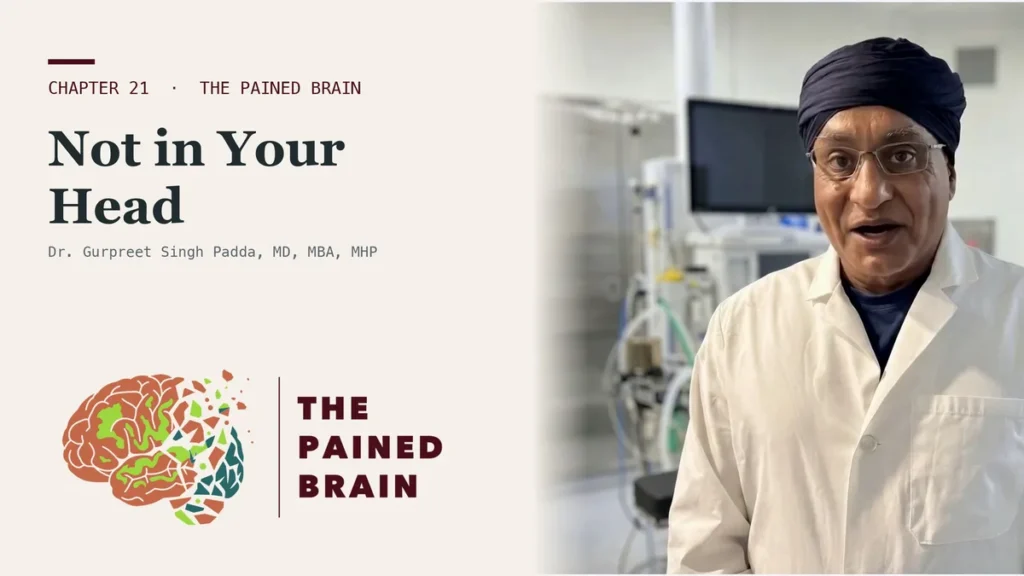
I am Dr. Gurpreet Singh Padda, MD, MBA, MHP, and the video above is Chapter 21 of The Pained Brain, written with Dr. KrisJay Fucanan, MD. Chronic pain and depression are not two conditions that happen to share a patient. They are one physiology with two names, which is why plans aimed at only one of them keep stalling in the same place.
The model was written to widen the search
The biopsychosocial model has a birthday. In 1977 a psychiatrist argued that the dominant model of disease left no room for the social, psychological and behavioral sides of illness. The sentence in the modern literature that matters most to a patient is about direction: many practitioners do not realize these associations run both ways. Pain produces distress and broken sleep, and distress and broken sleep produce pain, through tissue.
Used as an ending instead of a beginning, the model does damage with its own literature. A synthesis of 82 qualitative studies covering 2,434 women with chronic pain catalogues visits where clinicians questioned whether the illness was real, and what that cost in credibility, agency and access to care. The model was built to end that conversation, not to hand it a vocabulary.
How much psychology actually predicts
A predictor is not a cause, and the honest size is moderate. Across 46 samples and 9,579 patients, fear of pain correlated with disability at .42, rising to .50 once measurement error was removed, and neither age nor sex changed that. After knee replacement, where roughly one in four patients develops persistent pain, catastrophizing raised the absolute risk by 23%, severe acute postoperative pain by 30% and higher preoperative pain by 35%, while body mass index and range of motion predicted nothing. Among 3,276 women followed after breast cancer surgery, anxiety and depression before the operation predicted pain a year out at correlations of 0.15 to 0.22, weak in the authors’ own word, though significant.
Psychology is a real predictor. It is not the whole prediction, and it is not the whole cause.
Where mood stops being only psychological
Depression is, in a measurable subgroup, an inflammatory state. Pooled across 24 studies, tumor necrosis factor ran 3.97 picograms per milliliter higher in depressed people and interleukin-6 ran 1.78 higher than in controls. In pooled data, 27% of depressed patients had a C-reactive protein above 3 milligrams per liter and 58% above 1, at 1.46 times the odds of matched controls. Hold the limit next to the finding: roughly three quarters never cross the higher line, so this describes a subgroup, not a theory of depression.
The arrow also runs from body to mood. Children in the top third of interleukin-6 at age nine carried 1.55 times the odds of depression at eighteen. Catastrophizing, the thought pattern the questionnaires score, tracked the interleukin-6 rise after laboratory pain independently of how much pain people reported, while cortisol did not follow it.
The metabolic half of the same loop
Depression is also insulin resistance, in both directions. Across 21 studies the two were associated at a pooled effect of 0.19. Depression at baseline carried 1.60 times the risk of later type 2 diabetes, and diabetes carried 1.15 times the risk of later depression. In a nine-year Dutch cohort with no prior depression, the triglyceride-to-HDL ratio predicted a first episode of major depression at a hazard of 1.89, fasting glucose at 1.37, and prediabetes developing in the first two years at 2.66. The sugar moved first. Insulin resistance shows up years before a diagnosis, as the glucose test that misses it explains.
The drugs sit in the loop too. In 294,719 British adults, antidepressant use raised the rate of gaining 5% of body weight by a ratio of 1.21 that persisted for years, one extra weight-gain episode for every 27 people treated in the second year. That is not an argument against a prescription that is right for the patient. It is an argument for a weight and a fasting glucose on the chart before the first dose. In a midlife cohort followed seven years, the group whose biology took a metabolic form ran 2.00 times the relative risk of chronic pain that interferes with life, and 2.03 times the risk of hurting in three or more places, on absolute probabilities of 4.88 against 2.48 percent.
Loneliness is an exposure
Social isolation raised mortality by 29%, loneliness by 26% and living alone by 32%, and the counted and the felt versions did not differ. In chronically lonely people, 209 genes ran differently in their white blood cells, with glucocorticoid-response genes damped and NF-κB genes lifted, and cortisol did not explain the shift. Baseline loneliness predicted chronic pain seven years later at an odds ratio of 1.61, while isolation without loneliness came in at 1.05, which is nothing. Among 7,730 older adults, getting out of persistent loneliness dropped the risk of back pain to 0.76, while relief of severe back pain dropped the risk of later loneliness to 0.49. The driver that never shows up on a scan belongs on a problem list, not in small talk.
Push one input and the loop pushes back
Fixing sleep by itself leaves pain where it was. Among 100 people with knee arthritis and insomnia, cognitive therapy for insomnia normalized sleep in 76% against 48%, while pain fell 6.48 points against 6.12 on a 100-point scale, which is no difference; only the patients whose sleep improved most hurt less. In 367 older adults, combined sleep-and-pain therapy improved insomnia by 1.89 points and left pain severity unchanged between arms.
Surgery makes the same point. Pooling 44 studies and 21,452 spine surgery patients, 37% carried depression before the operation. They sat a standardized 0.52 worse going in and 0.52 worse coming out, and the amount they improved matched everyone else’s, a difference of 0.04. The operation works on the depressed patient. It does not treat the depression, so she lands where she started, minus the disc.
Expectation is real and it wears off. Across 130 studies the nocebo effect was a medium 0.522, so every clinician who says a spine is crumbling is prescribing. Sham physical and psychological treatments beat no treatment at all by a standardized 0.21 in the short term, which came to 39% of the treatments’ short-term effect, and nothing was detectable at medium or long term.
Small effects that stack, with the bridge in place
Combinations do what single layers cannot. When primary-care patients with depression and musculoskeletal pain got optimized antidepressant treatment plus pain self-management, 26.0% improved in both depression and pain against 7.9% with usual care, a relative risk of 3.3. Duloxetine is the one antidepressant a network analysis of 25 drugs was certain about: the odds of substantial relief rose 1.91-fold and pain moved a standardized 0.31, in trials that had mostly excluded the depressed patients who get the prescription. Food and movement carry their own physiology. Twelve weeks of a dietitian-delivered Mediterranean diet put 32.3% of depressed adults into remission against 8.0%, one remission for every 4.1 treated. Walking or jogging treats depression at an effect of 0.62, though a sensitized patient does not get the analgesia a healthy exerciser gets, so the dose has to be built up the way a drug is.
The procedures live inside the loop too. Across 346 patients in seven hospitals, three different procedures each gave about 1.8 points of relief, and what predicted failure was not anatomy: each point of depression score cut the odds of success to 0.94, and poor baseline function cut them to 0.59. That is not an argument against the needle. In 169 patients with cervical radicular pain, adding an epidural to conservative care produced a positive outcome in 56.9% at three months, against 26.8% for conservative care alone and 36.7% for the injection alone. The injection is the bridge, and what happens in the weeks it buys is the treatment. That logic runs through the chapter before this one, and the final chapter follows the patient home. The Chapter 21 supplement holds every study named here with its population, its numbers and what it cannot show.
Frequently asked questions
Is my chronic pain all in my head?
No. The numbers behind the psychological layer describe things measured in a body: a cytokine, a fasting glucose, a gene switched on in a white blood cell. Depression, sleep loss and isolation change tissue, which is why they change pain. A physician who stops at a psychological explanation has ended the workup instead of widening it. A scan that does not match the pain still has a physical explanation.
Which comes first, the pain or the depression?
Both, and that is the point. Pain and depression travel together 30 to 50 percent of the time, 36.7% of people with chronic pain carry a diagnosis of major depression, and the figure reaches 54.0% in fibromyalgia. Inflammation measured in childhood predicted depression years later, and pain predicts later low mood in people who started with neither. Metabolic inflammation is a shared road between them.
Can treating depression reduce pain?
Partly, and the sizes deserve honesty. Pain reprocessing therapy left 55% pain-free or nearly so at five years against 26% with placebo, and emotional awareness and expression therapy beat cognitive therapy by 1.59 points in older veterans. Both are real, and neither is big enough to carry a patient whose sleep, glucose and household go untreated. What the evidence shows for acceptance and commitment therapy.
Why would a pain physician check A1c or fasting insulin?
Because a metabolic phenotype predicted high-interference pain seven years later at 2.00 times the relative risk, and insulin resistance and depression predict each other. The same markers change what a procedure delivers: metabolic syndrome raised wound complications 1.6-fold and renal complications 4.48-fold after spine surgery. High insulin has a direct mechanism for making you hurt.
If I fix my sleep, will my pain improve?
Sleep is necessary and it is not sufficient. Insomnia therapy reliably fixes sleep, yet in a controlled trial pain fell about the same in both arms, 6.48 points against 6.12 on a 100-point scale. The patients whose sleep improved most did hurt less, which is why we treat it, as one input of five rather than the whole plan. Sleep and pain run in a loop that goes both ways.
Five inputs, one plan
If your pain has been split between a psychiatrist, an endocrinologist and a procedure schedule, we put the mood, the metabolism and the needle into one plan.
Request an appointment, call (314) 481-5000, or text (314) 886-5902.
Sources
- Engel, G. L. (1977). The need for a new medical model: a challenge for biomedicine. Science, 196(4286), 129–136. https://doi.org/10.1126/science.847460
- Zale, E. L., Lange, K. L., Fields, S. A., & Ditre, J. W. (2013). The relation between pain-related fear and disability: a meta-analysis. The Journal of Pain, 14(10), 1019–1030. https://doi.org/10.1016/j.jpain.2013.05.005
- Aaron, R. V., Ravyts, S. G., Carnahan, N. D., Bhattiprolu, K., Harte, N., McCaulley, C. C., Vitalicia, L., Rogers, A. B., Wegener, S. T., & Dudeney, J. (2025). Prevalence of Depression and Anxiety Among Adults With Chronic Pain: A Systematic Review and Meta-Analysis. JAMA Network Open, 8(3), e250268. https://doi.org/10.1001/jamanetworkopen.2025.0268
- Osimo, E. F., Baxter, L. J., Lewis, G., Jones, P. B., & Khandaker, G. M. (2019). Prevalence of low-grade inflammation in depression: a systematic review and meta-analysis of CRP levels. Psychol Med, 49(12), 1958–1970. https://doi.org/10.1017/S0033291719001454
- Watson, K. T., Simard, J. F., Henderson, V. W., Nutkiewicz, L., Lamers, F., Nasca, C., Rasgon, N., & Penninx, B. W. J. H. (2021). Incident Major Depressive Disorder Predicted by Three Measures of Insulin Resistance: A Dutch Cohort Study. Am J Psychiatry, 178(10), 914–920. https://doi.org/10.1176/appi.ajp.2021.20101479
- Liang, Y., & Booker, C. (2024). Allostatic load and chronic pain: a prospective finding from the national survey of midlife development in the United States, 2004-2014. BMC Public Health, 24(1), 416. https://doi.org/10.1186/s12889-024-17888-1
- Han, X., Qiao, Y., Tan, J., Luo, Z., Nicholas, S., Maitland, E., Han, L., Xu, Z., & Wang, J. (2025). Social Connection and Chronic Pain: A Cohort Study to Explore the Association of Social Isolation and Loneliness with Chronic Pain Among Older Adults in China. Journal of Pain Research, 18, 4187–4199. https://doi.org/10.2147/JPR.S526555
- Smith, M. T., Finan, P. H., Buenaver, L. F., Robinson, M., Haque, U., Quain, A., McInrue, E., Han, D., Leoutsakis, J., & Haythornthwaite, J. A. (2015). Cognitive-behavioral therapy for insomnia in knee osteoarthritis: a randomized, double-blind, active placebo-controlled clinical trial. Arthritis & Rheumatology, 67(5), 1221–33. https://doi.org/10.1002/art.39048
- Javeed, S., Benedict, B., Yakdan, S., Saleem, S., Zhang, J. K., Botterbush, K., Frumkin, M. R., Hardi, A., Neuman, B., Kelly, M. P., Steinmetz, M. P., Piccirillo, J. F., Goodin, B. R., Rodebaugh, T. L., Ray, W. Z., & Greenberg, J. K. (2024). Implications of Preoperative Depression for Lumbar Spine Surgery Outcomes: A Systematic Review and Meta-Analysis. JAMA Network Open, 7(1), e2348565. https://doi.org/10.1001/jamanetworkopen.2023.48565
- Kroenke, K., Bair, M. J., Damush, T. M., Wu, J., Hoke, S., Sutherland, J., & Tu, W. (2009). Optimized antidepressant therapy and pain self-management in primary care patients with depression and musculoskeletal pain: a randomized controlled trial. JAMA, 301(20), 2099–110. https://doi.org/10.1001/jama.2009.723
Dr. Gurpreet Singh Padda, MD, MBA, MHP