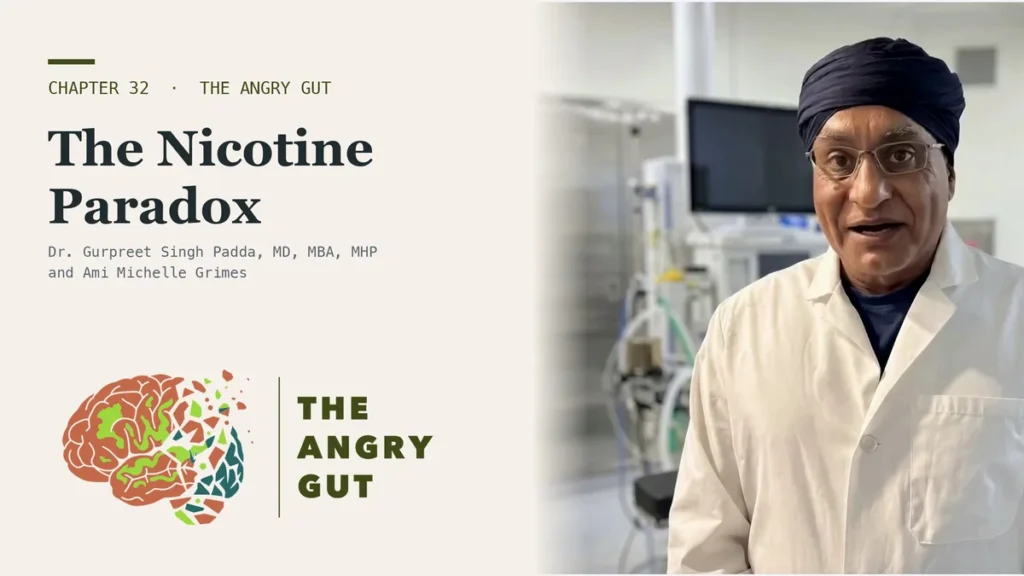
Nicotine can make you poop, but only once. In healthy people a high dose set off mass peristalsis, the single wave that empties a colon. It does not restart a stalled gut. And it cannot rebuild whatever stopped that colon from emptying on its own.
I am Dr. Gurpreet Singh Padda, MD, MBA, MHP, and the video above closes The Angry Gut, written with Ami Michelle Grimes. Patients ask about this more often than doctors admit, usually after a forum post about a vape and a reliable morning. So does nicotine make you poop? Sometimes, once, and through a path that is not the one a stalled bowel needs.
The first brain runs on acetylcholine
The nerve network in the gut wall is the first brain. The organ in the skull is the second, tied to the first by the vagus nerve. That first brain runs largely on acetylcholine. Nicotine speaks the same chemical language. That is the whole reason a cigarette ever changed anyone’s bowel habits.
The human evidence is narrow and real. In fresh human colon, nerve signals fired in 51 neurons drawn from 20 myenteric ganglia across 19 patients. They came in bursts of 2 to 23 signals at about 5.3 Hz. The limit is printed right next to it: only about 8% of these gut neurons responded at all. The authors themselves call that figure low. A real signal, in a small share of cells.
Two receptor types do two different jobs, and telling them apart settles most of the seeming conflicts. Fast signaling between gut neurons runs mainly through the alpha-3-beta-4 type. Block it and the responses drop. The alpha-7 type sits on immune cells called monocytes and macrophages instead. There, acetylcholine shuts off release of TNF, one of the body’s loudest inflammation signals. Vagus nerve stimulation blocks TNF in normal mice and fails completely in mice that lack alpha-7. That receptor mapping is rodent work and should be read as rodent work. The immune receptor is the one behind the reflex in the chapter on the vagus nerve.
Does nicotine make you poop? One wave is real. The housekeeping sweep is not.
Two claims about gut movement get made about this molecule. They do not stand or fall together.
The emptying claim holds up in people. In healthy subjects a high dose produced brief, strong, traveling squeezes and faster transit through the colon. That squeeze is mass peristalsis, the wave that empties a colon right before a bowel movement. It was not guessed from a receptor map. It was recorded in a human colon after a drug that acts like acetylcholine.
The housekeeping claim does not hold. The migrating motor complex is a separate cycle in a separate part of the gut. It is the fasting sweep through the stomach and small bowel. A dose equal to a patch made the stomach’s sweep cycle come around less often and scrambled its pacemaker. In nonsmokers, a too-fast stomach rhythm (tachygastria) rose from 2% to 16% of recording time. That rhythm settled with indomethacin, which means prostaglandins drive it. In smokers the tracing did not change. Two weeks of wearing a patch moved nothing anyone could measure. Stomach emptying, small-bowel transit and mouth-to-colon transit all stayed put. The same test did detect drug-caused damage to the gut lining, so the null result was not a dull tool.
Then somebody ran a randomized test of the idea that nicotine speeds the gut. Forty patients after planned colorectal surgery for cancer chewed either 2 mg nicotine gum or plain gum. Six in each group developed a long-lasting stalled bowel (ileus). Time to the main endpoint ran 4.50 days on nicotine against 3.50 on plain gum. Both medians favored the plain gum. No nicotine-type drug has ever been developed to speed the gut. The drug class that has is serotonergic.
Dose and site decide the direction
Three human results stop fighting once they are sorted by dose. A low dose placed inside the bowel lowered muscle tone in all 17 subjects. It also reduced or stopped the large squeezes in the patients who had colitis, while saline did nothing. A low dose through the body, the kind a patch delivers, made the colon less stretchy in healthy subjects. It left gut movement untouched in colitis patients. A large sudden dose brought on the traveling waves and quicker transit. Then came a relaxed lower colon and less squeezing.
Small doses quiet the lower colon, which is what an inflamed rectum needs. A large sudden dose makes a traveling wave, which is what a blocked one needs. There is an awkward catch for anyone judging a remedy by how they feel. When urgency and diarrhea settle, part of the relief may be the gut slowing down, not healing. Feeling better and being better are two separate measures.
Why a pain practice cares about receptors in the bowel wall
Three reasons, and only the first is obvious. A distended (stretched), blocked bowel makes pain of its own, and the receptor that drives mass peristalsis sits in the wall of that organ. Second, alpha-7 on macrophages is a brake on TNF. So the receptor family that moves the bowel also controls how loudly its immune tissue signals. The gut bacteria layered on top of that conversation are the subject of the pathways running from gut microbes to mood.
Third, and least discussed, the question stays open for money reasons. This is an off-patent plant compound that shares a last name with tobacco. A question with no sponsor stays unanswered. That is why the one form that might settle the argument has never been given to a human being.
Four hurdles, and a harm further up the tube
Anyone weighing this deserves the objections first. Tachyphylaxis (fast-building tolerance) leads, because a drug that quits working in two weeks makes a poor long-term therapy. The single direct human finding runs the other way. The nicotine response in human gut neurons did not fade between a first and a second dose. But that is two doses in a tissue bath, not two months in a patient. Irritation of an already inflamed lining has no long-term rectal safety data behind it. Delivering it locally cuts whole-body toxicity but never removes it. Peak blood nicotine after an enema arrives at 44 to 50 minutes. Of the 14 side effects recorded, 11 arrived 30 to 105 minutes later, most of them at the 9 mg dose. Blood-pressure spikes and a racing heart belong to the molecule, not to the smoke. Dependency does not leave when the burning does.
The named harm sits higher up. Nicotine through the skin lowers pressure in the valve at the bottom of the esophagus much as smoking does. pH monitoring confirms the extra acid exposure. For a patient who already has reflux, that is a clear argument against the patch.
One detail bends the toxicity story in a useful direction. In the liquid enema pilot, side effects showed up in 4 of 10 patients even though blood nicotine was low or not detectable. The authors judged them unrelated to the drug. If a patient feels ill on a dose that never reached her blood, some of what gets called nicotine toxicity is not nicotine.
Rescue is not repair
The hardest argument here is the one I make against myself. Forcing a bowel empty with a plant compound addresses the failure at the bottom and leaves the cause higher up untouched. If the vagal signal is damaged, no nicotine-type drug repairs a nerve. If the gut bacteria that set the pace have been flattened, no receptor jolt replaces a community. That case is laid out in the chapter on the flora. If the gut’s nervous system is injured, firing whatever neurons remain restores nothing.
Rescue still earns a place. In our practice a procedure is a bridge. It is fair for exactly as long as something waits on the far side. A drug that forces a bowel movement answers to the same test. A form that ended five days of nothing would be worth having. It would never be a treatment for why the bowel stopped.
So the plan has to reach the terrain. The first brain responds to being fed and tended, then left alone. It does not respond to a molecule bought online. There is no product for this, no dose set outside a trial, and nothing here to try at home. Do not start, stop or change any medication on your own; take it to the physician who prescribes for you. The Chapter 32 Deep Dive lists every study named here with its group, its numbers and what each one does not show. It also has questions worth asking at your next visit. And the previous chapter in this series sets up the argument this one closes.
Frequently asked questions
Does nicotine make you poop?
It can, once. In healthy volunteers a high dose produced strong traveling squeezes. That is the mass peristalsis wave that comes before a bowel movement, along with faster transit through the colon. The effect was sudden and brief. Then the lower colon relaxed and squeezed less. Nothing in the human record turns that single wave into a lasting treatment. The bacteria living in your gut shape what the colon does day to day.
Can nicotine restart a bowel that has stopped?
No human trial supports it. Nicotine gum tested after colorectal surgery was safe and useless. Time to the main endpoint ran 4.50 days against 3.50 on plain gum. Higher up, a patch-level dose scrambled the stomach’s pacemaker rather than steadying it. And two weeks of a patch changed neither stomach emptying nor transit. Pain-sensing nerves in the gut play their own part in inflammation.
Is a nicotine patch a problem if I have reflux?
It is a fair concern. Nicotine through the skin lowers the pressure in the valve at the bottom of the esophagus much as smoking does. pH monitoring confirms extra acid exposure. That makes the patch a poor fit for someone who already has reflux. It is a decision for the physician managing both problems. Some drugs quietly worsen the problem they treat.
Why would a pain clinic care about a gut receptor?
Because the alpha-7 type sits on monocytes and macrophages, where acetylcholine shuts off TNF release. A receptor family that controls inflammation in the gut wall works on the same terrain that keeps a nervous system on edge. Vagus nerve stimulation blocks TNF in normal mice and fails in mice lacking alpha-7. That is mouse work and reads as mouse work. Why we treat the inflammation before the joint.
Is there a nicotine suppository for a stalled gut?
No published trial of a nicotine suppository exists, for any use. One group built versions and measured release across a layer of cells in a dish. None of it ever entered a living gut. That is a lack of evidence, not a negative result. It is a reason for a proper trial, not an experiment on yourself. Pain rarely moves when only one input gets pushed.
A stalled gut deserves a cause, not a jolt
If your bowel and your pain have been treated as two separate problems, we start with the terrain underneath both and build the plan from there.
Request an appointment, or call or text us.
Sources
- Coulie, B., Camilleri, M., Bharucha, A. E., Sandborn, W. J., & Burton, D. (2001). Colonic motility in chronic ulcerative proctosigmoiditis and the effects of nicotine on colonic motility in patients and healthy subjects. Alimentary Pharmacology & Therapeutics, 15(5), 653-663. https://doi.org/10.1046/j.1365-2036.2001.00959.x
- Elfers, K., Sehnert, A. S., Wagner, A., Zwirner, U., Linge, H., Kulik, U., Poehnert, D., Winny, M., Gundert, B., Aselmann, H., & Mazzuoli-Weber, G. (2024). Functional and structural investigation of myenteric neurons in the human colon. Gastro Hep Advances, 4(1), 100537. https://doi.org/10.1016/j.gastha.2024.08.016
- Green, J. T., McKirdy, H. C., Rhodes, J., Thomas, G. A., & Evans, B. K. (1999). Intra-luminal nicotine reduces smooth muscle tone and contractile activity in the distal large bowel. European Journal of Gastroenterology & Hepatology, 11(11), 1299-1304. https://doi.org/10.1097/00042737-199911000-00020
- Ingram, J. R., Routledge, P., Rhodes, J., Marshall, R. W., Buss, D. C., Evans, B. K., Feyerabend, C., & Thomas, G. A. O. (2004). Nicotine enemas for treatment of ulcerative colitis: A study of the pharmacokinetics and adverse events associated with three doses of nicotine. Alimentary Pharmacology & Therapeutics, 20(8), 859-65. https://doi.org/10.1111/j.1365-2036.2004.02199.x
- Kohagen, K. R., Kim, M. S., McDonnell, W. M., Chey, W. D., Owyang, C., & Hasler, W. L. (1996). Nicotine effects on prostaglandin-dependent gastric slow wave rhythmicity and antral motility in nonsmokers and smokers. Gastroenterology, 110(1), 3-11. https://doi.org/10.1053/gast.1996.v110.pm8536873
- Lambrichts, D. P. V., Boersema, G. S. A., Tas, B., Wu, Z., Vrijland, W. W., Kleinrensink, G.-J., Jeekel, J., Lange, J. F., & Menon, A. G. (2017). Nicotine chewing gum for the prevention of postoperative ileus after colorectal surgery: a multicenter, double-blind, randomised, controlled pilot study. International Journal of Colorectal Disease, 32(9), 1267-1275. https://doi.org/10.1007/s00384-017-2839-z
- Pandolfino, J. E., & Kahrilas, P. J. (2000). Smoking and gastro-oesophageal reflux disease. European Journal of Gastroenterology & Hepatology, 12(8), 837-842. https://doi.org/10.1097/00042737-200012080-00002
- Suenaert, P., Bulteel, V., Den Hond, E., Geypens, B., Monsuur, F., Luypaerts, A., Ghoos, Y., & Rutgeerts, P. (2003). In vivo influence of nicotine on human basal and NSAID-induced gut barrier function. Scandinavian Journal of Gastroenterology, 38(4), 399-408. https://doi.org/10.1080/00365520310000834
- Wang, H., Yu, M., Ochani, M., Amella, C. A., Tanovic, M., Susarla, S., Li, J. H., Wang, H., Yang, H., Ulloa, L., Al-Abed, Y., Czura, C. J., & Tracey, K. J. (2003). Nicotinic acetylcholine receptor alpha7 subunit is an essential regulator of inflammation. Nature, 421(6921), 384-388. https://doi.org/10.1038/nature01339
Dr. Gurpreet Singh Padda, MD, MBA, MHP