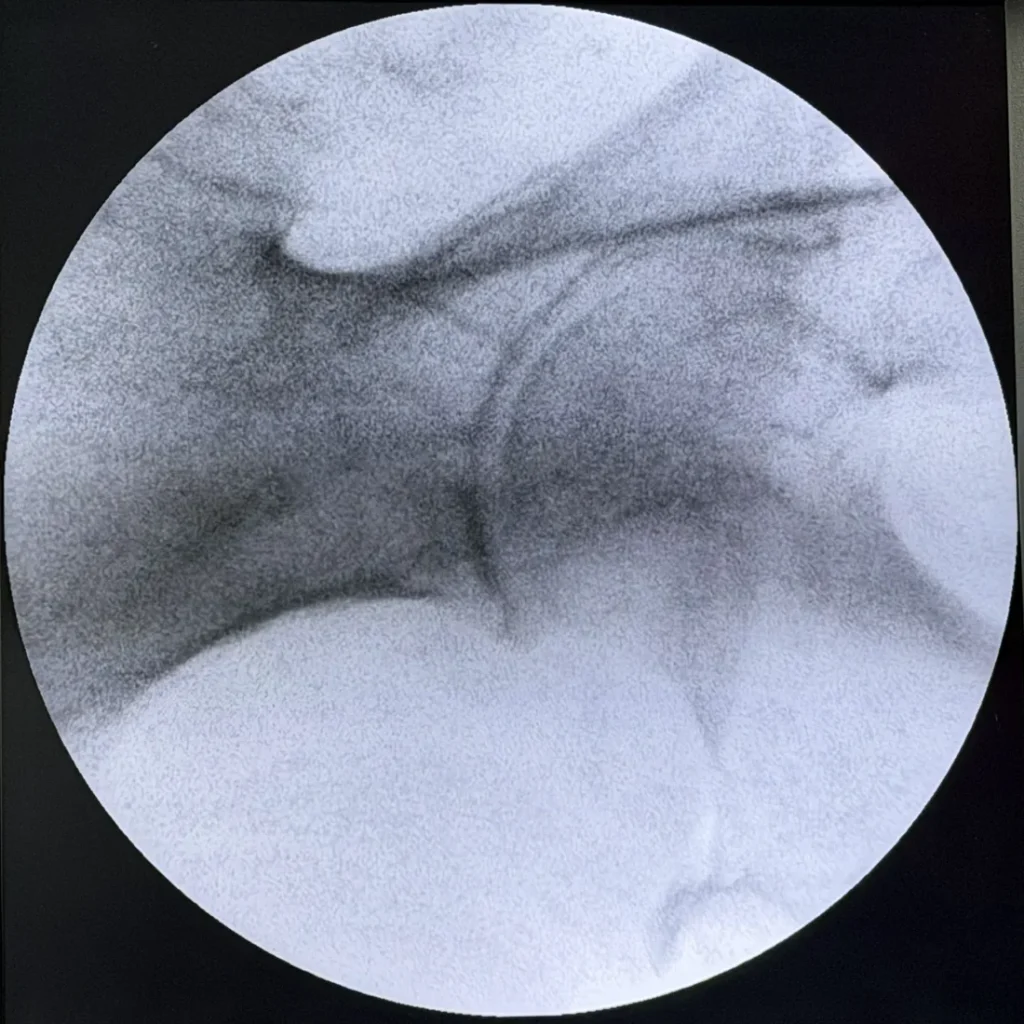
When sciatica is not a disc, the cause usually lives in the buttock: deep gluteal syndrome, which covers piriformis syndrome, gemelli–obturator internus syndrome, ischiofemoral impingement and proximal hamstring syndrome. The hip joint must be ruled out first, because it is more common and easier to treat.
When leg pain does not come from a disc, it has to come from somewhere. That is the part of the sciatica talk that usually gets skipped. The low back MRI is read. A wear-and-tear finding is named as the cause. If spine treatment fails, the case is filed as hard, not reopened.
There is a set list of structures that cause sciatica-like leg pain with no disc involved. Most of them live in the buttock. “Piriformis syndrome” is a satisfying label. It names one muscle. It explains why the buttock hurts and the leg tingles. And it comes with a stretch you can start that afternoon. The catch is that the deep gluteal space holds several structures that can cause almost the same complaint. The piriformis is just the one with the best-known name.
The umbrella term for the group is deep gluteal syndrome — pressure on the sciatic or pudendal nerve from pelvic causes that are not the disc. It includes piriformis syndrome, gemelli-obturator internus syndrome, ischiofemoral impingement syndrome, and proximal hamstring syndrome. The idea exists because the old piriformis-only model was too narrow. It could not explain what doctors were seeing.1
The four conditions inside the deep gluteal space
- Piriformis syndrome — the sciatic nerve irritated by the piriformis where the two cross at the greater sciatic notch.
- Gemelli–obturator internus syndrome — the same nerve, one layer lower, irritated by the small rotator muscles under the piriformis.
- Ischiofemoral impingement — a narrowed space between the ischium (sit bone) and the lesser trochanter (a bump on the thighbone), with the quadratus femoris muscle pinched between them.
- Proximal hamstring syndrome — tendinopathy (a worn, irritated tendon) or scarring at the ischial tuberosity (the sit bone), right where the sciatic nerve passes.
All four cause pain at the back of the hip that spreads. All four are worse with sitting. The review that grouped them notes that deep gluteal syndrome has often been missed or mistaken for something else.1 A careful history and exam with provocation tests sort them out. So do nerve tests when needed, and imaging. The symptom description does not.
And then there is the hip joint
Before any of the deep gluteal diagnoses is considered, the hip joint itself must be ruled out, because it is both more common and easier to treat.
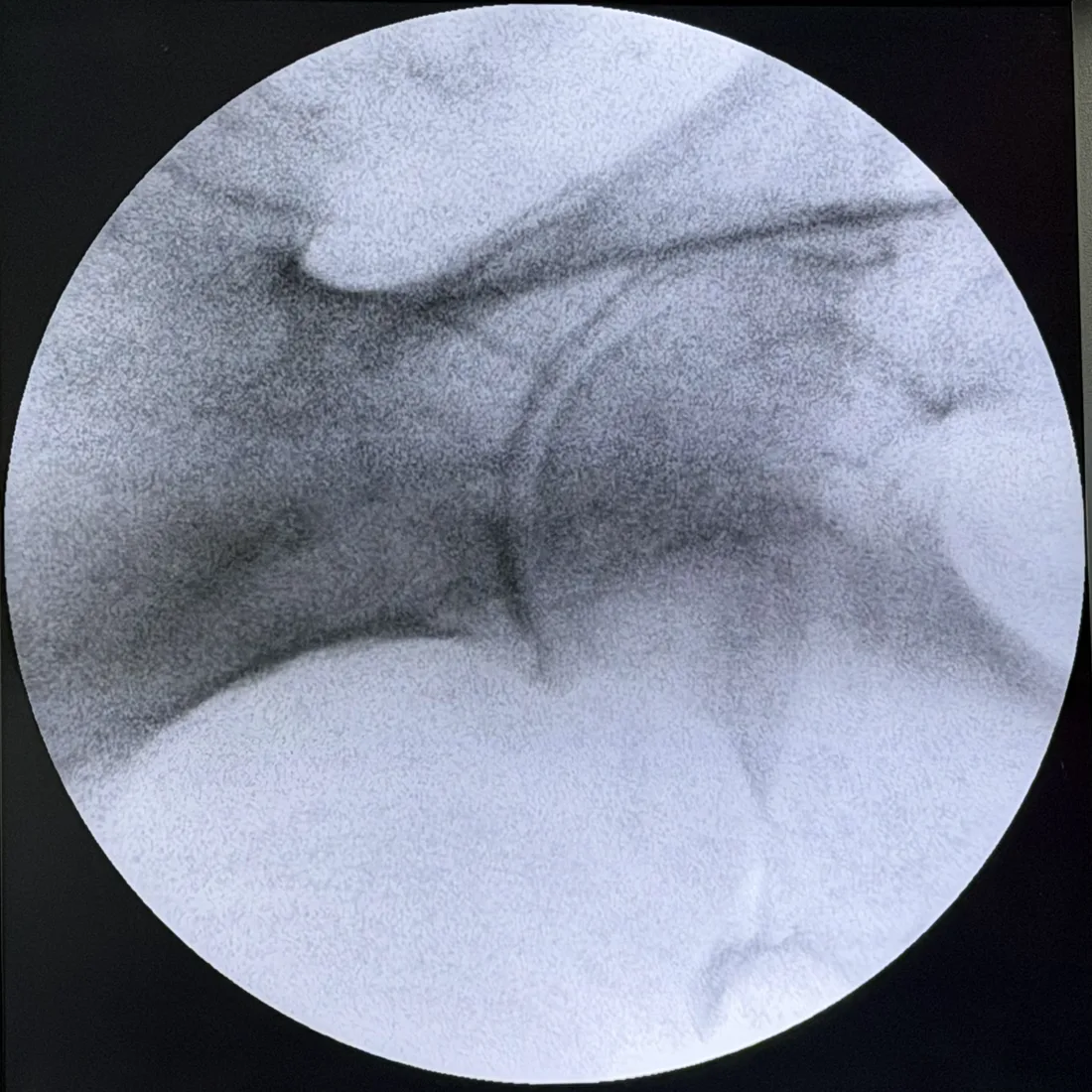
This is not a made-up failure. Hip osteoarthritis, femoroacetabular impingement (a hip shape problem), and avascular necrosis (bone death from lost blood supply) all belong on the list for pain at the back of the hip. All of them are missed when the exam starts and ends with pressing on the buttock. The practical test is plain: check how the hip moves, and compare inward rotation side to side.
Why the spine gets the credit it does not always deserve
When leg pain shows up, the reflex is to image the low back. That reflex is not wrong. A disc herniation or foraminal stenosis (a narrowed nerve exit) causes true nerve-root pain more often than anything in the buttock. The problem is what happens next.
A low back MRI in an adult over forty will almost always find wear and tear. That finding is named as the cause. The patient is sent toward the spine, and the deep gluteal space is never checked. When the epidural does not help, the usual verdict is that the pain is hard to treat, not that the target was wrong.
The way out of that loop is to test the level the scan pointed to, not treat it on faith. A selective nerve root block places anesthetic (numbing medicine) at one specific root, with contrast dye showing it stayed there. It answers whether that root carries your pain. If it does, you have a target. If it does not, the disc finding on the report was a side note, and the buttock still needs checking.
Nerve testing helps here, but for a narrower reason than most people expect. It can help rule out other causes, a low back root problem in particular. But no well-accepted nerve test confirms piriformis syndrome.2 It rules out. It does not rule in.
What is actually left to make the diagnosis with
Once the spine and the hip joint are dealt with, the diagnosis of piriformis syndrome rests on a few things. There is the history. There is tenderness over the muscle and the greater sciatic notch. There are moves that load or stretch the piriformis. And there is ruling out everything else. The newest review states the limit plainly. Many exam signs are reported for piriformis syndrome, but no one knows how well they pick it up or rule it out. Part of the reason is that there is no single accepted case definition.2
That is shaky ground for a treatment plan. It is why a targeted, image-confirmed injection carries real diagnostic weight here. It would not carry that weight in a joint where the diagnosis was already sure. The response to a correctly placed injection is one of the few hard facts you can get.
The question worth asking before an injection is scheduled
Not “will this injection help?” but “if this injection does nothing, what will we have learned, and what is next on the list?” If there is no answer to the second half, the list has not been worked through yet.
Frequently asked questions
Why does piriformis pain hurt so badly when I sit?
Sitting loads the deep gluteal space directly. Body weight presses the muscle, and everything under it, against the sit bone and the back edge of the pelvis. A nerve that is already irritated does not handle steady pressure well. Tenderness over the greater sciatic notch and pain made worse by sitting are among the most consistently reported features. Keep in mind that the same posture also sets off proximal hamstring problems and pudendal nerve irritation. So trouble sitting does not tell you which structure is at fault. Learn more: pelvic pain that is worse when you sit.
Can you permanently get rid of piriformis syndrome?
Many people do settle for good, and most get there without a procedure. They change the load, the seat, or the training mistake that set it off, and give the tissue time. What reliably comes back is the case where the cause was never found, because the muscle was treated but the reason it was overloaded was not. The same is true when the first diagnosis was wrong, which is common in this region. Learn more: when a piriformis injection does not work.
How do I know it is not my hip joint?
You often cannot tell from symptoms alone, which is the point. Hip osteoarthritis classically causes groin pain. But a fair number of people with an arthritic hip feel the pain in the buttock and say it runs down the leg. The exam sorts them out better than the story does. Hip motion, mainly inward rotation, tends to be stiff and painful when the joint is the source. An image-guided diagnostic injection into the joint settles it when the exam is unclear. Learn more: lateral hip pain that is rarely just bursitis.
Does an MRI diagnose piriformis syndrome?
No. A pelvic MRI is used to rule out the things that do show up on imaging — a mass pressing on the sciatic nerve, ischiofemoral impingement, a proximal hamstring tear, hip disease — and that is a useful job. What it does not do is confirm piriformis syndrome, because no imaging finding proves the diagnosis. Ultrasound may show a thickened muscle, but no one has shown that this matches the clinical diagnosis. Learn more: what fluoroscopy images can and cannot prove.
Should I have a lumbar MRI first if the pain runs down my leg?
Usually yes, and then read it carefully. Ruling out a spine cause is a sensible first step when pain runs below the knee or there is any neurologic deficit (lost strength, feeling or reflexes). The trap is that a low back MRI in anyone past forty will nearly always show some disc wear. A finding that looks right then ends the search before the buttock is ever checked. A scan that shows something is not the same as a scan that explains something. Learn more: sciatica is not a diagnosis.
To discuss your own case, request an appointment through the appointment request form, call (314) 481-5000, or text (314) 886-5902. You can review the full range of pain treatments, read about the pain management doctors in St. Louis, or find both offices on the locations page.
Sources
- Park JW, Lee YK, Lee YJ, Shin S, Kang Y, Koo KH. “Deep gluteal syndrome as a cause of posterior hip pain and sciatica-like pain.” The Bone & Joint Journal. 2020;102-B(5):556–567. doi:10.1302/0301-620X.102B5.BJJ-2019-1212.R1
- Lo JK, Robinson LR. “Piriformis syndrome.” Handbook of Clinical Neurology. 2024;201:203–226. doi:10.1016/B978-0-323-90108-6.00002-8
Dr. Gurpreet Singh Padda, MD, MBA, MHP