Stop taking omeprazole with your physician, not alone. Twice-daily dosing steps down to once daily first. The rebound heartburn that follows usually begins between day 5 and 14 and lasts 4 to 5 days. That rebound is the drug’s effect, not proof the disease came back. Alginate covers the gap by physics instead of shutting acid off.
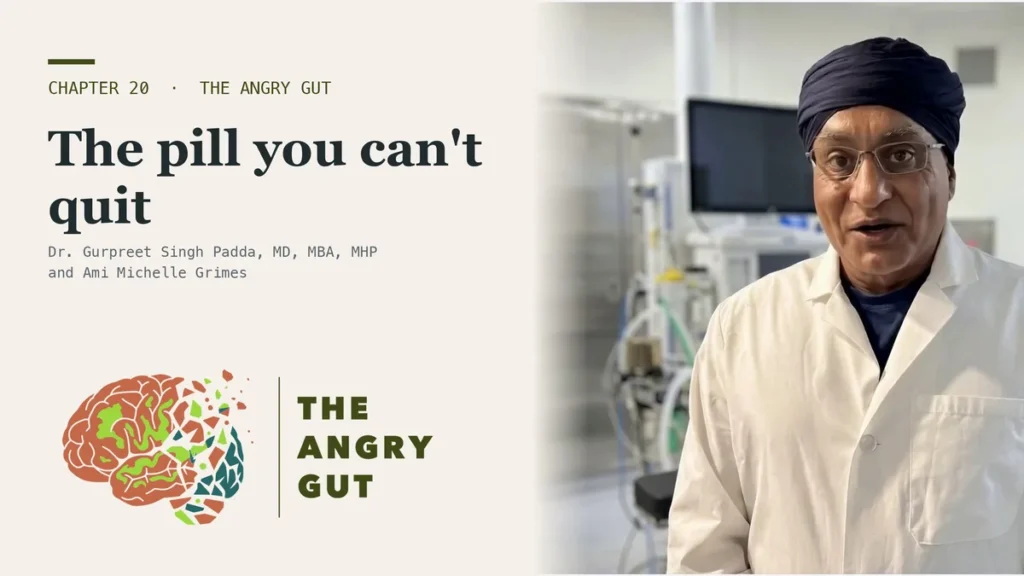
The video The Heartburn Pill You Can’t Quit walks through one man’s case. He is sixty-one. He has taken omeprazole every morning since 2016, for a six-week course nobody ever ended. He tried to quit twice, and each time the burning came back harder inside two weeks. Here the focus is the part a pain practice owns. What does the drug do to the nutrients nerves run on? Why does stopping hurt? And how do you plan an exit instead of winging it? The argument comes from The Angry Gut, by Dr. Gurpreet Singh Padda, MD, MBA, MHP, and Ami Michelle Grimes.
Why a pain clinic reads the heartburn line on your medication list
Some pain patients take an acid blocker for a sound reason. Think of a bleeding ulcer, erosive esophagitis, Barrett’s esophagus, or a person who has to stay on an anti-inflammatory. In those cases, blocking acid protects tissue and prevents deaths. Taking it away does real harm.
Where acid blockers meet pain pills and the gut lining they both touch, the reason to keep one can be real. The trouble is everyone else. Somewhere between 25% and 70% of people get one of these drugs without a proper reason. Once written, the prescription tends to outlive its reason.
That is how refills work. Renewing takes a click. Questioning the drug takes a visit, sometimes a scope, and a talk nobody is paid to have. So the pill rolls on for years. No one asks which job, if any, it is still doing.
Which side effects of long-term omeprazole are real?
Most fear about these drugs comes from observational data. In that data, sicker people take more pills, and the pill takes the blame. The decisive test randomized 17,598 people to pantoprazole or placebo for three years. It tracked a long list of harms: pneumonia, C. difficile, fractures, kidney disease, diabetes, dementia, gastric atrophy. Only one outcome stood apart. Gut infection ran 1.4% on the drug against 1.0% on placebo, an odds ratio of 1.33.
Set that beside the pooled observational estimate of 4.28 for gut infection. Randomization shrank a fourfold alarm to roughly a one-third rise.
Two scary claims did not hold up. A veterans study blamed the drug class for 45.20 extra deaths per 1,000 patients. A claims analysis put dementia at a hazard ratio of 1.44. The trial found neither. Fracture risk shows a signal, but reviewers grade most of that evidence very low to low certainty. The case against a pill with no job left needs none of those fears.
Does omeprazole cause vitamin B12, magnesium or iron deficiency?
Acid is how vitamin B12 gets pried off the protein it arrives attached to. In one large analysis, two or more years of an acid pump blocker carried a B12 deficiency odds ratio of 1.65. The weaker H2 blocker came in at 1.25. The odds rose to 1.95 above one and a half pills a day. The dose curve is what makes it believable: deeper blocking, more deficiency.
For a pain practice this is not trivia. B12 sits on the short list of quiet deficiencies that drive nerve pain. A burning foot is easy to blame on sugar or a disc without anyone asking about the stomach.
Magnesium and iron follow the same logic, though those figures come from narrow groups. In kidney transplant patients, low magnesium sat at an odds ratio of 2.16. In renal transplant patients, iron deficiency ran at 1.57, and 2.30 on a high dose. Neither group looks like the average reader. They show a direction, not your personal risk.
Protein is the third loss. Pepsin, the enzyme that breaks down protein in the stomach, only works in acid. Raise the pH, and protein reaches the small intestine barely touched. Germs the acid used to kill come along with it.
Why does heartburn come back when you stop omeprazole?
The heartburn that came back after each try was not proof the disease was still there. The drug does this to almost anyone. Healthy volunteers with no reflux took eight weeks of an acid pump blocker and then stopped. Over the next four weeks, 44% reported at least one real acid symptom, against 15% on placebo. A separate trial with a different drug landed on the same 44%, against 9%.
You can measure how it happens. Hold acid down, and gastrin climbs. Gastrin is the hormone that orders acid production. The cells that release it multiply. So do the histamine-releasing cells gastrin drives. The pump gets overbuilt while it is switched off. Switch it back on, and the extra capacity shows up as heartburn.
The timing is steady enough to plan around. Symptoms usually begin between day 5 and 14 and last 4 to 5 days on average. But in one study, 38% did not start until week 3 or 4. The measured over-secretion lasted more than 8 weeks and less than 26. Every drug in the class does it. It tracks how deep the blocking went, not the brand on the bottle.
Here is what a pain patient should notice. This drug creates the very symptom it treats and punishes every exit with a flare. They teach people to mistake withdrawal for disease. Chronic pain medicine knows that loop well. The next installment follows a pain prescription that closes the same trap around the bowel, and closes it harder.
How do you wean off omeprazole safely?
The honest numbers on stopping are modest. In a double-blind trial of long-term users, only 27% were off the drug a year later. Tapering did not beat stopping outright, 31% against 22%. People with true reflux disease succeeded far less often, 21% against 48%. A higher gastrin level at the start predicted who would go back on it.
Expert guidance built on that evidence is short. Anyone without a clear reason for the drug deserves a trial off it. Some conditions sit on the do-not-stop list: severe erosive esophagitis, an esophageal ulcer, a stricture, Barrett’s esophagus, eosinophilic esophagitis and idiopathic pulmonary fibrosis. Twice-daily dosing steps down to once daily first. The decision rests on the missing reason, never on fear of side effects. Make it with your physician, not alone.
Plan the gap before it comes. Alginate floats a raft on top of the stomach contents. It works by physics, not by shutting acid off. Against omeprazole, both reached the first 24-hour heartburn-free period in 2.0 days. A primary care program across 26 practices used alginate as rescue. There, 35.3% stepped off, 5.0% stepped down and then off, and 34.8% only stepped down.
Which lifestyle changes actually reduce acid reflux?
Reflux is mostly mechanics. The main trigger is a brief relaxing of the valve at the bottom of the esophagus. Stretch sets how often that happens. Researchers compared 84 people across three weight groups. Valve pressure, valve length and swallowing squeeze were alike. The relaxations were not: 2.1, 3.8 and 7.3 an hour. The share causing reflux rose from 17.6% to 63.5%.
That is where behavior earns its place, with a reason attached. Losing belly weight lowers the pressure across the valve. In that study, that pressure climbed from 4.5 to 10.0 mm Hg with weight. Raising the head of the bed, or lying on the left side, lets gravity keep the after-dinner acid pocket below the valve. Those were the steps that held up in systematic review. Avoiding tobacco, alcohol, chocolate and fatty meals made sense on paper but had no patient-level proof.
The belly that raises the pressure is also an inflamed organ. It pumps out signals that turn pain up through metaflammation. And it has an upstream address: a food system that subsidizes acellular carbohydrates, then sells the pill for the pressure they create. Swapping one pill for another leaves that address untouched.
Eating pattern gets its own post in the earlier post on grazing as a business model. Every study and figure, and what each one does and does not show, is laid out in the companion Deep Dive on stomach acid and its myths.
Frequently asked questions
Is it safe to take omeprazole long term?
With a clear reason, the randomized evidence is reassuring. A three-year trial found a small rise in gut infection. It found no difference for dementia, fractures, kidney disease or pneumonia. The real-world risks are nutrient loss and a rebound that makes stopping hard. So the better question is whether the first reason still exists. Every long medication list deserves a review one drug at a time.
How long does rebound heartburn last after stopping a PPI?
In most people it begins between day 5 and 14 and lasts 4 to 5 days. Some do not feel it until week 3 or 4. Symptoms still going at week six point more to reflux disease that never left than to rebound. Knowing which one you are in tells your physician how long to hold steady. The same patience governs any medication taper.
Can omeprazole cause vitamin B12 deficiency?
Yes, and the risk rises with dose and time. Stomach acid frees B12 from the protein in food. Two or more years of use carried a deficiency odds ratio of 1.65. That rose to 1.95 above one and a half pills a day. So check B12 in anyone with nerve symptoms and a long acid-blocker history. Why a normal-looking B12 result can still mislead.
Do I need an acid blocker if I take anti-inflammatory pain medicine?
That may be exactly the right reason to keep one. If you have to stay on an anti-inflammatory, acid blocking protects the stomach lining and prevents serious harm. The goal is not fewer pills for their own sake. It is a current reason for every pill, reviewed with the prescriber on a schedule. A dose on a chart is never the same thing as a diagnosis.
Can acid-reducing drugs cause bacterial overgrowth and bloating?
The link is real and moderate. Pooled observational studies put small intestinal bacterial overgrowth at an odds ratio of 1.71 in users. How strong it looks depends a lot on how overgrowth is tested. The popular tests are weaker than they look. Bloating on these drugs calls for a look at the whole gut terrain, not another prescription. Why the enemy named on a stool report is often the wrong one.
What happens if you stop taking omeprazole suddenly?
Acid output usually overshoots. While omeprazole holds acid down, gastrin climbs and the acid-making machinery grows. When the pill stops, the extra capacity shows up as heartburn. In healthy volunteers with no reflux, 44% had acid symptoms after stopping eight weeks of treatment, against 15% on placebo. The measured over-secretion lasted more than 8 weeks and less than 26. So it does pass.
When should omeprazole be stopped?
When the reason it was started no longer exists. Anyone without a clear reason deserves a trial off the drug. The decision rests on that missing reason, never on fear of side effects. Some people should stay on it. Severe erosive esophagitis, an esophageal ulcer, a stricture, Barrett’s esophagus, eosinophilic esophagitis and idiopathic pulmonary fibrosis sit on the do-not-stop list. Make the call with your physician.
What can I take instead of omeprazole for heartburn?
Alginate covers the gap. It floats a raft on top of the stomach contents. It works by physics, not by shutting acid off. In a head-to-head trial against omeprazole, both reached the first 24-hour heartburn-free period in 2.0 days. Losing belly weight lowers the pressure that drives reflux. Raising the head of the bed or lying on the left side lets gravity keep acid below the valve.
Put every prescription on trial, starting with the quiet ones
If you live with chronic pain and a heartburn pill has ridden along for years, bring the whole list. Bring the date each drug started. We review what each one is still doing before anything new is added.
Request an appointment, or call or text us.
Sources
- Moayyedi, P., Eikelboom, J. W., Bosch, J., Connolly, S. J., Dyal, L., Shestakovska, O., Leong, D., Anand, S. S., Stork, S., Branch, K. R. H., Bhatt, D. L., Verhamme, P. B., O’Donnell, M., Maggioni, A. P., Lonn, E. M., Piegas, L. S., Ertl, G., Keltai, M., Bruns, N. C., … Yusuf, S. (2019). Safety of Proton Pump Inhibitors Based on a Large, Multi-Year, Randomized Trial of Patients Receiving Rivaroxaban or Aspirin. Gastroenterology, 157(3), 682-691.e2. https://doi.org/10.1053/j.gastro.2019.05.056
- Lam, J. R., Schneider, J. L., Zhao, W., & Corley, D. A. (2013). Proton pump inhibitor and histamine 2 receptor antagonist use and vitamin B12 deficiency. JAMA, 310(22), 2435-42. https://doi.org/10.1001/jama.2013.280490
- Reimer, C., Søndergaard, B., Hilsted, L., & Bytzer, P. (2009). Proton-pump inhibitor therapy induces acid-related symptoms in healthy volunteers after withdrawal of therapy. Gastroenterology, 137(1), 80-87, 87.e1. https://doi.org/10.1053/j.gastro.2009.03.058
- Niklasson, A., Lindström, L., Simrén, M., Lindberg, G., & Björnsson, E. (2010). Dyspeptic symptom development after discontinuation of a proton pump inhibitor: a double-blind placebo-controlled trial. The American Journal of Gastroenterology, 105(7), 1531-1537. https://doi.org/10.1038/ajg.2010.81
- Namikawa, K., & Björnsson, E. S. (2024). Rebound acid hypersecretion after withdrawal of long-term proton pump inhibitor (PPI) treatment: Are PPIs addictive? International Journal of Molecular Sciences, 25(10), 5459. https://doi.org/10.3390/ijms25105459
- Björnsson, E., Abrahamsson, H., Simrén, M., Mattsson, N., Jensen, C., Agerforz, P., & Kilander, A. (2006). Discontinuation of proton pump inhibitors in patients on long-term therapy: a double-blind, placebo-controlled trial. Alimentary Pharmacology & Therapeutics, 24(6), 945-954. https://doi.org/10.1111/j.1365-2036.2006.03084.x
- Targownik, L. E., Fisher, D. A., & Saini, S. D. (2022). AGA Clinical Practice Update on de-prescribing of proton pump inhibitors: Expert review. Gastroenterology, 162(4), 1334-1342. https://doi.org/10.1053/j.gastro.2021.12.247
- Wu, J. C. Y., Mui, L. M., Cheung, C. M. Y., Chan, Y., & Sung, J. J. Y. (2006). Obesity is associated with increased transient lower esophageal sphincter relaxation. Gastroenterology, 132(3), 883-9. https://doi.org/10.1053/j.gastro.2006.12.032
- Kaltenbach, T., Crockett, S., & Gerson, L. B. (2006). Are lifestyle measures effective in patients with gastroesophageal reflux disease? An evidence-based approach. Archives of Internal Medicine, 166(9), 965-971. https://doi.org/10.1001/archinte.166.9.965
- Pouchain, D., Bigard, M.-A., Liard, F., Childs, M., Decaudin, A., & McVey, D. (2012). Gaviscon vs. omeprazole in symptomatic treatment of moderate gastroesophageal reflux: A direct comparative randomised trial. BMC Gastroenterology, 12, 18. https://doi.org/10.1186/1471-230X-12-18
Dr. Gurpreet Singh Padda, MD, MBA, MHP