Anxiety that shows up with a bloated, unpredictable bowel usually gets filed as two problems. The gut goes to one specialist, the worry to another, and the pain riding along with both goes to a third. The evidence on gut health and anxiety says those three files belong in one folder.
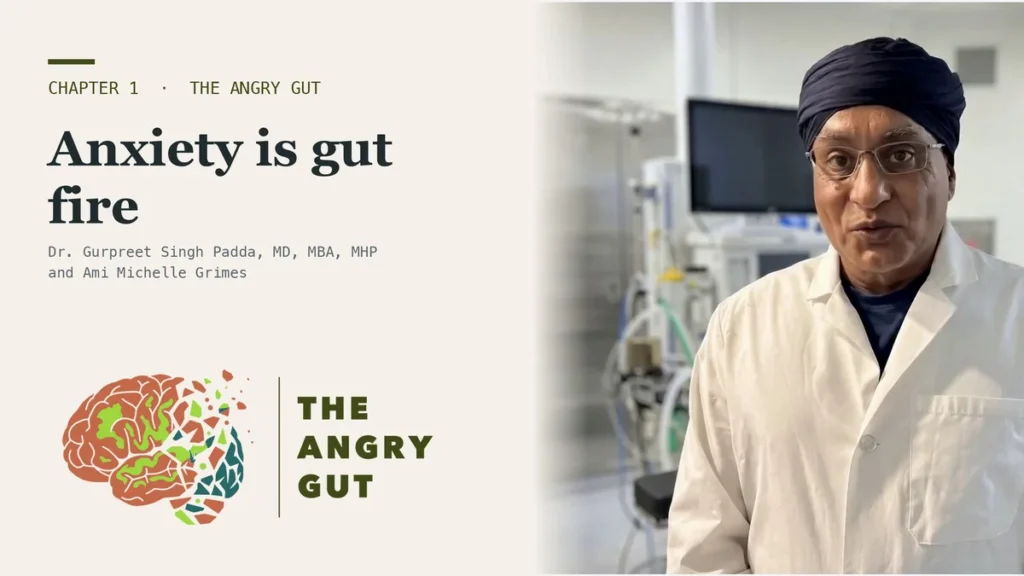
In the video Your Anxiety Is a Fire in Your Gut, I, Dr. Gurpreet Singh Padda, MD, MBA, MHP, tell the story of one patient who lived inside that split for nine years. Here I want to go further into what a pain practice sees every day: how an inflamed first brain can sharpen visceral pain, why some people feel the fire and others do not, and what actually moved symptoms when it was tested.
Nine years, two specialists and one missed pattern
She was in her forties when she came to see me. A serotonin reuptake inhibitor started for panic had been raised twice for depression and had never quite worked. Across the same decade she lived with loose stools, bloating that changed her clothes by evening, and an irritable bowel label reached by ruling everything else out. Her mood doctor never asked about her bowel. Her bowel doctor never asked about her mood.
Her labs told a story nobody had assembled: a C-reactive protein of 6.2, a high fasting insulin, three antibiotic courses in two years, and a diet nearly empty of fermentable fiber. That is not a careless-doctor story. It is what happens when medicine pays separately for the skull and the bowel, and pays nobody to connect them.
The gut lining cell that can drive visceral pain and anxiety
The experiment that matters most for a pain patient here is one few people have heard of. In mice, researchers switched enterochromaffin cells, the serotonin-releasing cells of the gut lining, up and down directly (Bayrer et al., 2023). Turning them on was enough to make the gut hypersensitive to stretch. It also produced anxiety-like behavior, which settled once serotonin signaling was blocked.
Two details matter for chronic pain. Prolonged activation left the gut persistently hypersensitive even with no inflammatory episode to start it, so the sensitization outlasted any fire. And the circuit appeared to be tonically engaged in females. This is mouse work, and brain serotonin was never measured. What it shows is a nerve sensitized from the lining, the same kind of process behind pain that no longer matches the scan.
I repeated a simpler version to patients for years: the gut makes serotonin, so the gut runs your mood. The first half holds. The gut makes about 90 to 95 percent of the body’s serotonin. The second half does not, because serotonin cannot cross the blood-brain barrier (Chen et al., 2021). Gut serotonin handles motility, secretion, clotting and immune signaling. It reaches the brain as a message on a nerve, through 5-HT3 receptors on vagal fibers, not as a molecule in the bloodstream.
Gut health and anxiety: same inflammation, different alarm
This fire can be lit on purpose. Healthy adults given a small dose of bacterial endotoxin show a drop in mood, and one trial of one hundred and fifteen healthy adults went looking for who dropped the most (Irwin et al., 2019). Three traits predicted it: baseline perceived stress, sensitivity to feeling socially cut off, and the anxiety and low mood people already carried.
The striking part is what did not differ. None of those traits were related to how much the inflammatory chemicals rose. Everyone’s cytokines climbed. What differed was how hard the alarm answered, and the stronger switching-on of inflammatory control pathways was already visible at thirty minutes, before any cytokine had risen.
Chronic pain runs on the same principle. Two people can carry similar tissue findings and live completely different lives with them, because the amplifier is personal. Loneliness belongs on that list as a biological input rather than a footnote, which is why social isolation behaves as an inflammatory state.
Hepatitis C clinics saw the clinical version for two decades. Among patients treated with interferon, an inflammatory cytokine, the risk of an induced major depressive episode was higher with a history of psychiatric disorder (OR 3.18), in women (OR 1.40), and with higher baseline interleukin-6 (Udina et al., 2012). The drug did not create the vulnerability. It found it.
Only some patients are inflamed, and it shows in treatment
Inflammation is not the whole story of depression. Across 30 studies, 27 percent of people with depression had a CRP above 3 mg/L (Osimo et al., 2019). An antibody that blocks TNF made no overall difference in treatment-resistant depression, yet the result turned on baseline CRP. Above 5 mg/L, 62 percent responded against 33 percent on placebo, in groups of only 13 and 9 patients (Raison et al., 2013).
A pain practice recognizes that pattern. The inflamed patient is rarely inflamed only in mood. It is the patient with the high insulin, the widening waist, the unsettled bowel and the pain that has not responded, and it is why high insulin belongs in a pain workup. Her CRP of 6.2 put her squarely in that group. The wall that lets the fire start is its own subject, taken up in the leaking gut wall.
Your medication list shapes your gut bacteria too
Medication effects on the gut reach far past antibiotics. In a screen of more than 1,000 drugs against 40 gut bacterial strains, 24 percent of drugs with human targets inhibited at least one strain, with antipsychotics overrepresented (Maier et al., 2018). In population data, medication explained more of the variation in gut microbiome makeup than any other factor measured (Falony et al., 2016).
The influence runs both ways. In depressed teenagers, several bacterial groups that were reduced came back after sertraline treatment. A pain patient on several daily medications carries a microbiome shaped partly by the pharmacy. That is not a reason to change any prescription on your own. It is a reason to hand the whole list to one physician who reads it as a system, which is where what else is in the pill picks up.
What moved symptoms: food before capsules
When treating the first brain was actually tested, food beat capsules. In the SMILES trial, adults with major depression randomized to dietary support reached remission 32.3 percent of the time, against 8.0 percent with social support, a number needed to treat of 4.1 (Jacka et al., 2017). In a head-to-head trial in distressed adults, a high-prebiotic diet reduced mood disturbance (d = −0.60), a probiotic capsule fell short of that (d = −0.19), and the combination did least (d = −0.03) (Freijy et al., 2023).
The physiological reason is specific. Gut bacteria ferment fiber into short-chain fatty acids, and butyrate in particular switches on the enzyme enterochromaffin cells use to make serotonin (Hwang & Oh, 2025). In mice, acetate made from fermented inulin crosses into the brain and joins its own glutamate and GABA cycles. Fiber does not deliver a neurotransmitter. It changes how your own tissue behaves.
Inflammation then decides how much raw material the brain gets. Most free tryptophan in the blood is consumed down the kynurenine pathway, and inflammatory cytokines push more of it that way. The brain makes its serotonin from what is left over.
Where to start when pain, gut and mood travel together
- Ask whether your C-reactive protein has ever been measured, and if it was above 3 mg/L, what explains it. One high value is a reason to repeat the test, not a diagnosis.
- Ask for a fasting insulin, not only a glucose.
- Bring every medication and supplement to a physician who reads them together.
- Build meals around fermentable fiber and whole foods, the input the trials show is connected.
- Count conflict and isolation as part of your medical history. They change how loudly the alarm answers.
None of this replaces the medication that steadies you. An antidepressant has a real job, and any change to it is a decision to work through with the physician who prescribed it. What it cannot do is quiet a fire burning below the skull.
The genetic studies that argue against this model, and why they do not settle it, are set out with their full figures in the Deep Dive for Chapter 1, a companion to The Angry Gut, which I wrote with Ami Michelle Grimes. If you have not yet read why we call the gut the first brain, begin with the enteric nervous system.
Frequently asked questions
Can gut problems cause anxiety?
They can contribute. In mice, switching on serotonin-releasing cells in the gut lining produced anxiety-like behavior that settled when serotonin signaling was blocked. In people, markers of bacterial fragments crossing the gut wall run higher in depression. The link is strongest in people who are measurably inflamed, roughly a quarter of depressed patients by CRP. See how we approach anxiety alongside chronic pain.
Does gut serotonin affect the brain?
Not directly. The gut makes around 90 to 95 percent of the body’s serotonin, but serotonin cannot cross the blood-brain barrier. Gut serotonin influences the brain by firing vagal nerve fibers, while inflammation shifts tryptophan toward the kynurenine pathway and leaves less for the brain to build its own serotonin. Follow the nerve that carries the signal.
Is chronic inflammation linked to depression?
In a subset of people, yes. Across 30 studies, 27 percent of people with depression had a CRP above 3 mg/L, and 58 percent were above 1 mg/L. Triggering inflammation with endotoxin lowers mood in healthy volunteers, and interferon induced major depression in about one in four hepatitis C patients. The link is real but not universal. Read more on metabolic inflammation and depression.
Do probiotics help anxiety or depression?
The evidence is weaker than it is for food. Pooled probiotic trials in diagnosed patients show benefit, but the effect falls by nearly 32 percent once high-bias trials are removed, and certainty is rated low. In a direct comparison, a high-prebiotic diet beat a probiotic capsule on mood disturbance. See why a capsule is not a terrain strategy.
Should I stop my antidepressant if my gut is inflamed?
No. Gut inflammation is not a reason to stop or change a psychiatric medication on your own. The medicine steadies the receiver while the underlying fire is addressed, and adjusting it is a decision for you and the physician who prescribed it. Gut-directed care adds work the pill cannot do. Learn what else is in the pill you already take.
When pain, gut and mood arrive together
We read inflammation markers, insulin, your medication list and your gut alongside the pain itself, because a fire below the skull does not answer to treatment aimed only above it.
Request an appointment, call (314) 481-5000, or text (314) 886-5902.
Sources
- Bayrer, J. R., Castro, J., Venkataraman, A., Touhara, K. K., Rossen, N. D., Morrie, R. D., Maddern, J., Hendry, A., Braverman, K. N., Garcia-Caraballo, S., Schober, G., Brizuela, M., Castro Navarro, F. M., Bueno-Silva, C., Ingraham, H. A., Brierley, S. M., & Julius, D. (2023). Gut enterochromaffin cells drive visceral pain and anxiety. Nature, 616(7955), 137-142. https://doi.org/10.1038/s41586-023-05829-8
- Irwin, M. R., Cole, S., Olmstead, R., Breen, E. C., Cho, J. J., Moieni, M., & Eisenberger, N. I. (2019). Moderators for depressed mood and systemic and transcriptional inflammatory responses: A randomized controlled trial of endotoxin. Neuropsychopharmacology, 44(3), 635–641. https://doi.org/10.1038/s41386-018-0259-6
- Udina, M., Castellví, P., Moreno-España, J., Navinés, R., Valdés, M., Forns, X., Langohr, K., Solà, R., Vieta, E., & Martín-Santos, R. (2012). Interferon-induced depression in chronic hepatitis C: A systematic review and meta-analysis. The Journal of Clinical Psychiatry, 73(8), 1128–1138. https://doi.org/10.4088/JCP.12r07694
- Osimo, E. F., Baxter, L. J., Lewis, G., Jones, P. B., & Khandaker, G. M. (2019). Prevalence of low-grade inflammation in depression: A systematic review and meta-analysis of CRP levels. Psychological Medicine, 49(12), 1958–1970. https://doi.org/10.1017/S0033291719001454
- Raison, C. L., Rutherford, R. E., Woolwine, B. J., Shuo, C., Schettler, P., Drake, D. F., Haroon, E., & Miller, A. H. (2013). A randomized controlled trial of the tumor necrosis factor antagonist infliximab for treatment-resistant depression: The role of baseline inflammatory biomarkers. JAMA Psychiatry, 70(1), 31–41. https://doi.org/10.1001/2013.jamapsychiatry.4
- Maier, L., Pruteanu, M., Kuhn, M., Zeller, G., Telzerow, A., Anderson, E. E., Brochado, A. R., Fernandez, K. C., Dose, H., Mori, H., Patil, K. R., Bork, P., & Typas, A. (2018). Extensive impact of non-antibiotic drugs on human gut bacteria. Nature, 555(7698), 623–628. https://doi.org/10.1038/nature25979
- Falony, G., Joossens, M., Vieira-Silva, S., Wang, J., Darzi, Y., Faust, K., Kurilshikov, A., Bonder, M. J., Valles-Colomer, M., Vandeputte, D., Tito, R. Y., Chaffron, S., Rymenans, L., Verspecht, C., De Sutter, L., Lima-Mendez, G., D’hoe, K., Jonckheere, K., Homola, D., … Raes, J. (2016). Population-level analysis of gut microbiome variation. Science, 352(6285), 560–564. https://doi.org/10.1126/science.aad3503
- Jacka, F. N., O’Neil, A., Opie, R., Itsiopoulos, C., Cotton, S., Mohebbi, M., Castle, D., Dash, S., Mihalopoulos, C., Chatterton, M. L., Brazionis, L., Dean, O. M., Hodge, A. M., & Berk, M. (2017). A randomised controlled trial of dietary improvement for adults with major depression (the ‘SMILES’ trial). BMC Medicine, 15(1), 23. https://doi.org/10.1186/s12916-017-0791-y
- Freijy, T. M., Cribb, L., Oliver, G., Metri, N.-J., Opie, R. S., Jacka, F. N., Hawrelak, J. A., Rucklidge, J. J., Ng, C. H., & Sarris, J. (2023). Effects of a high-prebiotic diet versus probiotic supplements versus synbiotics on adult mental health: The “Gut Feelings” randomised controlled trial. Frontiers in Neuroscience, 16, 1097278. https://doi.org/10.3389/fnins.2022.1097278
- Hwang, Y. K., & Oh, J. S. (2025). Interaction of the vagus nerve and serotonin in the gut-brain axis. International Journal of Molecular Sciences, 26(3), 1160. https://doi.org/10.3390/ijms26031160
Dr. Gurpreet Singh Padda, MD, MBA, MHP