He came in for a kidney stone. The scan found the stone and a liver the radiologist described as echogenic, the look of fat. His enzymes were called fine. He did not drink. For twelve years he had been told to lose weight, and he had done it four times, and the weight had come back four times.
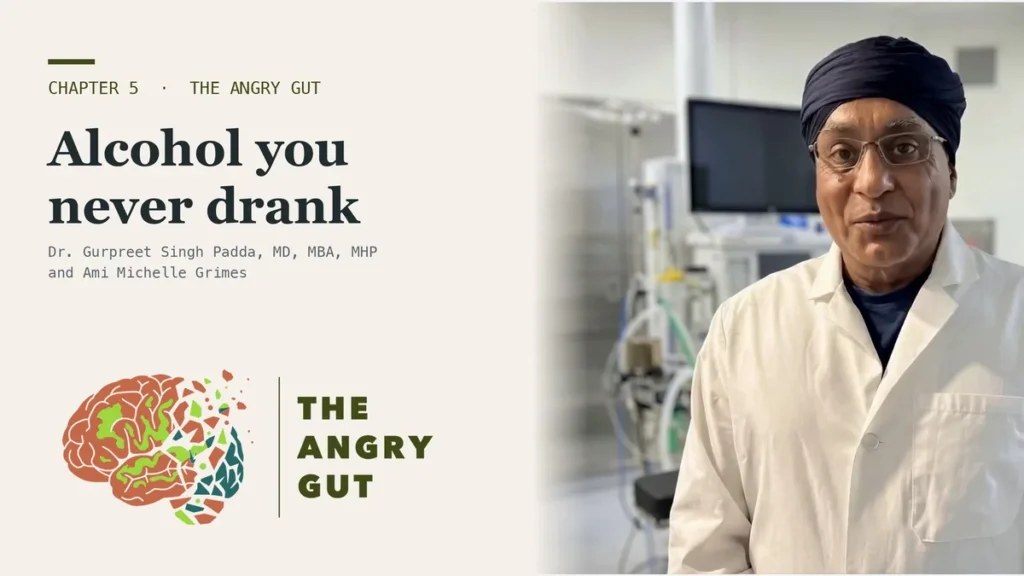
That is how fatty liver symptoms usually present in real life: as nothing that points at the liver. The video above is Chapter 5 of The Angry Gut, by Dr. Gurpreet Singh Padda, MD, MBA, MHP, and Ami Michelle Grimes, and it asks his question out loud. How does fat get into a liver when the patient does not drink? For someone living with chronic pain, the answer matters twice, because the same terrain that fills the liver also feeds the nerves that hurt.
Fatty liver symptoms, and why labs miss them
A fatty liver rarely announces itself with a pain you can point to. It announces itself through the company it keeps:
- insulin resistance
- weight that returns after it is lost
- fatigue
- in the patients we see, chronic pain and low mood sitting in the same chair
Clinical trials tend to remove exactly that patient, the one with the fatty liver, the insulin resistance, the pain and the depression all at once, because a clean answer needs a clean population.
The labs miss it for a mechanical reason. Everything the bowel absorbs travels first to the liver through the portal vein, and the liver works as a filter on that stream. When surgeons sampled portal blood during elective abdominal operations, endotoxin, the bacterial fragment the immune system reads as an alarm, was present in 97% of patients. In blood from the arm it turned up in only 4 of 34, and 3 of those 4 had liver disease (Jacob et al., 1977). The arm looks clean because the filter is working, not because the stream is.
The vein nobody asked about
Across pooled studies, blood endotoxin is higher in people with simple fatty liver than in liver-healthy controls, and higher again in steatohepatitis, the inflamed stage, even after adjusting for body mass index (Soppert et al., 2023). The more fat in the liver, the more alarm leaks past the filter.
The counterpoint is worth stating clearly. In adolescents with biopsy-proven disease, endotoxin markers were raised with obesity, and raised just as much in obese teenagers whose livers were healthy. What those markers tracked was body fat, not liver damage (Boone et al., 2026). The delivery is real. An endotoxin blood panel sold to stage your liver is not.
Medication enters the story here, and pain patients should hear it. In a study of 178 adults tested with sugar probes, the standard small-bowel measure could not tell people with metabolic fatty liver from healthy controls. After a challenge dose of aspirin, gut leak rose in every group (Swanson et al., 2024). A barrier can look normal at rest and fail under a common pain reliever. That is not a reason to change a medication on your own. It is a reason to tell your physician everything you take for pain.
Alcohol made inside a man who does not drink
The finding that reframes this disease came from sampling the right vein. In people having bariatric surgery, ethanol in the portal vein was, at the median, 187 times the level in fasting arm blood. It climbed with the disease: 2.1 mM with no liver fat, 8.0 mM in simple fatty liver and 21.0 mM in steatohepatitis. When the liver’s alcohol clearance was blocked with a drug before a meal, arm ethanol rose 15-fold in people with fatty liver (Meijnikman et al., 2022).
His bowel was brewing, and his liver was cleaning up so efficiently that no blood test caught it. In stool from patients with steatohepatitis, ethanol-producing yeast grew in 9 of 10 patients and 0 of 10 controls (Mbaye et al., 2022). At the far end of the spectrum sits auto-brewery syndrome, where gut organisms produce enough alcohol to intoxicate. Most people never get near that. The quiet version is the one that matters for a liver.
There is a fair objection. In children with early fatty liver and in mice, the stronger difference was clearance, not production: the liver’s alcohol-clearing enzyme was less active, and the authors tied that impairment to insulin (Engstler et al., 2016). Either the bowel makes more alcohol or an insulin-resistant liver clears less of it. Both roads run through insulin, and no clinical study has yet tested cause and effect directly. That is the evidence tier. It is mechanism, and we treat the mechanism in the patient the trials left out.
Where the liver meets chronic pain
Insulin is the hinge. A liver fed endotoxin and alcohol from the gut becomes insulin resistant, and high insulin does not stay in the liver. It changes how nerves fire and how inflammation resolves, which is why we treat it as a pain driver, a case laid out in how high insulin makes you hurt and in The Pained Brain chapter on insulin and pain.
Two biological drivers feed that hinge: bacterial fragments that switch on inflammation in the liver, and fermentation products the liver converts into stored fat. The social driver is money: sweetener is the cheapest thing a subsidized farm economy produces, so it lands in nearly every packaged meal, and a gut fed sugar at every meal is a brewery with a steady supply. Alcohol adds its own pain chemistry on top, covered in alcohol, acetaldehyde and chronic pain, and that is true whether the ethanol came from a glass or from the gut.
The calorie argument and the patient it fails
The strongest case against all of this is simple arithmetic. Eat more than you burn and the surplus lands in the liver. In the largest randomized trial of a synbiotic in fatty liver, liver fat fell from 32.3% to 28.5% on treatment and from 31.3% to 25.2% on placebo, and weight loss was the only factor that moved it (Scorletti et al., 2020).
I said “lose some weight” at the end of visits for years and believed I had done something. My patient had heard it from a dozen of us and carried it out four times. The arithmetic is true, but it explains nothing about mechanism. Two people carry the same surplus and only one liver fills. The model has no answer for the South Asian patient with a normal body mass index, slender arms and a fat-packed liver: thin outside, fat inside, insulin resistant, and told his weight is normal. The failure of the simple calorie model is its own subject in why eat less, move more keeps failing.
Changing what the bowel delivers
If the liver answers to delivery, the target is what reaches the portal vein. In a four-month randomized trial of resistant starch in people with fatty liver, liver fat fell 9.08%, and 5.89% after adjusting for weight loss (Ni et al., 2023). That was not a capsule of organisms. It was a change in what the organisms were fed, and it moved liver fat further than the scale could explain.
In practice that means three levers, each with a physiological reason. The sugar load, because sweetener feeds fermentation that yields alcohol and fat-building substrate. The meal pattern, because fewer and less sugary meals mean fewer surges down the portal vein. And the metabolic state driving it, because an insulin-resistant liver clears alcohol poorly. None of it replaces pain treatment. Interventional care buys the window in which a patient can make those changes and feel the difference.
The wall that decides how much crosses into that vein is the subject of the previous chapter on leaky gut and the ordinary week. Every study above, with what each shows and what it cannot, is set out in the Chapter 5 Deep Dive.
Frequently asked questions
What are the first signs of a fatty liver?
Often there are none that point to the liver. It is commonly discovered by accident, on a scan done for something else, with liver enzymes read as normal. What shows up first is usually the terrain around it: insulin resistance, weight that keeps returning and fatigue. Insulin resistance can be present for years before glucose tests catch it, as insulin resistance before diabetes explains.
Can you get fatty liver without drinking alcohol?
Yes. Gut organisms can produce ethanol, and in people with fatty liver the portal vein carried far more alcohol than arm blood, rising with the stage of disease. An insulin-resistant liver also clears alcohol less well. The result is a liver exposed to alcohol in a person who never drinks. Recent research also suggests fatty liver comes in more than one form, summarized in two types of fatty liver disease.
Does fatty liver cause pain?
Fatty liver itself is often silent, but the insulin resistance and inflammation that come with it are drivers of chronic pain. High insulin and gut-derived endotoxin both raise the inflammatory tone the nervous system responds to. That is why a pain workup in our practice looks at the metabolic terrain as well as the painful joint or nerve, the approach described in why we treat insulin before we treat the joint.
Do probiotics fix a fatty liver?
Not on current evidence. Pooled reviews report some benefit, but the certainty is low, and the largest randomized trial found a synbiotic changed the stool microbiome without changing liver fat or fibrosis. Changing what the bacteria are fed, such as resistant starch, has moved liver fat more than adding organisms. Fat tissue elsewhere adds its own inflammatory load, as how visceral fat pumps out pain signals describes.
Is auto-brewery syndrome the same as fatty liver?
No. Auto-brewery syndrome is a rare condition in which gut organisms make enough alcohol to cause intoxication. Fatty liver involves a much quieter exposure: small amounts of gut-made alcohol that the liver clears before a blood test can see them. The two share a mechanism, sugar fermented by gut organisms, at very different scales. The oxidative strain that exposure puts on cells is covered in the ROS and inflammation loop behind chronic pain.
Look upstream of the pain
If your labs keep coming back fine and your pain does not, we look at the liver, the insulin and the gut that feeds them alongside the pain generator itself.
Request an appointment, call (314) 481-5000, or text (314) 886-5902.
Sources
- Jacob, A. I., Goldberg, P. K., Bloom, N., Degenshein, G. A., & Kozinn, P. J. (1977). Endotoxin and bacteria in portal blood. Gastroenterology, 72(6), 1268–1270. https://pubmed.ncbi.nlm.nih.gov/858472/
- Soppert, J., Brandt, E. F., Heussen, N. M., Barzakova, E., Blank, L. M., Kuepfer, L., Hornef, M. W., Trebicka, J., Jankowski, J., Berres, M.-L., & Noels, H. (2023). Blood endotoxin levels as biomarker of nonalcoholic fatty liver disease: a systematic review and meta-analysis. Clinical Gastroenterology and Hepatology, 21(11), 2746–2758. https://doi.org/10.1016/j.cgh.2022.11.030
- Boone, A. M., Bartlett, A. M., Bays, J. A., Kim, Y., Yu, Z., Palle, S. K., Friedman, J. E., & Short, K. R. (2026). Endotoxin markers are elevated in adolescents with obesity with and without metabolic dysfunction-associated steatotic liver disease. Pediatric Obesity, 21(2), e70093. https://doi.org/10.1111/ijpo.70093
- Swanson, G. R., Garg, K., Shaikh, M., & Keshavarzian, A. (2024). Increased intestinal permeability and decreased resiliency of the intestinal barrier in alcoholic liver disease. Clinical and Translational Gastroenterology, 15(4), e00689. https://doi.org/10.14309/ctg.0000000000000689
- Meijnikman, A. S., Davids, M., Herrema, H., Aydin, O., Tremaroli, V., Rios-Morales, M., Levels, H., Bruin, S., de Brauw, M., Verheij, J., Kemper, M., Holleboom, A. G., Tushuizen, M. E., Schwartz, T. W., Nielsen, J., Brandjes, D., Dallinga-Thie, G. M., Havik, S. R., Ackermans, M. T., … Nieuwdorp, M. (2022). Microbiome-derived ethanol in nonalcoholic fatty liver disease. Nature Medicine, 28(10), 2100–2106. https://doi.org/10.1038/s41591-022-02016-6
- Mbaye, B., Borentain, P., Magdy Wasfy, R., Alou, M. T., Armstrong, N., Mottola, G., Meddeb, L., Ranque, S., Gérolami, R., Million, M., & Raoult, D. (2022). Endogenous ethanol and triglyceride production by gut Pichia kudriavzevii, Candida albicans and Candida glabrata yeasts in non-alcoholic steatohepatitis. Cells, 11(21), 3390. https://doi.org/10.3390/cells11213390
- Engstler, A. J., Aumiller, T., Degen, C., Durr, M., Weiss, E., Maier, I. B., Schattenberg, J. M., Jin, C. J., Sellmann, C., & Bergheim, I. (2016). Insulin resistance alters hepatic ethanol metabolism: Studies in mice and children with non-alcoholic fatty liver disease. Gut, 65(9), 1564–1571. https://doi.org/10.1136/gutjnl-2014-308379
- Scorletti, E., Afolabi, P. R., Miles, E. A., Smith, D. E., Almehmadi, A., Alshathry, A., Childs, C. E., Del Fabbro, S., Bilson, J., Moyses, H. E., Clough, G. F., Sethi, J. K., Patel, J., Wright, M., Breen, D. J., Peebles, C., Darekar, A., Aspinall, R., Fowell, A. J., … Byrne, C. D. (2020). Synbiotics alter fecal microbiomes, but not liver fat or fibrosis, in a randomized trial of patients with nonalcoholic fatty liver disease. Gastroenterology, 158(6), 1597–1610.e7. https://doi.org/10.1053/j.gastro.2020.01.031
- Ni, Y., Qian, L., Siliceo, S. L., Long, X., Nychas, E., Liu, Y., Ismaiah, M. J., Leung, H., Zhang, L., Gao, Q., Wu, Q., Zhang, Y., Jia, X., Liu, S., Yuan, R., Zhou, L., Wang, X., Li, Q., Zhao, Y., … Jia, W. (2023). Resistant starch decreases intrahepatic triglycerides in patients with NAFLD via gut microbiome alterations. Cell Metabolism, 35(9), 1530-1547.e8. https://doi.org/10.1016/j.cmet.2023.08.002
Dr. Gurpreet Singh Padda, MD, MBA, MHP