She is fifty-five, and this is her third eradication. Two weeks of antibiotics, about six good weeks, then bloating after dinner, distension starting earlier each day, and the cycle back where it began.
Two and a half years of that, and nobody has ever given her anything to put back. The drug is not the part that fails her. The silence after it is. Anyone searching why small intestinal bacterial overgrowth returns after a course that plainly worked is circling that same gap, and SIBO relapse is what it produces.
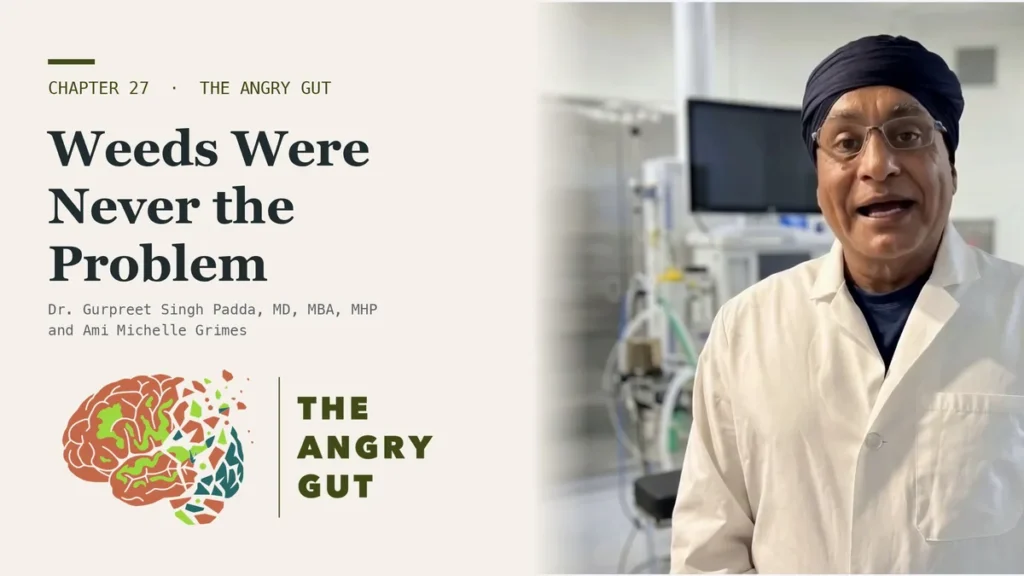
I am Dr. Gurpreet Singh Padda, MD, MBA, MHP, and I wrote The Angry Gut with Ami Michelle Grimes. The Weeds Were Never the Problem, the chapter video, traces her relapse curve. What follows is the part a pain practice has to manage: a shrinking interval, a medication list that feeds it, and a body that never gets a quiet stretch in which to repair.
Your gut is the first brain, and the vagus carries its traffic to the second. A bowel emptied and recolonized every couple of months keeps sending the same alarm upstairs, and metaflammation never gets a quiet stretch in which to settle.
What rifaximin does well, and what it cannot do
The drug deserves an accurate description first. Rifaximin is poorly absorbed and stays mostly in the lumen, exactly where the trouble sits. For a genuinely overgrown small bowel, prescribing it is reasonable medicine, and I prescribe it.
Be honest about the size of the win. Dosed at 550 mg three times a day across two weeks in irritable bowel syndrome without constipation, it delivered adequate global relief for 40.7% of patients against 31.7% on placebo, with bloating relief at 40.2% against 30.3%. Nine points, about eleven people treated for one helped, and a conditional society recommendation at moderate certainty.
Against the overgrowth itself the numbers are better. Pooled across 32 studies and 1,331 patients, eradication runs 70.8% by intention to treat, with adverse events at 4.6%. When methane is the gas, adding neomycin raised clinical response to 85% against 56% and cleared methane in 87% against 28% — from a retrospective chart review with eight patients in one arm, and no randomized trial of that combination exists.
A drug that empties a room is not a drug that furnishes one.
The relapse curve she was never shown
Even a clean kill is temporary, and the shape of the failure is on record. After a week of rifaximin cleared the breath test, positivity returned in 12.6% of patients at three months, 27.5% at six and 43.7% at nine, with symptoms rising alongside the test rather than lagging behind it. Nearly half are positive again inside a year.
The largest dataset is starker. In diarrhea-predominant irritable bowel syndrome, only 44.1% responded to an open-label course at all, and 692 of 1,074 responders, 64.4%, lost the benefit within eighteen weeks. A second course beat placebo only modestly, 38.1% against 31.5%, and left stool consistency untouched.
Then the number that should end the debate about counting organisms. Among patients whose overgrowth was demonstrably gone, only 67.7% felt better. A third get a clean test and stay sick.
I ran this cycle for years and scored it by the kill. She was scoring it by the interval, and the interval was getting shorter.
A prescription and a scar, not a microbe
Look at what predicted her return. Chronic proton pump inhibitor use raised the odds of a positive follow-up test more than threefold, and a prior appendectomy raised them nearly sixfold. Each added year of age nudged them up too, at an odds ratio of 1.09. None is an organism: a prescription, a scar, a birthday.
Only one of the three is modifiable. Her acid blocker came off in a conversation with the physician who prescribed it, which is the only way that decision should be made. An acid blocker earns its place in the right patient; the question is whether she was that patient.
This cycle also has a sponsor. A branded antibiotic course can be billed, repeated and reimbursed, and a sales force stands behind it. Fermented milk has none of that, and no representative details yogurt. The kill earns trials and a guideline line; the reseed earns a shrug at the door. Milk the cow rather than cure the cow.
Why the empty gut refills with the wrong tenants
Relapse is predictable because the antibiotic removes two things: the overgrowth, and whatever was holding the line. That line has a name. Colonization resistance is the resident community actively excluding pathogens and suppressing the pathobionts already there, through microbial competition and the immune responses the residents provoke. Evict the residents and the result is not a blank page. It is an empty lot.
Empty lots are not settled at random. Whatever arrives first shrugs off bile and oxygen and carries resistance genes, while the butyrate makers that feed the colon are slow, fussy and strictly anaerobic. They lose every race that starts on bare ground.
The cleanest human measurement came from a deliberate experiment. Healthy young men received four days of three last-resort antibiotics. Enterobacteria and pathobionts bloomed first, including Enterococcus faecalis, while Bifidobacterium species and butyrate producers were depleted. Composition looked near baseline within about six weeks, which sounds like recovery until you read the next line: nine species that every participant had carried before the drug were still missing from most of them at 180 days. The organisms favored on the way back were the ones holding beta-lactam resistance genes. The drug does not just thin a community. It picks the next one.
Repeat courses do something worse than damage. In three people followed through two courses of ciprofloxacin, diversity fell within three to four days and the return was often incomplete, the community restabilizing somewhere else. So her sixth week is always the same week: she is not relapsing, she is being recolonized on schedule.
Why a capsule is not a reseed
The obvious next move is a probiotic, and the best study of that question found the opposite of what everyone expected. The strains did colonize the human mucosa better after antibiotics. But against simply letting the community rebuild unaided, the supplement left the native microbiome and the host’s own gene expression coming back in a way its authors called markedly delayed and persistently incomplete. Giving people back their own banked stool restored both within days.
Read the limits: what moved was composition and gene expression, not symptoms. Still, the mistake it names is precise. Strains passing through occupied the ground without doing the residents’ work. A tenant is not a farmer.
What we do in the week after the last dose
Four steps, and I will say plainly what they rest on. None has been tested against the others; each follows from something that has been. This is mechanism and practice experience, not trial evidence, and it should be labeled that way.
First, the kill happens for a measured reason rather than a guessed one, because testing before treating decides which gas and which drug. Second, reseeding starts the same week the antibiotic finishes, since the community is deciding who lives there over days, not months. Third, it is fermented food rather than a capsule, which in practice means a long, warm ferment carrying live counts far above anything a capsule holds. No trial has tested that preparation for this purpose in anybody, and the capsule is the thing that was tested and slowed recovery down. Fourth, the substrate goes in with the organisms, because seeding a field without feeding it stages a famine.
The closest thing to the combined strategy paired rifaximin with Saccharomyces boulardii [a probiotic yeast] where the overgrowth followed long-term acid suppression: persistence at four weeks roughly halved, 41.5% against 21.8%. A yeast is not a resident bacterium, and four weeks is early against a curve that bites at nine months. A hint in her situation, not an answer.
Then the predictors get treated instead of noted as bad luck. The bile side of the same circuit belongs in that conversation. Rank the four by importance and the kill comes last, because clearing ground is the easy half of farming.
All four went into her plan. Her breath test was flat at the nine-month mark, where nearly half of treated patients turn positive again, and no fourth course has been needed. One patient, and I will not dress that up as a trial. The Deep Dive carries every study behind these four steps, with its sample size, its population and the limit the authors set themselves. The exposure hiding in a damp house is the stall I check before any of this.
Frequently asked questions
Why does SIBO keep coming back after rifaximin?
Because the drug removes the overgrowth and the resident community that was holding the line, and bare ground refills with whatever grows fastest. Recurrence reaches 43.7% by nine months after a clearing course. The strongest predictors were a proton pump inhibitor and a prior appendectomy, neither of which is a microbe. Why killing is the wrong default frame is the argument underneath this one.
Should I take a probiotic capsule after antibiotics?
The best test of that question found supplementation delayed the native community’s return compared with recovering on its own, while banked autologous stool restored it within days. That study measured composition, not symptoms, so it is not proof a capsule harms you. It is a reason to prefer food over a few transient strains. Repeat antibiotic courses run the same pattern in pelvic pain.
Does a clean breath test mean I will feel better?
Not reliably. Among patients whose overgrowth was demonstrably cleared, only 67.7% reported feeling better, so a third hold a clean test and stay symptomatic. That tells you the organism count was never the whole disease, and that symptoms deserve their own measurement. A test result that does not match the symptom is a familiar problem in pain medicine.
Can my acid blocker be driving the relapse?
Chronic proton pump inhibitor use raised the odds of a positive follow-up test more than threefold in the recurrence cohort, which makes it the one predictor a person can actually change. It is also the right drug for some conditions, so nothing here is a reason to stop it on your own. Raise it with the prescriber. Weeding, then seeding, then feeding is the order that follows.
Is fecal transplant an option for overgrowth?
Not outside recurrent Clostridioides difficile. There, one donor infusion cleared the illness in 13 of 16 people, while vancomycin alone managed 4 of 13. The procedure has also killed people: regulators reported resistant infections in immunocompromised adults, with deaths. Outside that one disease the trial results conflict. What keeps refilling the small bowel from above comes next.
The week after the antibiotic is the appointment that matters
If each course buys you fewer good weeks than the last, the plan has a missing half. We measure before we kill, then rebuild the ground so the next course is not inevitable.
Request an appointment, call (314) 481-5000, or text (314) 886-5902.
Sources
- Pimentel, M., Lembo, A., Chey, W. D., Zakko, S., Ringel, Y., Yu, J., Mareya, S. M., Shaw, A. L., Bortey, E., & Forbes, W. P. (2011). Rifaximin therapy for patients with irritable bowel syndrome without constipation. The New England Journal of Medicine, 364(1), 22-32. https://doi.org/10.1056/NEJMoa1004409
- Gatta, L., & Scarpignato, C. (2017). Systematic review with meta-analysis: Rifaximin is effective and safe for the treatment of small intestine bacterial overgrowth. Alimentary Pharmacology & Therapeutics, 45(5), 604-616. https://doi.org/10.1111/apt.13928
- Lauritano, E. C., Gabrielli, M., Scarpellini, E., Lupascu, A., Novi, M., Sottili, S., Vitale, G., Cesario, V., Serricchio, M., Cammarota, G., Gasbarrini, G., & Gasbarrini, A. (2008). Small intestinal bacterial overgrowth recurrence after antibiotic therapy. The American Journal of Gastroenterology, 103(8), 2031-5. https://doi.org/10.1111/j.1572-0241.2008.02030.x
- Lembo, A., Pimentel, M., Rao, S. S., Schoenfeld, P., Cash, B., Weinstock, L. B., Paterson, C., Bortey, E., & Forbes, W. P. (2016). Repeat treatment with rifaximin is safe and effective in patients with diarrhea-predominant irritable bowel syndrome. Gastroenterology, 151(6), 1113-1121. https://doi.org/10.1053/j.gastro.2016.08.003
- Low, K., Hwang, L., Hua, J., Zhu, A., Morales, W., & Pimentel, M. (2010). A combination of rifaximin and neomycin is most effective in treating irritable bowel syndrome patients with methane on lactulose breath test. Journal of Clinical Gastroenterology, 44(8), 547-50. https://doi.org/10.1097/MCG.0b013e3181c64c90
- Caballero-Flores, G., Pickard, J. M., & Núñez, G. (2022). Microbiota-mediated colonization resistance: mechanisms and regulation. Nature Reviews Microbiology, 21(6), 347-360. https://doi.org/10.1038/s41579-022-00833-7
- Palleja, A., Mikkelsen, K. H., Forslund, S. K., Kashani, A., Allin, K. H., Nielsen, T., Hansen, T. H., Liang, S., Feng, Q., Zhang, C., Pyl, P. T., Coelho, L. P., Yang, H., Wang, J., Typas, A., Nielsen, M. F., Nielsen, H. B., Bork, P., Wang, J., … Pedersen, O. (2018). Recovery of gut microbiota of healthy adults following antibiotic exposure. Nature Microbiology, 3(11), 1255-1265. https://doi.org/10.1038/s41564-018-0257-9
- Suez, J., Zmora, N., Zilberman-Schapira, G., Mor, U., Dori-Bachash, M., Bashiardes, S., Zur, M., Regev-Lehavi, D., Ben-Zeev Brik, R., Federici, S., Horn, M., Cohen, Y., Moor, A. E., Zeevi, D., Korem, T., Kotler, E., Harmelin, A., Itzkovitz, S., Maharshak, N., … Elinav, E. (2018). Post-antibiotic gut mucosal microbiome reconstitution is impaired by probiotics and improved by autologous FMT. Cell, 174(6), 1406-1423.e16. https://doi.org/10.1016/j.cell.2018.08.047
- Maev, I. V., Andreev, D. N., Shaburov, R. I., Zaborovsky, A. V., Fomenko, A. K., Sokolov, P. S., Tsaregorodtsev, S. V., Devkota, M. K., Dicheva, D. T., Cheremushkin, S. V., Cheremushkinа, N. V., & Vychkin, A. V. (2025). [Study on the efficacy of combination therapy with rifaximin and Saccharomyces boulardii CNCM I-745 in patients with small intestinal bacterial overgrowth associated with long-term use of proton pump inhibitors]. Terapevticheskii Arkhiv, 97(8), 660-667. https://doi.org/10.26442/00403660.2025.08.203301
- van Nood, E., Vrieze, A., Nieuwdorp, M., Fuentes, S., Zoetendal, E. G., de Vos, W. M., Visser, C. E., Kuijper, E. J., Bartelsman, J. F. W. M., Tijssen, J. G. P., Speelman, P., Dijkgraaf, M. G. W., & Keller, J. J. (2013). Duodenal infusion of donor feces for recurrent Clostridium difficile. The New England Journal of Medicine, 368(5), 407-15. https://doi.org/10.1056/NEJMoa1205037
Dr. Gurpreet Singh Padda, MD, MBA, MHP