A sixty-one-year-old man arrives for his ninth epidural in three years. Same level, same six weeks of relief, same instruction to return in twelve weeks. Nobody has measured his fasting insulin or asked how he sleeps. He is a composite, and I have treated him. Fee-for-service healthcare did not invent his back pain. It built the calendar he is living on.
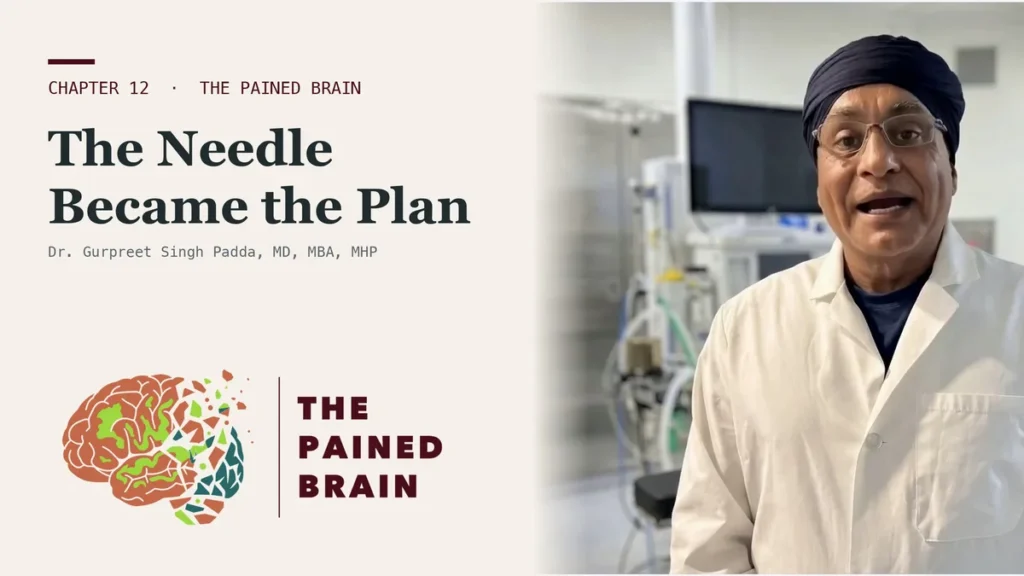
The video above is Chapter 12 of The Pained Brain, coauthored by Dr. Gurpreet Singh Padda, MD, MBA, MHP, and Dr. KrisJay Fucanan, MD. It lays out who is paid for what. This page goes further into the studies, including the ones that complicate the story, and ends with questions you can take to your own physician.
How fee-for-service healthcare shapes a pain plan
Fee-for-service means each procedure, visit and test is paid separately. That rewards the count, not the result. An injection that buys six weeks so a patient can rehabilitate, sleep and change his terrain is a bridge, and I will defend it. The ninth injection at the same level with nothing planned between is an assembly line. The difference is not the needle. It is what happens during the weeks the needle buys.
The volume grew faster than the patients. In traditional Medicare, the epidural rate rose 103 percent per 100,000 beneficiaries from 2000 to 2010, and the transforaminal type rose 579.1 percent. Sacroiliac injections rose 281 percent from 2000 to 2022 while the Medicare population grew 63.3 percent. Among 196,332 commercially insured patients, the mean was 4.46 spinal procedures in the year after the first, and the busiest tenth of providers did 36.6 percent of all of them.
Fairness belongs in the same paragraph. A repeat radiofrequency ablation after real relief wears off is consistent with guidelines, and claims data cannot tell a planned repeat from a failure. Among 44,936 ablation patients, 33.1 percent had a second within six months. And since 2019 the curves have bent: all interventional techniques fell 16.8 percent in traditional Medicare through 2024. Those are counts with no outcome attached. They cannot say whether the man in the chair now has a plan or simply fewer injections.
The pay formula and who owns the scanner
Across 31 physician organizations in 22 health systems, volume was the base of pay in 83.9 percent of primary-care plans and 93.3 percent of specialist plans. Asked how a physician could raise his income, 70.0 percent of organizations gave the same answer: increase volume.
Ownership sharpens it. When a physician group owned the MRI scanner, lumbar scans came back negative 86 percent more often. The scan is not inert: among patients of orthopedists, receiving one raised the probability of back surgery by 34 percentage points. Private equity’s share of pain physicians climbed from 0.4 percent to 8.2 percent in a decade.
The detail that complicates the story comes from the Veterans Health Administration, where physicians draw salaries. There, spinal injections for low back pain were still the single costliest low-value service, at 21.4 percent of low-value spending. Salary did not abolish the habit. Training, referral patterns and belief carry part of this, and any account that blames only the fee is incomplete.
A drug to treat a drug
Among 1,342 people living with chronic pain, 71.4 percent took five or more medications and 25.9 percent took ten or more. Among American adults whose pain limits work, each additional five medications carried 1.47 times the odds of an emergency visit. The mechanism is often a cascade. Gabapentinoids can cause fluid retention in the legs; among 23,544 nursing-home residents starting one, about 1 in 20 received a loop diuretic within three months, at a median of 36 days. A second drug for the first drug’s side effect is the model in miniature, and the same pattern shows up in the heartburn pill that is hard to quit. One medication list, one person, one fall shows what that costs an older patient. Never stop or change a medication on your own; review the list with the physician who prescribes it.
Devices follow the same logic with a battery. In a matched claims comparison of 1,260 patients given a spinal cord stimulator, 22.1 percent had the device revised or removed within two years, and chronic opioid use was no lower than with conventional care by the second year. Pooled across 38 studies, 11.9 percent of stimulators were explanted by three years, and 32.8 percent of those who kept theirs had less than half their pain relieved.
And the cheapest step is often skipped. Of 411 patients who went to lumbar spine surgery at one center, 34.8 percent had a physical therapy plan of care in the year before, only 14.6 percent had six or more exercise visits, and 84.4 percent had filled an opioid.
Malpractice fear, or the fee?
Physicians know. Among 2,106 surveyed, the median estimate of unnecessary care was 20.6 percent, 84.7 percent named fear of malpractice as the reason, and 70.8 percent agreed that physicians do more procedures when they profit from them. The malpractice story does not hold up well. When 36 hospitalists rated their own 4,215 orders, 28 percent carried some defensive motive, but completely defensive orders made up only 2.9 percent of cost, and the physicians claiming the most defensive orders spent no more than the rest.
The people inside the system pay too: 39.1 percent of American physicians report high moral distress, at 4.4 times the odds of other workers. I was trained by this system and I bill it. The procedures in this book are its procedures. What I refuse is the procedure as the destination. The reforms aimed at the fee have mostly missed; Choosing Wisely cut low-value back imaging by 4 percent, and a value-based payment program left it at 13.8 percent in both arms.
What a lifelong label can hide
Chronic is often read as permanent. A landmark trial began by calling type 2 diabetes a disorder that requires lifelong treatment, then put 149 people with it on a structured weight-loss program run in primary care. At one year, 46 percent were in remission against 4 percent. At two years it was 36 against 3 percent, and 40 percent were still on diabetes medication against 84 percent. It is a diabetes trial, not a pain trial, and a share of remitters relapsed. It shows that a terrain labeled lifelong can move. The link between that terrain and pain is covered in what diabetes remission does to chronic pain, and the nervous-system side in the chapter on central sensitization.
The pain programs are real and smaller. Multidisciplinary rehabilitation beats usual care by about half a point on a ten-point pain scale. Where these programs earn their place is dependency: in a three-week program of 1,457 patients, 86.74 percent of opioid users were weaned, though 30.70 percent were back on an opioid within a year. Tapering works best when procedures keep a patient out of withdrawal and functioning, which is the approach in opioid tapering as a bridge. Continuity is the other lever: in a Norwegian registry of more than four million patients, keeping one family doctor past fifteen years went with a quarter lower odds of dying than a single year did.
The cheapest intervention of all is a conversation. Across 209 trials, decision aids made patients 1.75 times as likely to choose care that matched their own values, with no added regret and about ninety seconds more consultation.
Questions that turn a subscription back into a bridge
- What is supposed to change between this procedure and the next one?
- Have I had a real course of physical therapy, six visits or more?
- Does anyone involved have a financial interest in the scanner, therapy or facility?
- Which of my medications treats a side effect of another?
- If a stimulator is offered, whose explant rate am I being quoted?
- Is there a decision aid for this choice?
The Chapter 12 supplement lists each study above with its population, its number, and what it cannot prove. Fast, low-cost treatments paid less than slow ones are the thread from the cluster headache chapter, and whether the needle lands where the picture says is taken up in the chapter on image guidance.
Frequently asked questions
How many epidural steroid injections can you have?
There is no magic series and no fixed count that fits everyone. Injections should follow clinical need, with each one judged by how much relief it gave and what was done with that time. If the relief is shrinking and nothing is changing between injections, the plan needs rethinking rather than another appointment on the calendar. Read what an epidural steroid injection actually does to an inflamed nerve.
What is fee-for-service healthcare?
It is a payment model in which each visit, test and procedure is billed and paid separately. It rewards the number of services rather than whether the patient improves. Inside many health systems, physician pay is still built mainly on volume even when the organization holds value-based contracts. See how medical necessity is established before a pain procedure.
Why does each injection seem to last less time?
Often nothing has failed in the procedure itself. The driver underneath, whether metabolic inflammation, poor sleep, deconditioning or a sensitized nervous system, keeps generating pain while the injection only quiets it. When the weeks of relief are not used to address those drivers, the relief tends to shorten. Here is why each injection can buy less time than the last.
Is a spinal cord stimulator worth it?
It can help selected patients, but outcome numbers vary with who reports them. Independent pooling found about 12 percent explanted by three years, while a manufacturer registry reported an annual rate of 3.5 percent. Ask what the trial period is meant to prove and what happens if the device does not help. Learn what a spinal cord stimulator trial actually tells you.
How do I know whether my pain care is a plan or a routine?
A plan names the pain generator, explains what each procedure is buying time for, and changes something between visits: sleep, food, movement, medications or the behavioral work. A routine repeats the same procedure at the same interval with nothing else moving. If you cannot say what has changed in the last six months, ask. Which pain specialist to see when treatment has not helped.
A Procedure Should Come With a Plan
When we recommend an injection, it is to buy time for work on what drives the pain. Come in with your medication list and your procedure history, and leave with the plan for the weeks in between.
Request an appointment, call (314) 481-5000, or text (314) 886-5902.
Sources
- Abbott, Z. I., Nair, K. V., Allen, R. R., & Akuthota, V. R. (2012). Utilization characteristics of spinal interventions. The Spine Journal, 12(1), 35–43. https://doi.org/10.1016/j.spinee.2011.10.005
- Starr, J. B., Gold, L. S., McCormick, Z., Suri, P., & Friedly, J. (2019). Repeat procedures and prescription opioid use after lumbar medial branch nerve radiofrequency ablation in commercially insured patients. The Spine Journal, 20(3), 344–351. https://doi.org/10.1016/j.spinee.2019.10.005
- Reid, R. O., Tom, A. K., Ross, R. M., Duffy, E. L., & Damberg, C. L. (2022). Physician Compensation Arrangements and Financial Performance Incentives in US Health Systems. JAMA Health Forum, 3(1), e214634. https://doi.org/10.1001/jamahealthforum.2021.4634
- Paxton, B. E., Lungren, M. P., Srinivasan, R. C., Jung, S.-H., Yu, M., Eastwood, J. D., & Kilani, R. K. (2012). Physician self-referral of lumbar spine MRI with comparative analysis of negative study rates as a marker of utilization appropriateness. AJR. American Journal of Roentgenology, 198(6), 1375–1379. https://doi.org/10.2214/AJR.11.7730
- Zahlan, G.; De Clifford-Faugère, G.; Nguena Nguefack, H. L.; Guénette, L.; Pagé, M. G.; Blais, L.; Lacasse, A. (2023). Polypharmacy and Excessive Polypharmacy Among Persons Living with Chronic Pain: A Cross-Sectional Study on the Prevalence and Associated Factors. J Pain Res, 16, 3085–3100. https://doi.org/10.2147/JPR.S411451
- Hayes, K. N.; Belanger, E.; Oganisian, A.; Joshi, R.; Wang, X. J.; Grove, L. R.; Corcoran, K. L.; Zullo, A. R. (2025). Predictors of a Gabapentinoid-Loop-Diuretic Prescribing Cascade in U.S. Nursing Home Residents. J Am Geriatr Soc, 74(2), 336–344. https://doi.org/10.1111/jgs.70219
- Dhruva, S. S., Murillo, J., Ameli, O., Morin, P. E., Spencer, D. L., Redberg, R. F., & Cohen, K. (2023). Long-term Outcomes in Use of Opioids, Nonpharmacologic Pain Interventions, and Total Costs of Spinal Cord Stimulators Compared With Conventional Medical Therapy for Chronic Pain. JAMA Neurology, 80(1), 18–29. https://doi.org/10.1001/jamaneurol.2022.4166
- Carrignan, J. A., Simmet, R. T., Coddington, M., Gill, N. W., Greenlee, T. A., McCafferty, R., & Rhon, D. I. (2020). Are Exercise and Physical Therapy Common Forms of Conservative Management in the Year Before Lumbar Spine Surgery? Archives of Physical Medicine and Rehabilitation, 101(8), 1389–1395. https://doi.org/10.1016/j.apmr.2020.04.006
- Lyu, H., Xu, T., Brotman, D., Mayer-Blackwell, B., Cooper, M., Daniel, M., Wick, E. C., Saini, V., Brownlee, S., & Makary, M. A. (2017). Overtreatment in the United States. PLoS One, 12(9), e0181970. https://doi.org/10.1371/journal.pone.0181970
- Lean, M. E.; Leslie, W. S.; Barnes, A. C.; Brosnahan, N.; Thom, G.; McCombie, L.; Peters, C.; Zhyzhneuskaya, S.; Al-Mrabeh, A.; Hollingsworth, K. G.; Rodrigues, A. M.; Rehackova, L.; Adamson, A. J.; Sniehotta, F. F.; Mathers, J. C.; Ross, H. M.; McIlvenna, Y.; Stefanetti, R.; Trenell, M.; … Taylor, R. (2018). Primary care-led weight management for remission of type 2 diabetes (DiRECT): an open-label, cluster-randomised trial. Lancet, 391(10120), 541–551. https://doi.org/10.1016/S0140-6736(17)33102-1
Dr. Gurpreet Singh Padda, MD, MBA, MHP